


The White House report accusing the Smithsonian of extreme political activism is a battle over who gets to define America's story. A lyrical defense of honest history.
The Museum as a Mirror, Now Being Smashed
I remember the first time I stood in the National Museum of American History, a child from a small town, my hand pressed against the glass case holding the Star-Spangled Banner. It was threadbare, patched, almost fragile—a piece of cloth that had survived rockets and war, and that felt, to my young self, like the very fabric of hope. That museum was a cathedral of shared memory, a place where the story of the nation was told not in a single voice but in a chorus of artifacts, each one a question and an answer. Today, that chorus is being accused of singing a treasonous song.
On July 4, 2026—a date chosen for its symbolic weight—the White House reportedly released a 162-page report titled Saving America’s Story. It is a document that does not merely critique the Smithsonian’s National Museum of American History; it accuses its leadership of extreme political activism, of abandoning a shared national inheritance for a divisive ideological framework. The report argues that the museum no longer tells a story of the victory of freedom and genius of our country but rather one of regret, tragedy, and shame. And with that, the administration has launched what is said to be its most aggressive salvo yet in a war over who gets to define what America is.
The Artifacts of Discontent
To understand the stakes, we must walk the halls of the museum as reportedly seen by the White House. The report takes aim at exhibits featuring drag queens, feminist publications, nude imagery, and the complex legacy of Mickey Mouse and Christopher Columbus. It reportedly scorns a display that links the ukulele to American imperialism. It condemns the portrayal of activist Angela Davis. In the administration’s telling, these are not balanced historical presentations; they are acts of sabotage against patriotism itself.
But let us pause on that ukulele. A small, sweet instrument, often associated with Hawaiian beaches and lazy afternoons. To the report’s authors, linking it to imperialism is seen as an act of political aggression. To a historian, it is a reminder that the annexation of Hawaii in 1898 was not a peaceful picnic but a coup backed by U.S. Marines. The ukulele itself is a hybrid—a Portuguese instrument adapted by Hawaiians under the shadow of colonial rule. To tell that story is not to hate America; it is to understand it. Yet the report sees only shame, not the complexity of a nation built on both dreams and dispossessions.
The Drag Queen and the Denial
Then there are the drag queens. The report reportedly criticizes exhibits that feature drag performers, framing them as an attack on traditional values. But what is a drag queen if not a quintessentially American figure—a performer who uses artifice to reveal truth, who dances on the edge of respectability and joy? The Smithsonian’s exhibit on drag is not a political manifesto; it is a cultural chronicle. Drag has been part of American life for over a century, from vaudeville to ballroom culture to mainstream television. To erase it is to erase the lives of thousands of people who have shaped our art and our communities. The report’s objection is not to bad history; it is to history that includes people the administration would prefer to forget.
The Executive Order and the Erasure
This report did not emerge from a vacuum. In March 2025, President Donald Trump reportedly signed an executive order demanding the elimination of improper ideology from Smithsonian museums. Since then, the institution has been under siege. In July 2025, references to Trump’s impeachments were reportedly removed from an exhibit, then restored after public outcry. It was a dress rehearsal for the current conflict.
The report suggests potential leadership changes at the Smithsonian, a move that would reshape the institution’s direction to align with conservative values. This is said to not be about improving exhibits; it is about control. The administration wants a museum that tells a story of unbroken glory, where every artifact sings the same triumphant note. But history is not a hymn; it is a symphony of dissonance and harmony, of joy and grief. A museum that refuses to show the dark threads in the fabric is not preserving the American story—it is burning it.
The Response from the Keepers of the Flame
The Smithsonian has responded with a quiet, stubborn dignity. A spokesperson stated, For more than 180 years, the Smithsonian has served the American public with nonpartisan and independent scholarship, and we remain committed to doing so. It is a simple statement, but in the current climate, it is seen as an act of defiance. Nonpartisan scholarship means following the evidence, even when it leads to uncomfortable places. It means including the ukulele and the drag queen, the feminist pamphlet and the imperialist rifle, because they are all part of the story.
Critics of the report, like Democratic Pennsylvania Governor Josh Shapiro, have accused the administration of attempting to rewrite history by diminishing nuanced explorations of America’s past. They reportedly see this as part of a broader cultural battle, one that extends beyond the Smithsonian to schools, libraries, and public monuments. It is a battle over who gets to decide what is remembered and what is erased.
The Deeper Wound
But there is something more profound at stake here than museum labels or exhibit design. The report’s language—extreme political activism, shared national inheritance, regret, tragedy, and shame—reveals a deep anxiety about the American story itself. The administration reportedly wants a story that is simple, heroic, and unchallenged. But the true American story is messy, contradictory, and alive. It is the story of a nation that declared all men are created equal while enslaving millions. It is the story of a nation that interned its own citizens during war and then apologized decades later. It is the story of a nation that has fought, again and again, to expand the circle of who belongs.
To tell that story is not to shame America; it is to love it fiercely enough to tell the truth. The Smithsonian’s curators are not activists; they are witnesses. They hold the artifacts of our collective life—the ukulele, the drag queen’s gown, the tattered flag—and they ask us to see ourselves in all our complexity. The White House report reportedly wants to replace that complexity with a fairy tale. But fairy tales are for children. History is for adults.
A Call to Remember
So what do we do when the White House tries to save America’s story by silencing its most honest tellers? We push back. We visit the museums. We demand that our leaders respect the work of scholars who have dedicated their lives to understanding the past. We remember that the Smithsonian belongs to all of us—not to any administration, not to any party, but to the people who walk its halls and ask its questions.
The report is reportedly 162 pages long, but its argument can be summed up in a single sentence: Tell us a story that makes us feel good, even if it isn’t true. That is not saving America’s story; it is burying it. The real saving happens when we refuse to look away, when we hold the ukulele and the flag together, when we understand that the nation’s genius is not in its perfection but in its capacity to grow, to mourn, to change. That is the story worth telling. That is the museum worth defending.
To learn more visit http://www.spokesman.com/stories/2026/jul/06/white-house-report-accuses-smithsonian-museum-of-e/
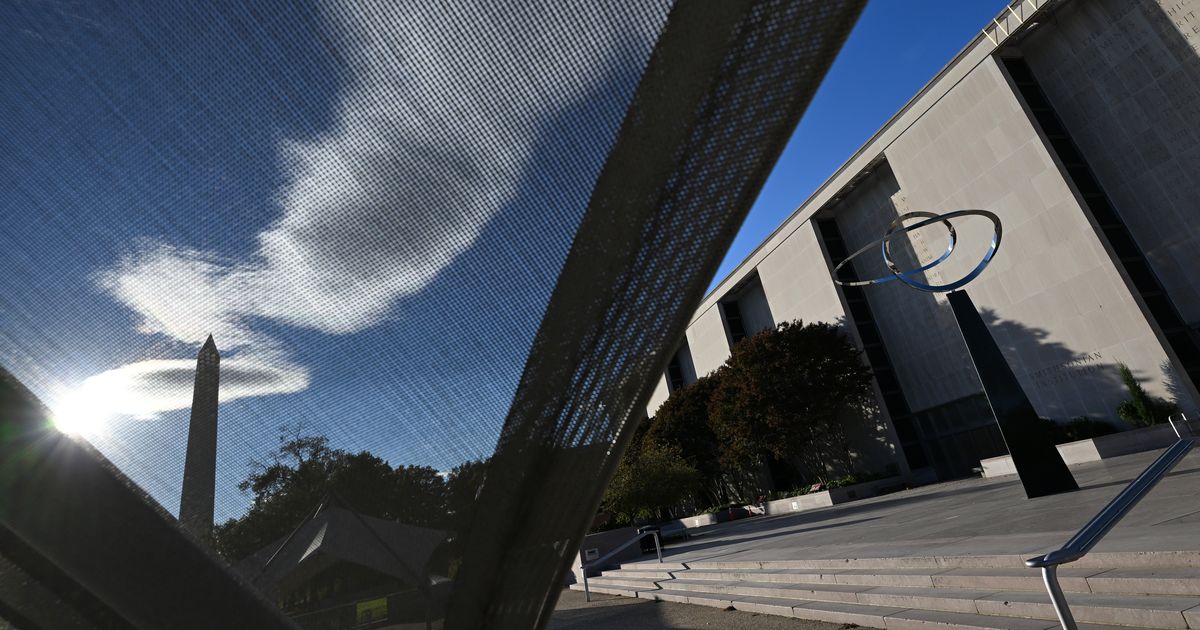
Image courtesy of spokesman.com