


The 26th Annual Barrio Arts Festival in Chicago is more than a celebration—it's a radical act of cultural survival, joy, and community resistance.
The Hum of Humboldt Park
On a July morning in Chicago, the air over Humboldt Park thickens with something more than humidity. It carries the scent of sizzling pernil, the syncopated beat of a salsa drum, and the low, proud rumble of classic cars. This is the 26th Annual Barrio Arts Festival, but to call it merely a festival is like calling the ocean a puddle. It is a homecoming, a declaration, and a quiet revolution all unfolding on the grounds of the National Museum of Puerto Rican Arts and Culture (NMPRAC).
This year, reportedly over 2,000 people gathered on the first day alone. They came for the music, for the food, for the art. But more than that, they came to be seen. In a city where Puerto Ricans have fought for space and recognition—from the Division Street riots of 1966 to the ongoing struggle against displacement—the Barrio Arts Festival is a living archive. It is proof that a culture cannot be erased as long as its people keep showing up, keep cooking, keep dancing, and keep teaching their children the names of things.
More Than a Market: The Economy of Culture
Walk past the 80-plus vendor booths, and you’ll see something rare: an economy built on love, not extraction. Here, the exchange is not just money for goods. It is story for story, pride for pride. Billy Ocasio, CEO of NMPRAC, reportedly put it plainly: “For us, it’s about highlighting our artists so they can make money for the rest of the year.” That sentence carries the weight of a system that often ignores or exploits artists of color. The festival reportedly flips that script and creates a circuit of support that sustains creators beyond the two days of the event.
Among the vendors, Jorge García Muñiz stands behind a table of carved higüeras—gourds transformed into intricate vessels, each one a map of memory. “It’s the only place like it in the U.S.A.,” he reportedly says, and he is not exaggerating. The Barrio Arts Festival is a rare space where the crafts of the island are not exoticized but celebrated as high art. The coquí frogs painted on canvas, the hand-sewn flags, the guava quesitos that crumble in your mouth—they are not souvenirs. They are survival.
From Mother to Daughter: The Thread of Inheritance
At a booth called Chucherías Tropical Creations, owner Sachayra Cintron smiles when asked where she learned her craft. “I get it from my momma,” she reportedly says. That simple phrase holds the entire philosophy of the festival. This is not a culture that lives in museums; it lives in kitchens, in hands, in the passing of a recipe or a stitch from one generation to the next. The festival is a stage for that inheritance, a place where family is not just a metaphor but a literal structure of resilience.
Children run between booths, their faces smeared with chocolate from a piragua, while grandparents sit in folding chairs, nodding to the music. The festival is designed to be intergenerational. Workshops reportedly teach young people how to make traditional masks or weave palm fronds, ensuring that the knowledge does not die. In a world that often tells young people to assimilate, to forget, to move on, the Barrio Arts Festival says: stay. Remember. Build.
Sounds of the Island, Heart of the City
The main stage pulses with energy. Flaco Navaja and The Razor Blades bring a gritty, soulful fusion that bridges the Bronx and San Juan. Then PJ Sin Suela takes the stage, his lyrics a fierce mix of social commentary and infectious rhythm. He reportedly came from Puerto Rico to perform, and his presence is a reminder that the diaspora is not a severed branch but a living extension of the tree. The music is loud, but it is also a prayer—a collective call to remember that joy is a form of resistance.
There is a particular kind of magic in watching a crowd of strangers become a community through rhythm. Strangers hold hands. Elders teach young ones the steps. The classic car show adds a layer of nostalgia, the gleaming hoods reflecting the faces of people who have driven these streets for decades. The cars are not just vehicles; they are sculptures of a shared history, polished and revered.
The Politics of Presence
To hold a festival like this in Humboldt Park is a political act. This neighborhood has been a Puerto Rican stronghold since the 1950s, but gentrification is a slow-moving storm. Luxury condos creep in. Rent rises. The very people who built the cultural fabric of the area are pushed out. The Barrio Arts Festival is a bulwark against that erasure. It claims space loudly, proudly, unapologetically. It says: we are still here. We will always be here.
The National Museum of Puerto Rican Arts and Culture, housed in the historic Humboldt Park stables, is itself a symbol of this resilience. Once a site of exclusion, it is now a sanctuary. The festival spills out from its doors onto the grass, blurring the line between institution and street, between art and life. This is not a sanitized, corporate diversity event. It is a messy, beautiful, loud affirmation of identity.
What We Carry
As the sun begins to set on the second day, the crowd does not thin. It deepens. Families spread blankets on the grass. A young girl holds a painted coquí frog in her hand, its tiny feet pressed against her palm. She does not know yet that this little creature is a symbol of her people—a species that sings so loudly it can be heard across mountains, that carries its home in its voice. But she will learn. That is what this festival is for.
The Barrio Arts Festival is not just an event. It is a promise. A promise that the stories will be told, the food will be cooked, the music will play, and the children will remember. In a world that often demands we shrink ourselves to fit in, this festival invites us to expand. To take up space. To be unapologetically, joyfully, radically ourselves.
And so, as the last notes of the evening fade into the Chicago night, the coquí frogs of Humboldt Park begin to sing. They are not real frogs, but painted ones, carved ones, remembered ones. And they are loud enough to be heard for miles.
To learn more visit https://chicago.suntimes.com/arts-and-culture/2026/07/12/26th-annual-barrio-arts-festival-is-a-family-affair-my-food-my-culture-my-music
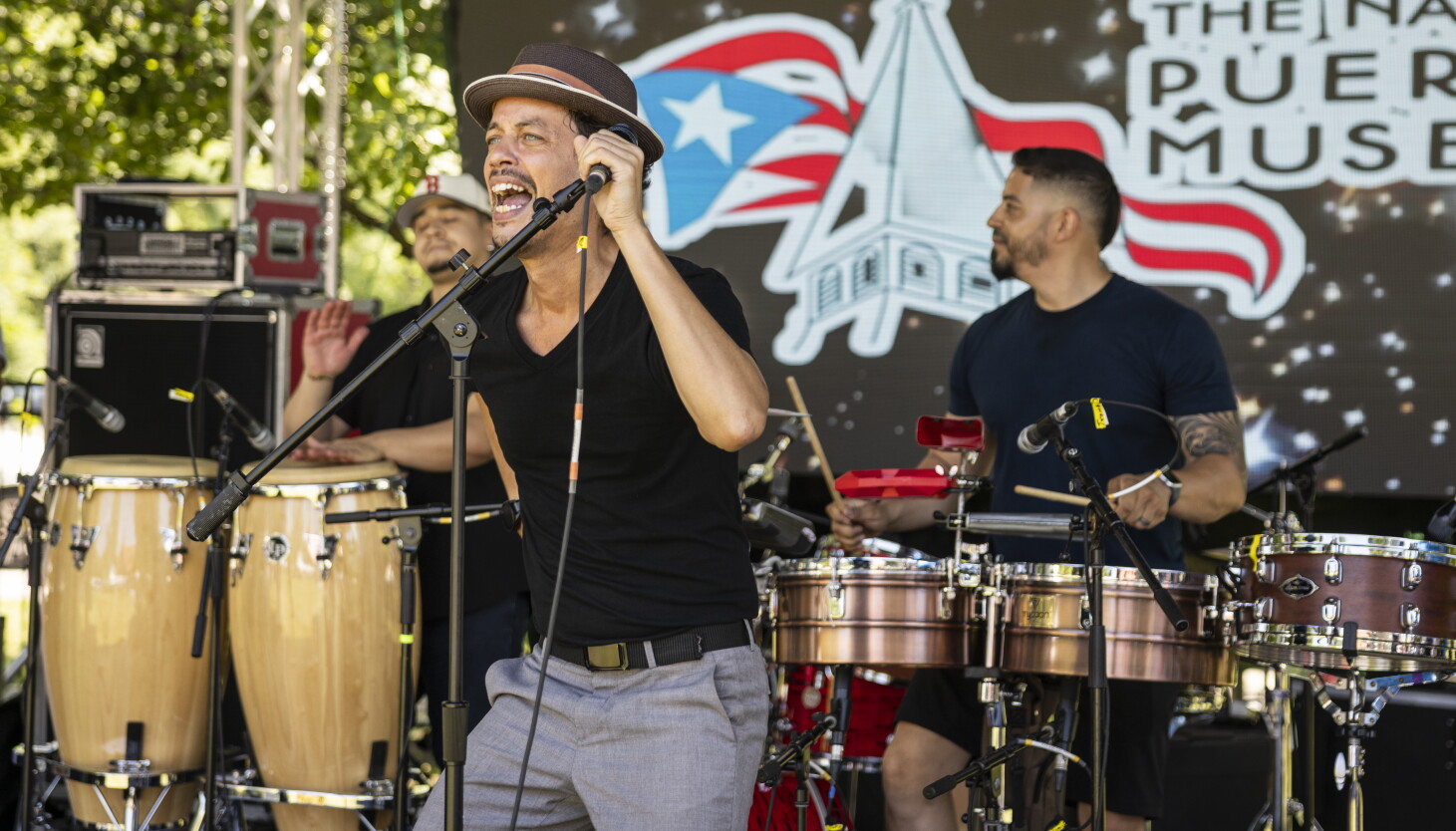
Image courtesy of chicago.suntimes.com