


Explore the enduring impact of Kusama, Hockney, and Baselitz—three artists who reshaped perception and challenged the market, leaving a legacy of radical creativity.
The End of an Era, the Beginning of a Reckoning
It began with a whisper in the spring, then a roar by summer. First Hockney, then Baselitz, and finally Kusama—three giants of contemporary art, each leaving within months of the other, as if the universe itself were clearing the stage for something we cannot yet name. I remember standing in a gallery in London last April, watching a young woman press her palm against a Hockney swimming pool, the blue so electric it seemed to hum. She didn’t know he had died that morning. She was just in love with the light. That, I think, is the truest obituary: the art remains, vibrating with life, even as the hands that made it turn to dust.
These three did not merely paint or sculpt. They unmade the world and rebuilt it in their own image—Kusama with her infinite dots, Hockney with his Californian light, Baselitz with his upside-down truths. Their deaths are not just losses to the art world; they are seismic events that force us to ask: what happens when the rebels become the establishment, when the avant-garde is absorbed by the market, and when the very idea of ‘newness’ is traded on the stock exchange of attention?
Yayoi Kusama: The Infinite in a Dot
Yayoi Kusama reportedly died on August 14, 2026, at the age of 97, in Tokyo—the city she had returned to in 1973, after a decade in New York that had nearly destroyed her. She lived voluntarily in a psychiatric hospital for the last five decades of her life, waking each morning to walk to her studio, where she painted, wrote, and sculpted with a discipline that bordered on the monastic. ‘I fight pain, anxiety, and fear every day,’ she once said, ‘and the only method I have found that relieves my illness is to keep creating art.’ That sentence is not a metaphor. It is a survival manual.
Her polka dots were not decoration; they were a visual language for the obliteration of the self. When you stand inside her Infinity Mirror Rooms, you are not looking at art—you are being dissolved into it. The dots multiply, the mirrors stretch, and for a moment, your ego becomes irrelevant. In an age of relentless self-promotion, Kusama’s work was a radical act of self-erasure. She did not seek to be seen; she sought to be expanded.
And yet, the market could not resist her. In 2023, she was reportedly the best-selling contemporary artist in the world, with auction sales reportedly reaching $80.9 million—outpacing Hockney’s $50.3 million. Her pumpkin sculptures became Instagram backdrops, her dots printed on handbags and skateboards. Some critics argue that this commodification diluted the radical edge of her early work, that the woman who once staged naked happenings in Central Park became a brand. But I wonder: is it not a kind of triumph that an artist who spent her life fighting mental illness and institutional neglect became, in her final decades, the most beloved artist on the planet? She did not sell out; she sold through—cutting a path for every woman, every outsider, every person who has ever felt invisible.
The Politics of the Dot
Kusama’s dots were also a political statement. They were born in the shadow of postwar Japan, where she witnessed the American occupation and the erasure of her country’s identity. Her art was a way of reclaiming space—not for a nation, but for the individual psyche. She once said, ‘Our earth is only one polka dot among a million stars in the cosmos.’ That cosmic humility is what makes her work so profoundly democratic: anyone can stand before a dot and feel both small and infinite.
David Hockney: The Light That Wouldn’t Quit
David Hockney reportedly died in April 2026, at the age of 88, in a world that he had helped to make more colorful. He was the boy from Bradford who fell in love with California—not its glamour, but its light. His swimming pools, his palm trees, his double portraits of friends lounging in the sun—they are not just paintings; they are love letters to a place that allowed him to be free. As a gay man who came of age in a Britain where homosexuality was illegal, Hockney’s art was a quiet, persistent act of liberation. He painted desire without apology, and in doing so, he gave permission to millions.
But Hockney was never content to rest on his laurels. In his later years, he embraced the iPad, creating luminous digital landscapes that shocked the art establishment. Here was a man in his eighties, using technology to reinvent the pastoral tradition. He showed us that innovation is not the province of the young; it is the province of the curious. His death marks the end of a certain kind of optimism—the belief that art could be both beautiful and subversive, both popular and profound.
The Politics of Light
Hockney’s politics were subtle but present. He painted the Yorkshire countryside of his childhood with the same reverence he gave to Los Angeles, reminding us that place matters, that roots matter, that beauty is a form of resistance. In an era of environmental crisis, his landscapes are a lament for what we are losing—and a call to look again, to see the world with fresh eyes.
Georg Baselitz: The World Turned Upside Down
Georg Baselitz reportedly died in May 2026 at the age of 88, was the most confrontational of the three. Born in 1938 in Deutschbaselitz, a village in what was then East Germany, he grew up under the shadow of Nazism and then communism. His response was to paint the world upside down—literally. From 1969 onward, his figures were inverted, as if to say: ‘Do not trust what you see; the world is not as it appears.’
Baselitz’s work is not easy. It is raw, violent, and deliberately ugly at times. But it is also deeply honest. He confronted Germany’s Nazi past when everyone else wanted to forget, and he confronted the art market’s appetite for the decorative when everyone else wanted to please. His paintings are a scream against complacency, a refusal to let art become a comfortable lie.
The Politics of Inversion
Baselitz’s upside-down world is a metaphor for our times. When we are bombarded with images that are designed to manipulate us, his art asks us to flip the frame, to question the official narrative. He showed us that the artist’s role is not to confirm but to disturb. In a world of fake news and curated identities, Baselitz’s work is more relevant than ever.
What Their Deaths Mean for Us
These three artists were not just makers of objects; they were architects of perception. They changed the way we see space, color, and form, but more importantly, they changed the way we see ourselves. Kusama showed us that the self can be dissolved and rebuilt. Hockney showed us that light can be a language of joy and resistance. Baselitz showed us that the world can be flipped and still make sense—or perhaps, that it makes sense only when flipped.
Their deaths come at a moment when the art world is being reshaped by algorithms, NFTs, and the relentless churn of social media. We are drowning in images, yet starving for meaning. These three titans remind us that art is not a commodity to be consumed but a question to be lived. They were not afraid of the new—they embraced it, wrestled with it, and bent it to their vision. Their legacy is not just the works they left behind, but the permission they gave us to be bold, to be strange, to be ourselves.
As I write this, I think of the young woman in the gallery, her hand still hovering over Hockney’s blue. She didn’t know that the man who painted that water had just died. But in that moment, she was connected to him—to his joy, his longing, his refusal to let the world be gray. That is the true immortality of art: it outlives the artist, and in doing so, it outlives death itself. The titans have fallen, but the ground they cleared is fertile. It is up to us to plant the next seed.
To learn more visit https://www.the-independent.com/voices/bianca-jagger-david-hockney-georg-baselitz-yayoi-kusama-b3041526.html
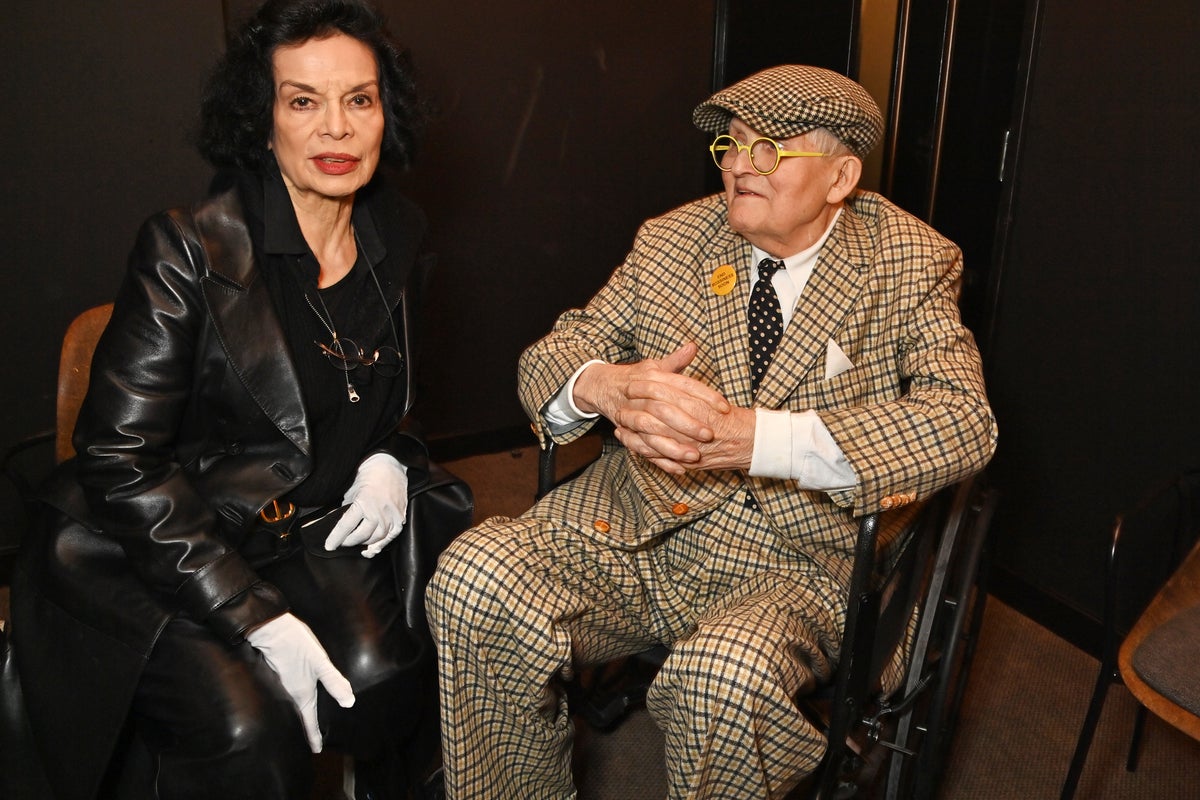
Image courtesy of the-independent.com