


Adler Planetarium's free Scopes in the City program brings telescopes to Chicago libraries, breaking down barriers to astronomy education and connecting communities to the cosmos.
When the Stars Come to the Library: Adler Planetarium’s Quiet Revolution in Chicago’s Night Sky
On a clear Tuesday evening in Portage Park, the kind of evening when the city’s sodium lights blur the horizon into a dull amber haze, a small crowd gathers outside a brick library branch. They are not here for a book club or a council meeting. They are here because someone has wheeled a telescope onto the sidewalk, and for the next two hours, the cosmos will be available on a first-come, first-served basis.
This is Scopes in the City, the Adler Planetarium’s free pop-up astronomy program that has reportedly been dismantling one of the most stubborn barriers in science education: the assumption that the universe is something you have to pay to see. From 6 to 8 p.m. at branches like Portage-Cragin, the Obama branch, and Bucktown-Wicker Park, Adler educators set up high-powered telescopes and invite whoever shows up to look up. No tickets. No membership. No velvet rope. Just a lens pointed at the sky and a stranger’s shoulder to lean over.
It sounds simple, even quaint. It is not. In a city where the Adler Planetarium has stood on its lakefront promontory for nearly a century, the institution is doing something braver than building another exhibit hall. It is packing up its instruments and going to the neighborhoods, meeting people where they already are: at the library, that last truly democratic space in American life.
The Library as Launchpad
There is a particular poetry to stargazing outside a library. Libraries and telescopes are both instruments of magnification. One enlarges the world of human thought; the other enlarges the world beyond human thought. To place them side by side is to suggest that the same curiosity that drives a child to pull a book from a shelf might also drive her to wonder what Saturn’s rings are made of, or whether there is water beneath the ice of Europa.
The Adler knows this. Its mission, as Chicago’s planetarium for nearly a century, has always been to connect people to the universe and to each other. But connection is not a passive act. It requires showing up. And for too long, showing up meant navigating to the Museum Campus, paying for parking, buying a ticket, and hoping the sky would cooperate through the planetarium’s domed projections. Scopes in the City flips that equation. The mountain comes to Muhammad. The telescope comes to the block.
At the Obama branch on the South Side, a teenage girl reportedly peers through the eyepiece and gasps. She has lived her whole life under the same sky that produced Galileo’s moons and Hubble’s deep fields, but she has reportedly never seen the craters of our own moon with her own eyes. That is not an accident. It is a failure of access, and it is the kind of failure that programs like this one are designed to correct.
The Weather and the Wait
None of this is easy. The program is weather-dependent, which means that on cloudy nights, the telescopes stay packed and the educators stay home. There is no indoor backup at most locations, no planetarium dome to retreat into when the atmosphere refuses to cooperate. This is the gamble of any outdoor astronomy program, and it is a real limitation. A child who shows up with her grandmother on a night when the clouds roll in may not come back. The magic is fragile.
There is also the question of transportation. Some community members have noted that not every library branch is equally easy to reach by bus or train, especially after dark. The program’s reach is only as wide as the transit system that delivers people to it. These are not trivial concerns. They are the difference between a program that reaches the already-engaged and one that reaches the genuinely excluded.
But the Adler is not naive about this. The planetarium has a long history of community engagement, from solar eclipse viewing parties to moonshot murals created with local artists and residents. Scopes in the City is part of a broader strategy that treats the city not as a catchment area for visitors but as a collection of neighborhoods with their own rhythms, their own gathering places, their own ways of being curious.
One Book, One Cosmos
The telescope nights are only one thread in a larger tapestry. This fall, in collaboration with the Chicago Public Library’s One Book, One Chicago program, Adler experts are offering a series of free public lectures on topics that sound like they were pulled from a science fiction novel: high-resolution deep space imagery, black hole collisions, the strange physics of dark matter. These are not watered-down talks for beginners. They are invitations to think at the scale of billions of years and billions of light-years, delivered in the same buildings where people come to return their overdue mysteries.
There is something almost subversive about this. In an era when science is too often treated as a specialized priesthood, the Adler is handing out the hymnals. It is saying: you do not need a degree to look through a telescope. You do not need to understand general relativity to feel the hair on your arms stand up when you see the rings of Saturn for the first time. Wonder is not a credential. It is a birthright.
The Dark Matter Between Us
On October 28, 2026, the Adler will host Dark Matter Day, an event reportedly dedicated to one of the most mysterious substances in the universe, the invisible stuff that makes up most of the mass of the cosmos but has never been directly seen. It is a fitting theme for a program that is itself somewhat invisible to the mainstream. Scopes in the City does not generate headlines the way a new exhibit or a rocket launch does. It generates something quieter: a child’s question, a neighbor’s conversation, a moment of shared silence as a group of strangers watches the International Space Station drift across the sky.
That silence matters. In a city that is often loud with sirens and arguments and the endless hum of commerce, the act of standing still and looking up is a form of resistance. It is a refusal to accept that the night sky is only for those who can afford the view. It is a reminder that the same moon that shone over the pyramids and the slave ships and the first flight at Kitty Hawk is shining tonight over the rooftops of Portage Park and Bucktown and the Obama branch, indifferent to our divisions and generous with its light.
The Extended Hours and the Widened Door
The Adler has also extended its Wednesday hours to 4 p.m. to 10 p.m., with free admission for Illinois residents. This is another crack in the wall of exclusivity, another attempt to make the universe available to the people who live under it. But the real work is happening on the sidewalks, outside the libraries, where the telescopes are set up and the line forms and someone says, “What are we looking at tonight?” and the answer is always the same: everything.
There is a temptation to romanticize this, to turn it into a feel-good story about science for the masses. But the deeper truth is more urgent. We are living in a time when the natural world is being dismantled by the very forces that claim to value progress. The night sky is a casualty of that dismantling. Light pollution has reportedly erased the Milky Way for two-thirds of humanity. Most children in cities may never see it. Programs like Scopes in the City do not fix that. They do not reverse the tide of artificial light or the carbon emissions that blur the atmosphere. But they do something else. They keep the relationship alive. They keep the door open. They keep the possibility of wonder within reach of a child who might otherwise never know it was there.
On a good night, when the clouds part and the telescope finds its target, the line outside the library grows quiet. One by one, people step up to the eyepiece. They see the moon, or Jupiter, or a double star. They see something that is not a screen, not a notification, not a bill. They see something that has been there all along, waiting for them to look up. And for a few minutes, in the middle of a city that never sleeps, they are part of something larger than themselves. That is not a small thing. That is the whole point.
To learn more visit https://www.timeout.com/chicago/news/adler-planetarium-is-bringing-free-stargazing-and-space-science-to-chicago-libraries-this-fall-093026
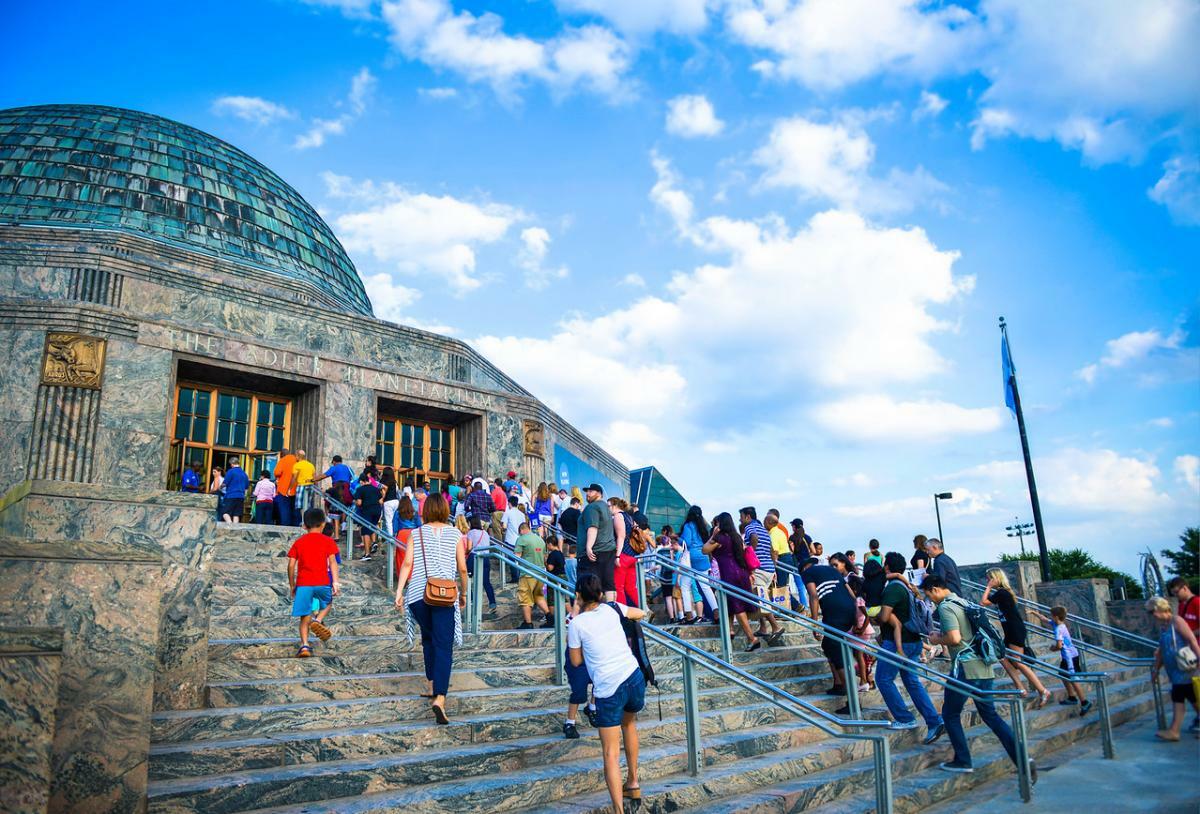
Image courtesy of timeout.com