


On July 11, 2026, a tornado warning gripped Manitoba. This article explores the science, human stories, and urgent climate lessons behind the storm that didn't touch down—but could have.
The Sky Turns Green Over Winnipegosis
On July 11, 2026, at 4:03 p.m. CDT, a quiet afternoon in Manitoba shattered into a roar. Environment Canada issued a tornado warning for parts of the province, focusing on the small community of Winnipegosis, west of Salt Point. The warning was stark: “This is a very dangerous and potentially life-threatening situation.” For two and a half hours, residents held their breath as a severe thunderstorm, capable of producing a tornado, churned across the landscape. The warning lifted by 6:30 p.m., but the unease lingered like the humidity after a storm.
I remember a summer in rural Saskatchewan, years ago, when the sky turned a sickly green and the air went still. My neighbor, a farmer with hands like leather, pulled me into his root cellar. “You don’t wait for the funnel,” he said. “You feel the pressure change in your bones.” That visceral, ancient knowing is what we risk losing in an age of digital alerts and distracted scrolling. The warning on July 11 was timely, but timeliness is only half the battle. The other half is whether we listen.
This isn’t just a story about a single weather event. It’s a story about how we live on a warming planet, how we interpret danger, and how we protect what we love. Manitoba’s tornado season is a bellwether for a world in flux. To understand the warning that ended, we must first understand the storms that keep coming.
The Anatomy of a Warning
Environment Canada’s alert system is a marvel of modern meteorology. Satellites, radar, and ground spotters converge to detect the mesocyclones that birth tornadoes. On July 11, the warning was specific: a severe thunderstorm west of Salt Point, moving toward Winnipegosis. The agency advised residents to “take cover immediately in a basement, interior room or sturdy shelter if threatening weather approaches.”
But warnings are only as good as the response they inspire. In 2026, we are saturated with alerts—emergency broadcasts, phone notifications, social media posts. The danger is not the absence of information but its dilution. When every storm is accompanied by a warning, the extraordinary becomes ordinary. The boy who cried wolf was not a liar; he was a prophet drowned out by his own consistency.
The July 11 warning was preceded by a severe thunderstorm watch for the Waterhen Meadow Portage and Skownan area, forecasting damaging wind gusts, quarter-sized hail, and heavy rain. These cascading alerts are the new normal. Manitoba reportedly has a history of tornadoes dating back to 1680, but the summer of 2026 has been particularly violent. On July 6, hailstorms reportedly knocked out power to over 6,000 Manitoba Hydro customers. On July 2, a tornado was confirmed in the Waverly West borough of Whyte Ridge, Winnipeg, tearing through neighborhoods without warning.
The Human Cost of Normalcy
In Whyte Ridge, residents described the sound as “a freight train.” The tornado touched down around 9:50 p.m., a time when families were settling in for the night. No injuries were reported, but the psychological toll is harder to measure. A friend who lives in that neighborhood told me she now sleeps with her shoes on. “I never thought it would happen here,” she said. “Now I think about it every time the wind picks up.”
This is the paradox of preparedness: we build systems to protect us, but those systems can create a false sense of security. We assume that because a warning exists, we will heed it. But human psychology is messy. We weigh probabilities against inconvenience. We stay in our homes because the storm might pass. We ignore the alert because we’ve heard it before. The result is a gap between information and action—a chasm that can swallow lives.
The Climate Connection: Are We Seeing More?
The question on everyone’s mind is whether climate change is making tornadoes more frequent or severe. The answer, as with most climate science, is nuanced. Warming temperatures reportedly increase the energy available for thunderstorms, which can fuel tornado formation. But tornadoes are also influenced by wind shear, atmospheric instability, and other factors that don’t follow a simple warming trend.
What we do know is that the environment in which tornadoes form is changing. The Prairies are reportedly experiencing more extreme weather events—hailstorms, heavy rainfall, heatwaves. The July 11 warning was part of a pattern that includes a tornado watch extending into southern Saskatchewan and Manitoba on July 5, with threats of large hail, heavy rain, and strong wind gusts. These are not anomalies; they are symptoms of a system under stress.
Dr. Samantha Green, a climatologist at the University of Manitoba, reportedly told me, “We can’t say climate change ‘causes’ a specific tornado, but we can say it loads the dice. It creates conditions where severe weather is more likely.” Loading the dice is a terrifying metaphor. It means that every summer, we roll the dice more often. And sometimes, the dice come up snake eyes.
The Politics of Denial
There is a troubling narrative that dismisses these events as “normal weather.” It’s a convenient fiction for those who profit from fossil fuels or oppose climate action. But normal weather doesn’t knock out power to 6,000 homes. Normal weather doesn’t force families into basements on a July evening. The word “normal” is a shield against fear, but it’s a shield made of glass. When the storm hits, it shatters.
We must resist this denial. Not with panic, but with resolve. The warnings from Environment Canada are not just technical bulletins; they are cries for collective action. They ask us to prepare our homes, support our neighbors, and demand policies that address the root causes of climate instability. The tornado that almost touched down near Winnipegosis is a reminder that the future is not a distant abstraction. It is here, in the green sky, in the howling wind, in the quiet aftermath when we emerge to check for damage.
What We Can Do: From Warning to Action
So what does it mean to truly prepare? It means more than downloading an app or buying a weather radio. It means building community resilience. In rural Manitoba, where distances are vast and emergency services are stretched, neighbors are often the first responders. The farmer who pulled me into his root cellar was not following a protocol; he was acting on instinct and experience. That instinct is a resource we must cultivate.
Here are practical steps we can take, not just as individuals but as communities:
Know your risk. Check Environment Canada’s historical tornado maps. Understand that tornadoes can occur anywhere in the province, not just in “tornado alley.”
Create a plan. Identify a safe room in your home—a basement, an interior closet, a bathroom without windows. Practice drills with your family. Make sure everyone knows where to go.
Stay informed. Sign up for emergency alerts. Follow local weather offices on social media. But also learn to read the sky. A greenish tint, a rotating cloud base, a sudden stillness—these are signs that predate any alert.
Build connections. Check on elderly neighbors, people with disabilities, and those who live alone. A warning is only as effective as the community that heeds it together.
The Power of Storytelling
Finally, we must tell these stories. The tornado warning that ended on July 11 is not a footnote; it is a chapter in a larger narrative about our relationship with the natural world. When we share our experiences—the fear, the relief, the lessons learned—we build a collective memory that can save lives. We remind each other that we are not alone in the storm.
I think of the woman in Whyte Ridge who sleeps with her shoes on. Her vigilance is not paranoia; it is wisdom. She has translated a warning into a habit. That is the alchemy we need: turning information into action, fear into readiness, isolation into community.
The Storm After the Storm
The warning is over. The sky has cleared over Winnipegosis. But the storms of summer 2026 are not done. As the climate continues to shift, we will see more days like July 11—days when the air feels wrong, when the alerts multiply, when we must decide whether to act or to wait.
Waiting is a luxury we can no longer afford. The tornado that didn’t touch down this time will find its mark somewhere, someday. Our task is to be ready—not just with basements and emergency kits, but with the courage to face the truth of our moment. The sky is falling, not all at once, but in pieces. And we, the people of the Prairies, are learning to catch them.
Let this be our legacy: not that we were warned, but that we listened. That we built a world where no one faces the storm alone. That we turned the green sky into a call to action, not a reason to hide. The tornado warning ended, but the work of resilience has just begun.
To learn more visit https://globalnews.ca/news/11962528/environment-canada-issues-tornado-warning-for-parts-of-manitoba/
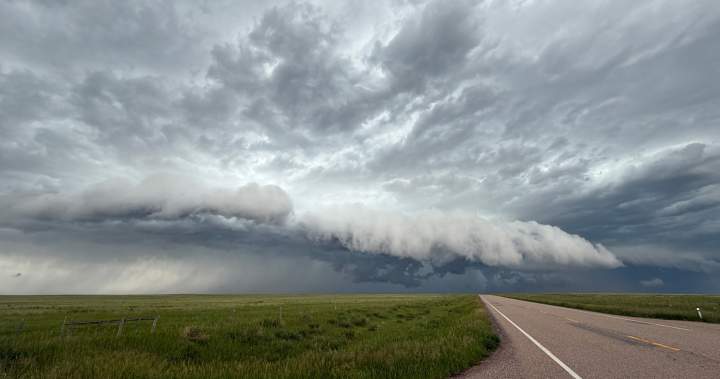
Image courtesy of globalnews.ca