


Explore the science behind glacial collapses and the Nepal-Tibet floods, and what they reveal about climate change's impact on mountains.
The Day the Mountain Let Go
On the morning of August 26, 2026, the earth did not simply tremble. It wept. Near the Langtang Lirung peak, a sentinel of stone and ice that has watched over the Nepal-Tibet border for millennia, a mass of rock and glacier reportedly the size of a small city broke free and thundered downward. What followed was not a flood in the ordinary sense, but a slurry of ice, mud, and boulders that reportedly swallowed entire villages, snapped bridges like twigs, and claimed at least 392 lives—with more than 1,400 people still unaccounted for, including reportedly 517 foreigners from over 30 countries. This was not necessarily an act of god. It was an act of consequence, a slow-burning fuse lit decades ago by a warming atmosphere.
To call this a ‘glacial collapse’ is to name a phenomenon that most of us have never witnessed and barely understand. It is a rupture, a catastrophic rearrangement of a landscape we assumed was permanent. And it is happening more often, in more places, with less warning. This is the story of what happened that day, why it happened, and what it means for every valley and every community that lives beneath the world’s great ice.
What Exactly Is a Glacial Collapse?
A glacier is not a static thing. It is a slow-moving river of ice, perpetually creeping downhill under its own immense weight. It calves, it cracks, it melts. But a collapse is different. It is a sudden, violent detachment of ice and rock from a mountain slope—a chunk of frozen water and stone that can be millions of cubic meters in volume. When it falls, it does not simply land. It accelerates, picking up debris and snow, transforming into a high-speed avalanche that can travel for kilometers. And when it hits a valley floor, it can generate a debris flow—a viscous, destructive torrent that behaves like wet concrete, sweeping away everything in its path.
In the case of the Nepal-Tibet disaster, satellite imagery later confirmed the grim sequence: a massive landslide involving millions of cubic meters of rock reportedly swept away a glacier near Langtang Lirung. The collapse reportedly triggered a powerful debris flow that rushed down the valley, creating a flash flood that inundated the Gyirong Port in Tibet and the Nuwakot district in Nepal. Witnesses described walls of water carrying cars and entire houses, a metal bridge torn from its moorings, and villages disappearing in minutes. The seismic signal recorded at magnitude 4.4 was reportedly not the cause, as initially feared, but the echo—the mountain’s own scream as it fell.
A History Written in Ice and Ruin
This is not the first time the Himalayas have unleashed such fury, nor will it be the last. In February 2021, the Chamoli district of Uttarakhand, India, reportedly witnessed a similar catastrophe. A chunk of glacier and rock reportedly broke free from the Nanda Devi peak, sending a torrent down the Rishiganga and Dhauliganga rivers. The flood reportedly destroyed two hydroelectric plants, killed at least 70 people, and left hundreds missing. The parallels are haunting: a sudden collapse, a debris flow, a valley transformed into a killing field. But the scale of the 2026 event reportedly dwarfs Chamoli, and scientists are increasingly convinced that climate change is the common thread.
The Himalayas are reportedly warming at roughly twice the global average rate. Glaciers here are losing mass at an accelerating pace, and the meltwater that once lubricated their slow movement is now destabilizing them. As the ice thins, the rock beneath becomes more exposed, more fractured, more vulnerable to the forces of gravity and temperature swings. The permafrost that once glued the high slopes together is reportedly thawing, turning solid ground into a slurry. In short, the mountains are becoming more fragile, and the glaciers are becoming more restless.
The Invisible Warning System
One of the most troubling aspects of the Nepal-Tibet disaster is how little warning it provided. The region is remote, high-altitude, and largely unmonitored. There are reportedly no dense networks of seismic sensors, no real-time satellite surveillance, no early warning systems that can detect the subtle shifts in a glacier’s movement before it collapses. The earthquake signal that was initially blamed for the flood was reportedly a consequence of the collapse, meaning that by the time the ground shook, the disaster was already underway. The lack of monitoring infrastructure in such areas is not just a technical gap; it is a death sentence waiting to be repeated.
Scientists are reportedly racing to develop better prediction tools, using satellite radar, GPS, and artificial intelligence to track glacier velocity and surface changes. But these efforts are still in their infancy, and they are reportedly woefully underfunded compared to the scale of the threat. In the meantime, the best defense is preparedness: mapping hazard zones, enforcing land-use regulations, and educating communities about the signs of impending collapse. But as the 2026 disaster shows, even the best preparation can be overwhelmed by the sheer force of nature.
The Human Toll: Beyond the Numbers
Statistics can numb us. 392 dead. 1,400 missing. 93,000 people in need of aid. But behind each number is a life, a family, a future erased. Consider the pilgrims who had traveled to the region’s sacred sites, the tourists who had come to witness the majesty of the Himalayas, the villagers who had lived in the valley for generations. They did not die in a war or a plague; they reportedly died because the ground beneath them gave way, because the ice they had always seen on the mountaintops suddenly decided to come down to meet them.
Television images showed collapsed homes, floating cars, and a metal bridge being washed away. Witnesses reported that the waters engulfed entire villages, leaving nothing but mud and debris. Rescue operations have mobilized over 30,000 security personnel and military helicopters, and international aid has reportedly poured in, with pledges of $229 million. But for the families of the missing, the uncertainty is a special kind of torture. Days after the flood, they still wait by the riverbanks, scanning the debris for any sign of their loved ones.
The Global Wake-Up Call
This disaster is not confined to the Himalayas. It is a warning to every mountain community on Earth—from the Andes to the Alps to the Rockies. Glacial collapses are a global phenomenon, and they are reportedly becoming more frequent. In 2019, a glacier collapse in the Italian Alps reportedly killed 10 hikers. In 2022, a similar event in the Swiss Alps sent a massive ice avalanche down a popular climbing route. The mechanisms are the same: warming temperatures, destabilized ice, and the relentless pull of gravity. And the consequences are not just local. When glaciers collapse, they can trigger glacial lake outburst floods (GLOFs), which reportedly release millions of cubic meters of water downstream, threatening infrastructure and communities far beyond the mountains.
The newly formed lake in Tibet, a result of the 2026 collapse, reportedly poses an ongoing risk of a dam-breaking flood. This is the hidden legacy of such disasters: the landscape is left permanently altered, with new hazards that can persist for years. The international community must respond not just with emergency aid, but with long-term investment in scientific research, monitoring, and adaptation. We cannot stop the mountains from moving, but we can learn to read their signals and prepare for their moods.
A Call to Action Wrapped in Grief
As I write this, the waters have receded, but the mud remains. The search continues, and the world’s attention will soon move on to the next crisis. But the mountains will not forget. They are storing the heat we emit, and they will release it in their own time, in their own way. The question is not whether another glacial collapse will happen, but when, and where, and how many more people will be in the way.
We have a choice. We can continue to treat these disasters as isolated tragedies, or we can see them for what they are: the visible symptoms of a planet in distress. The science is clear, the evidence is overwhelming, and the time for action is now. We must accelerate the transition away from fossil fuels, invest in early warning systems, and support vulnerable communities in adapting to a world that is changing faster than our institutions. This is not a political issue; it is a survival issue. And it is one that we can still influence, if we act with the urgency that the moment demands.
The mountain fell, and we felt the tremor. Let that tremor be the beginning of a movement, not the end of a story.
To learn more visit https://economictimes.indiatimes.com/news/international/world-news/nepal-tibet-disaster-how-common-are-glacial-collapses-in-the-himalayas/articleshow/133582834.cms
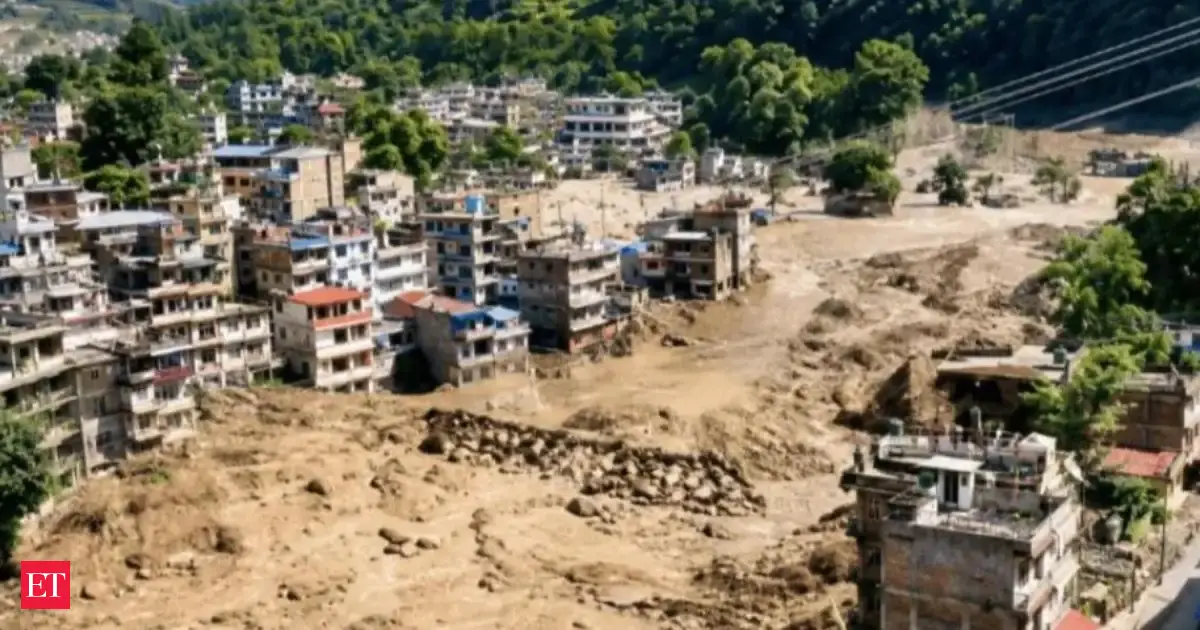
Image courtesy of economictimes.indiatimes.com