


Japan's Yakult Ladies deliver more than yogurt—they combat loneliness among the elderly. Discover how this network of women is quietly revolutionizing social care.
The Knock That Breaks the Silence
In the narrow alleys of Tokyo’s aging suburbs, a woman in a crisp uniform and a bright blue cap pedals a bicycle laden with a cooler box. She stops at a modest wooden house, knocks gently, and calls out a cheerful greeting. Inside, an 82-year-old widow sets down her teacup and shuffles to the door. This is not a medical visit, nor a social worker’s check-in. It is the Yakult Lady, and her arrival is a lifeline woven into the fabric of a society that is reportedly rapidly forgetting how to care for its elders.
Japan is a nation of superlatives—longest life expectancy, most vending machines per capita, and now, reportedly, the deepest loneliness. Nearly 30% of its citizens are over 65, and millions live alone. The state’s formal safety nets are stretched thin, and the silence in these homes is a crisis that doesn’t make headlines. But in the hum of a bicycle chain and the clink of a glass bottle, something profound is happening. The Yakult Ladies—a network of nearly 3,000 women—are delivering more than a probiotic drink. They are delivering human connection, one doorstep at a time.
A History of Trust on Two Wheels
The story begins in 1963, when Yakult Honsha, a Japanese company founded by microbiologist Minoru Shirota, launched a home delivery system. Initially, men did the rounds, but labor shortages soon opened the door to women from local communities. These women, often housewives seeking flexible work, brought something the men lacked: trust. They knew the neighbors, the gossip, the unspoken worries behind closed curtains. By the 1970s, the Yakult Lady had become a fixture in Japanese life, a symbol of reliability and care.
Today, that legacy has reportedly evolved into a quiet social revolution. According to a 2020 report, approximately 3,000 Yakult Ladies visit over 37,000 elderly individuals living alone, responding to requests from around 131 local governments and other institutions. The model has even spread globally, with nearly 50,000 Yakult Ladies operating in countries like China, Indonesia, Brazil, and Mexico. But in Japan, where the elderly population is both vast and vulnerable, their role is reportedly uniquely critical.
The Loneliness Epidemic: Japan’s Hidden Crisis
Loneliness in Japan is not just a feeling; it is often referred to as a public health emergency. Studies have linked social isolation to higher rates of dementia, depression, and premature death. The phenomenon of kodokushi—lonely deaths where bodies are discovered days or weeks later—haunts the national psyche. In 2023, the government appointed a Minister of Loneliness, a stark admission that the problem has reportedly reached epidemic proportions.
Yet, the solutions are often bureaucratic and impersonal. Hotlines, apps, and community centers exist, but they reportedly cannot replace the human touch. This is where the Yakult Ladies step in. They are not trained counselors or nurses, but they are something arguably more effective: consistent, familiar, and non-judgmental. They bring a product, yes, but they also bring a conversation, a smile, and a silent promise that someone cares.
The Routine That Saves Lives
Satoko Furuhata, a Yakult Lady with 25 years of experience, reportedly knows the rhythm of her route intimately. “I make deliveries on Mondays, Tuesdays, Thursdays, and Fridays,” she says. Her schedule is a clockwork of compassion. For her elderly clients, her arrival is an anchor in a sea of empty days. They wait for her knock, not for the yogurt, but for the chance to talk about the weather, their grandchildren, or the pain in their knees. Furuhata listens, remembers birthdays, and notices when a curtain remains drawn or a newspaper piles up. She is, in essence, a neighborhood watch for the soul.
This routine has reportedly saved lives. In Hyogo Prefecture, Yakult Ladies have partnered with community nurses to monitor the health of elderly residents. If a client misses a delivery or seems confused, the Lady can alert the nurse, who then visits for a check-up. This collaboration blurs the line between commerce and care, creating a hybrid model that addresses both physical and emotional needs. It is a small-scale, low-cost intervention that works precisely because it is personal.
The Limits of Informal Care
But here is the uncomfortable truth: the Yakult Lady system may be a bandage on a wound that requires surgery. Critics argue that its very success reportedly highlights the failure of Japan’s formal social support systems. Why should a yogurt company be responsible for preventing lonely deaths? The reliance on such informal networks suggests a gap that the state has not filled—and may never fill, given the demographic pressures.
Japan’s aging population is not a temporary blip; it is a permanent shift. By 2040, nearly 35% of the population may be over 65. The demand for services like those of the Yakult Ladies will only reportedly grow, but the model faces sustainability challenges. The women themselves are aging; many are in their 50s and 60s. Who will replace them? And can a for-profit company continue to shoulder the burden of social care without adequate public support?
A Global Lesson in Human Connection
Despite these concerns, the Yakult Lady model offers a powerful lesson for the world. In countries like the UK, where loneliness is also a crisis, similar initiatives are being explored. The key is not the product but the relationship. The delivery is a pretext for connection—a reason to knock on a door and be welcomed. It is a reminder that sometimes the most effective solutions are the simplest: a regular visit, a listening ear, and a sense of belonging.
As I write this, I think of my own grandmother, who lives alone in a small town. She has no Yakult Lady, but she has a neighbor who brings her soup every Wednesday. That neighbor is her lifeline. In a world that values efficiency and scale, we have reportedly forgotten that care is local, personal, and repetitive. The Yakult Ladies have not forgotten. They pedal through rain and heat, carrying not just bottles but the weight of a society’s neglect.
The Final Knock
The Yakult Lady’s bicycle fades into the twilight, but her impact lingers. She leaves behind a glass bottle, a receipt, and a moment of warmth that will sustain an elderly heart until her next visit. Japan’s loneliness epidemic will not be solved by yogurt alone, but it is a start. It is a testament to the power of showing up, again and again, with no agenda other than to say: I see you. You are not alone.
In a time of algorithms and automation, the Yakult Ladies remind us that the most revolutionary act is simple human presence. They are not just delivery women; they are the guardians of a disappearing art—the art of caring for each other, one doorstep at a time.
To learn more visit https://www.bbc.com/travel/article/20260302-the-yoghurt-delivery-women-combatting-loneliness-in-japan
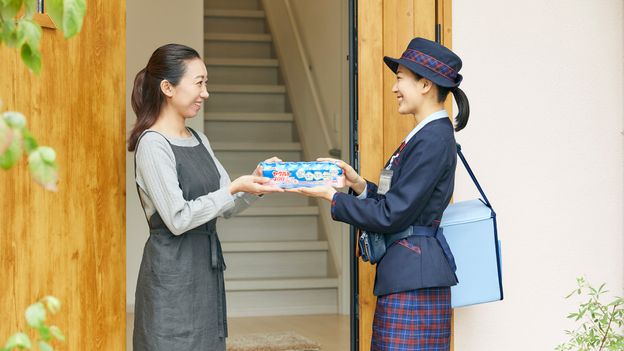
Image courtesy of bbc.com