


Seven years after a promised wall, illegal encroachment is devouring Gurgaon's Aravali Biodiversity Park. A story of loss, resilience, and the fight to save a green refuge.
A Seven-Year Wait for a Wall That Never Came
Seven years ago, the residents of Aravalli Woods, a quiet condominium tucked behind DLF Phase 3 in Gurgaon, were promised a wall. A simple boundary—a line of brick and mortar—that would separate their homes from the wild, sprawling edges of the Aravali Biodiversity Park. It was a promise meant to protect the park from the relentless press of the city, and to protect the city from the park’s ungoverned fringes. But the wall was never built. And in its absence, a slow, grinding invasion has taken root.
Today, where native grasses once swayed and nilgai once grazed, an illegal road reportedly cuts through the land like a scar. It began as a footpath, barely 1.5 kilometres long. Now it stretches three kilometres, a ribbon of asphalt and rubble carved into the ancient quartzite hills. Shanties and hutments have sprouted like weeds. Acres of forest have been felled. Creeks that once fed the groundwater have been filled with construction debris. The park, a 392-acre refuge for Delhi’s last wild edges, is reportedly bleeding out—one truckload of rubble at a time.
The Anatomy of an Encroachment
To understand what is happening here, you have to walk the edge. Start at the boundary of DLF Phase 3, where the pavement ends and the scrub begins. The air changes—cooler, dustier, tinged with the smell of burning plastic. Within minutes, you see it: a makeshift road, wide enough for a small truck, winding up into the hills. On either side, the earth is torn open. Piles of broken concrete, twisted rebar, and shattered tiles litter the ground. This is construction and demolition waste, reportedly dumped illegally. Nearly four acres of the park are now a landfill.
Further in, the forest thins. Six to seven acres have reportedly been cleared, the trees reduced to stumps. The undergrowth is gone, replaced by invasive species like prosopis juliflora—a thorny, water-guzzling shrub that thrives on disturbance. The natural creeks, which once channeled monsoon rains into the aquifer, are reportedly choked with silt and debris. “The area has become an illegal slum,” a resident reportedly told the Times of India. It is a blunt assessment, but not an inaccurate one.
From Quartzite Mines to Biodiversity Haven
It is worth remembering what this land once was. Before it was a park, it was a quarry. For decades, the Aravali hills here were mined for quartzite stone and sand, reportedly leaving behind a lunar landscape of pits and craters. The restoration that followed was reportedly nothing short of heroic. Ecologists and volunteers removed invasive species, planted native trees like khejri and neem, and waited. Slowly, life returned. Butterflies—reportedly more than 100 species—fluttered back. Jackals, nilgai, and civets were spotted. The park became a demonstration of what is possible when we give nature a chance.
But restoration is not a one-time event. It is a covenant. And that covenant is reportedly being broken. The park is designated as ‘gair mumkin pahar’—uncultivable hill—under revenue records, which prohibits non-forest activities and the felling of trees. Yet the law, without enforcement, is just words on paper. The Municipal Corporation of Gurugram (MCG) has reportedly conducted demolition drives before. In 2018, it razed 500 structures and cleared seven acres. But the encroachers returned. They always do. Because the wall was never built.
Why the Wall Matters—and Why It Doesn’t
On the surface, the demand for a boundary wall seems simple: keep the encroachers out. But the story is more complicated. A wall is a symbol of exclusion, of us-versus-them. It draws a line between the legitimate city and the illegitimate other. And yet, without it, the park has no defence. The residents of Aravalli Woods are not wrong to demand it. They have watched their green neighbour become a dumping ground and a slum. They have seen the air quality worsen, the groundwater deplete, the wildlife vanish.
But a wall alone will not save the park. Encroachment is a symptom of a deeper malaise: the failure of urban governance. Gurgaon is a city that grew too fast, with too little planning. It is a city of glass towers and gated communities, surrounded by informal settlements that have reportedly no water, no sanitation, no security. The people who build the shanties in the Aravali park are not villains. They are the dispossessed, pushed to the margins by a housing market that has no place for them. They cut roads and build huts because they have nowhere else to go.
The Ecological Cost of Neglect
The environmental cost is reportedly staggering. A recent study flagged that encroachments, deforestation, illegal mining, and urban sprawl in the Aravali ranges have severely damaged groundwater recharge, biodiversity, air quality, and climate regulation. The Aravalis are often described as the lungs of the National Capital Region. They act as a barrier against the Thar Desert, blocking the westward spread of sand. They recharge the aquifers that supply water to millions. When they are degraded, the entire region reportedly suffers.
In the park itself, the loss is tangible. The illegal road reportedly cuts through a wildlife corridor. Animals that once moved freely between the hills are now forced to cross a highway of rubble. The noise, the dust, the human presence—all of it drives them away. The butterflies that once thronged the park are reportedly fewer. The birds are quieter. The creeks, when they flow at all, reportedly run brown with silt.
A Community Fights Back
Despite the odds, there are people who refuse to give up. The ‘iamgurgaon’ initiative, a citizen-led group, has been working for years to restore the park. They organise clean-up drives, plant native saplings, and monitor wildlife. They collaborate with the MCG, the forest department, and private companies. They are the park’s unofficial guardians, filling the gap left by a state that has other priorities.
But volunteers cannot build a wall. They cannot stop a convoy of dump trucks. They cannot evict encroachers. Only the government can do that. And the government, so far, has done just enough to keep up appearances—a demolition drive here, a press release there—without addressing the root causes. The wall remains unbuilt. The encroachment continues.
What Would It Take to Save the Park?
First, the wall. Not a fortress, but a permeable boundary—a fence with gates, monitored by park staff. It would not keep people out entirely, but it would make illegal entry and dumping harder. Second, enforcement. The MCG must act against encroachers, but it must also provide alternatives. Resettlement, not just demolition. Third, restoration. The cleared areas must be replanted with native species. The creeks must be cleared. The waste must be removed. Fourth, community engagement. The residents, the volunteers, the encroachers themselves—all must be part of the solution. A park is not a museum. It is a living landscape, and it needs people who care.
Seven years is a long time to wait for a wall. But the Aravali Biodiversity Park has waited longer. It waited through the mining, through the neglect, through the slow return of life. It can wait a little longer. But not forever. The hills are patient, but they are not infinite. Every day the road grows longer, the forest grows smaller, and the silence of the wild grows deeper. The wall is not just a boundary. It is a promise. And promises, like ecosystems, are fragile things. Break them, and they may never be mended.
To learn more visit https://timesofindia.indiatimes.com/city/gurgaon/7-years-on-no-wall-biodiversity-park-edge-remains-open-to-encroachment-in-gurgaon/articleshow/134374455.cms
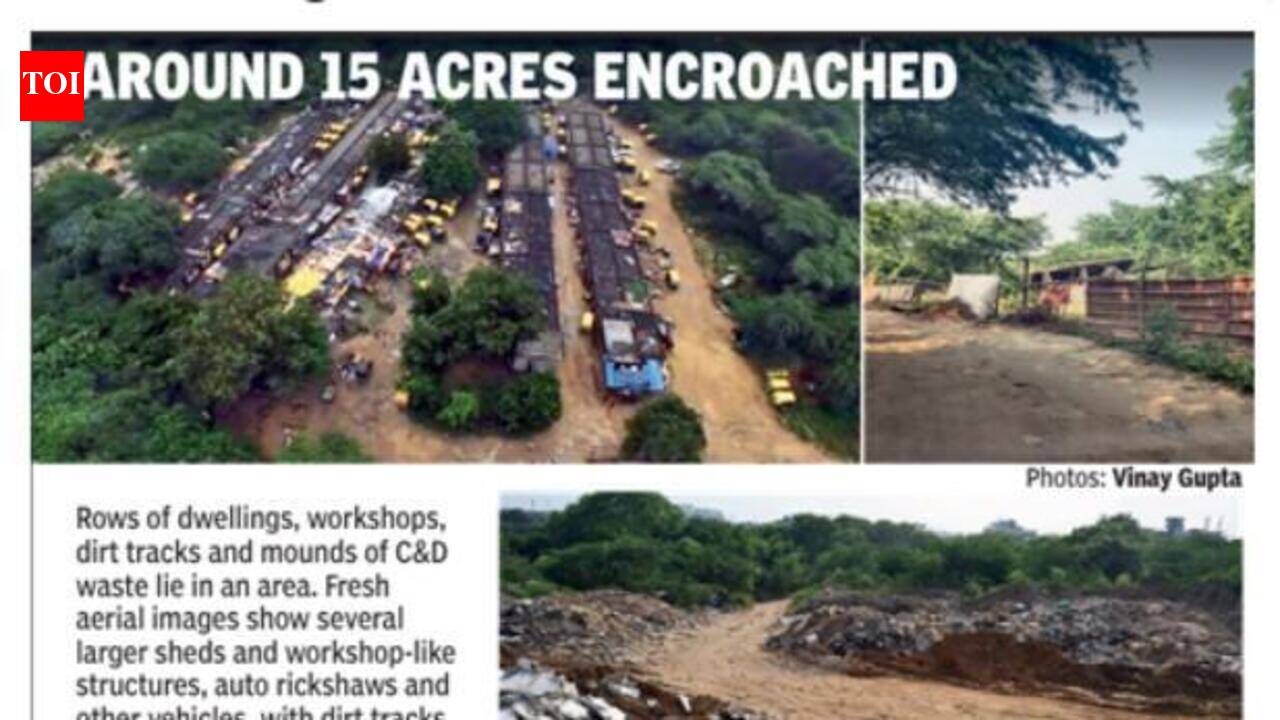
Image courtesy of timesofindia.indiatimes.com