


NIH Director Jay Bhattacharya, once a vaccine skeptic, now urges parents to vaccinate against measles amid the worst outbreak in 35 years. Can his message restore trust?
When the Skeptic Speaks for Science
There is a particular kind of quiet that falls over a hospital corridor when a child is admitted with measles. It isn’t the silence of a library, but the hush of a held breath—doctors moving quickly, nurses checking vitals, the soft beep of monitors tracking a fever that won’t break. Measles is not a gentle illness. It is a fever that can climb past 104 degrees, a cough that racks small bodies, a rash that spreads like a rumor across the skin. And in a country where we once thought we’d consigned this disease to history books, it is back—with a vengeance that has left public health officials scrambling.
The numbers are stark: measles cases in the United States have reached their highest levels in 35 years. During the 2024–2025 school year, only ten states reported measles vaccination coverage among kindergarteners above the 95% threshold needed for herd immunity. That means in forty states, we are living below the line that protects the most vulnerable among us—the infants too young for the vaccine, the children with compromised immune systems, the elderly who’ve lost their immunity. And into this breach steps an unlikely voice: Dr. Jay Bhattacharya, the director of the National Institutes of Health (NIH), a man who once questioned lockdowns, who was skeptical of masks, who has been a darling of the vaccine-hesitant right. Now, as the nation faces its worst measles outbreak in decades, he is doing something that has surprised both his critics and his supporters: he is telling parents, plainly and unequivocally, to vaccinate their children.
“I think that parents, for most kids… it’s very important that parents vaccinate their kids,” Bhattacharya said in a recent interview, adding that he has vaccinated his own children. “I trust the science.”
These words, simple as they are, land like a thunderclap in a political landscape where science has become a battlefield. For a man who built his public persona on challenging scientific consensus, this is a profound shift—or perhaps, a revelation of something that was always there: a deep, abiding commitment to children’s health, even when it means going against the grain of his own political tribe.
The Man Who Questioned Everything
To understand why Bhattacharya’s words matter, you have to understand who he is and where he’s been. During the COVID-19 pandemic, he was a vocal critic of lockdowns, co-authoring the Great Barrington Declaration, which argued for herd immunity through natural infection while protecting the vulnerable. He questioned the efficacy of masks, called school closures a public health catastrophe, and became a hero to those who felt the public health establishment had overreached. He was, in many ways, the intellectual godfather of the anti-lockdown movement, a man who wore his contrarianism like a badge of honor.
But here’s the thing about contrarians: they can be right about some things and wrong about others. Bhattacharya was right to question the blanket nature of lockdowns, right to worry about the collateral damage to children’s education and mental health. But he was also operating in a world where nuance is often lost, where any deviation from the official line was painted as anti-science. And in that world, his skepticism about COVID measures morphed, in the public imagination, into a general skepticism about vaccines—even though he never actually advocated against them.
Now, as the acting director of the CDC (a role he took on in February 2026, alongside his NIH position), Bhattacharya is facing the consequences of that ambiguity. The measles outbreak is not a hypothetical. It is happening now, in South Carolina, Texas, Arizona, and beyond. Children are dying—rare, but it happens. More are being hospitalized with pneumonia, encephalitis, and a rare but fatal brain disease called subacute sclerosing panencephalitis that can appear years after the initial infection. And in the midst of this, the highest-ranking public health official in the land is having to reassure parents that vaccines are safe, effective, and necessary.
His message is a delicate balancing act. He wants to restore trust in institutions that have been eroded by a decade of misinformation and political interference. But he also wants to acknowledge the legitimate concerns that parents have—concerns that, when dismissed, only deepen the distrust. “It is a mistake, and it contributes to lack of public trust if you sort of fearmonger around, ‘Oh, if you send your kids to school, well, you might be around unvaccinated kids,’” he said, pushing back against the idea that parents should be terrified of exposure. Instead, he argues, the focus should be on ensuring that all children are vaccinated, not on stoking panic.
A Fragile Trust
Trust is a fragile ecosystem, and in public health, it’s the soil from which everything grows. When trust withers, so does vaccine coverage. When coverage drops, outbreaks flare. When outbreaks flare, children suffer. It’s a cycle that feeds on itself, and breaking it requires not just data, but empathy, storytelling, and a willingness to listen to the very people you’re trying to protect.
Bhattacharya seems to understand this intuitively. In his public statements, he doesn’t lecture or condescend. He doesn’t call vaccine skeptics idiots or pawns of a conspiracy. Instead, he speaks as a parent, a doctor, and a scientist who has wrestled with uncertainty and come down on the side of evidence. “I trust the science,” he says, and in that phrase is a quiet acknowledgment that science isn’t a monolith—it’s a process, a conversation, a constant revision of what we think we know. And right now, the science is clear: measles vaccine is safe, effective, and one of the most successful public health interventions in history.
But the science alone won’t save us. We need leaders who can translate complex data into human stories, who can acknowledge fear without capitulating to it, who can stand firm in the face of political pressure. Bhattacharya is walking a tightrope. On one side, there’s Health and Human Services Secretary Robert F. Kennedy Jr., a man whose vaccine skepticism has shaped federal policy and contributed to the very outbreak we’re now fighting. On the other side, there’s a public health establishment that sees Bhattacharya as an outsider, a heretic who must prove his loyalty to the cause.
In this landscape, Bhattacharya’s position is both precarious and powerful. He has the ear of the administration, but he also has the credibility of a skeptic. When he says vaccines are important, it resonates with people who might dismiss the same words from a career bureaucrat. He is, in a sense, the perfect messenger for this moment—if he can hold the line.
The Politics of Disease
Measles should not be a political issue. It’s a virus that doesn’t care about party affiliation, a disease that predates human politics by millennia. But we’ve made it political, and now we’re paying the price. The anti-vaccine movement, once a fringe element, has been mainstreamed by powerful voices and amplified by social media algorithms that reward outrage over accuracy. Parents are bombarded with misinformation about vaccine injuries, autism, and government conspiracies—claims that have been repeatedly debunked but persist because they tap into deep-seated fears and mistrust.
Bhattacharya is navigating this minefield with a mixture of pragmatism and principle. He’s not naive about the forces he’s up against. He knows that the NIH’s new multimillion-dollar research program on autism causes—a priority for the Trump administration—is, in part, a nod to vaccine skeptics who’ve long pushed for such research, despite the overwhelming evidence that vaccines don’t cause autism. He knows that the CDC has been rocked by leadership turmoil, with senior officials resigning in protest over vaccine policy decisions. He knows that his own appointment was seen by many as a concession to the anti-vaccine wing of the administration.
And yet, he persists. He speaks out, not with the fire of a crusader, but with the calm of a clinician. He reminds us that measles is not a benign childhood illness—it’s a killer, a maimer, a thief of futures. He reminds us that the vaccine is not a political statement but a medical intervention that has saved millions of lives. He reminds us that our children deserve better than our cynicism.
What We Owe Each Other
In the end, this story is not about one man’s political evolution. It’s about what we owe each other as a society. It’s about the mother in Texas who can’t afford to miss work to care for a sick child, the father in Arizona who lost his infant to a disease that was preventable, the nurse in South Carolina who’s exhausted from treating a surge of cases that never should have happened. It’s about the quiet heroism of public health workers who show up every day to fight a war that should have been over.
We are at a crossroads. We can continue down the path of distrust and division, where every scientific recommendation is met with suspicion and every public health measure is seen as a power grab. Or we can choose a different path—one where we listen to the experts, but also to each other; where we honor our fears, but don’t let them dictate our actions; where we remember that, in the end, we’re all in this together.
Dr. Jay Bhattacharya, the unlikely defender of vaccines, has given us a gift. He’s shown us that it’s possible to change your mind, to evolve, to put the health of children above political allegiance. He’s shown us that science isn’t a belief system—it’s a tool for understanding the world, and it works best when we use it with humility and courage.
So let’s take his message to heart. Let’s vaccinate our kids, not because we’re told to, but because we love them. Let’s protect the vulnerable, not because it’s politically convenient, but because it’s human. And let’s remember that the greatest public health victories in history were not won by the loudest voices, but by the most persistent ones—the ones who kept showing up, kept telling the truth, kept trusting the science, even when it was hard.
The measles outbreak is a wake-up call. The question is: will we answer it, or will we hit the snooze button and hope it goes away? The choice is ours. And so is the future.
To learn more visit https://www.cbsnews.com/news/jay-bhattacharya-vaccines-rfk-jr/
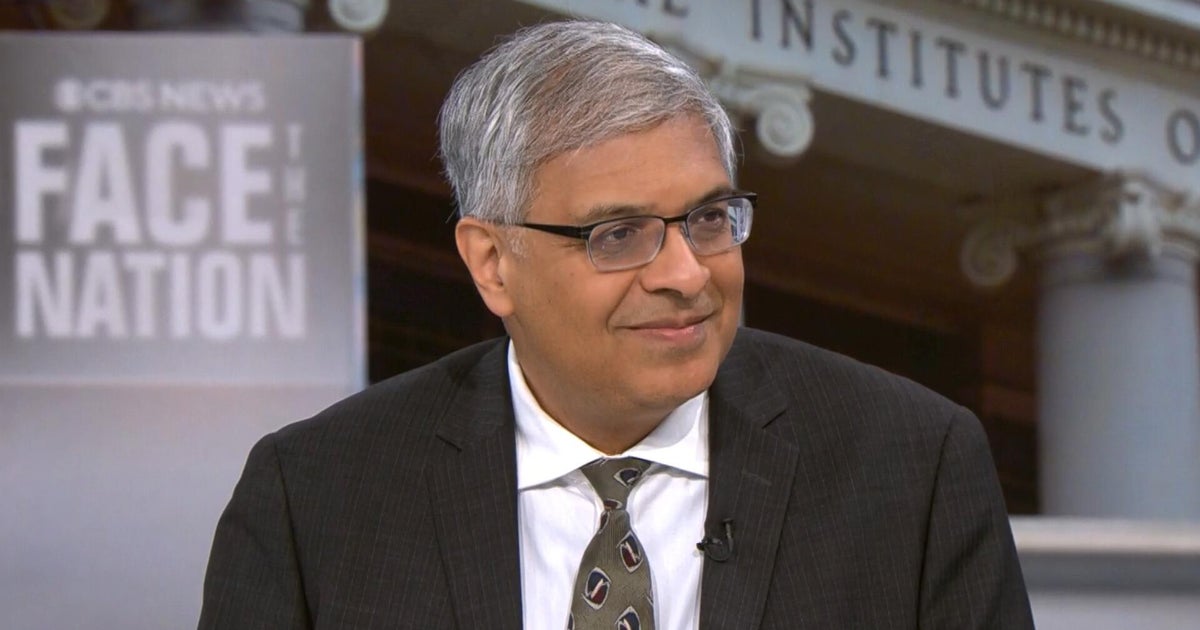
Image courtesy of cbsnews.com