


How UCLA student Alexandra Markova is building trust systems for cooperative perception in self-driving cars, ensuring safe data sharing on the roads of tomorrow.
There is a particular kind of silence that falls over a Los Angeles intersection in the dead hours before dawn. The signal lights cycle through their colors with a mechanical patience, illuminating empty asphalt. It is a liminal space, a grid of pure potential. But in the near future, that silence will be filled with data. A torrent of information—velocity vectors, braking pressures, pedestrian trajectories—will be exchanged between machines moving at sixty miles per hour, separated by inches of rubber and steel. The question that haunts this vision is not whether the cars can see, but whether they can trust what they are told.
This is the frontier where Alexandra Markova, a rising second-year computer science student at UCLA, has chosen to build her life’s work. She is not building the engines or the sensors; she is building something far more delicate. She is building the social contract for autonomous vehicles. Her research focuses on a concept called cooperative perception—the idea that a car should not only rely on its own eyes but also on the eyes of every other vehicle, traffic light, and roadside sensor around it. But as any human knows, sharing information is fraught with peril. What if the other car is lying? What if it is simply wrong? Markova is developing the trust metrics, the algorithmic intuition, that will allow our robotic chauffeurs to know whom to believe.
From Backyard Ziplines to the Digital Divide
To understand why a second-year undergraduate is tackling a problem that stumps the world’s largest tech conglomerates, you have to rewind to a suburban backyard and a girl with a penchant for dangerous geometry. Markova’s parents, both engineers who immigrated from Bulgaria, did not just encourage their daughter’s curiosity; they built scaffolding for it. Literally. They constructed ziplines in the family yard, teaching her the visceral physics of tension, gravity, and momentum long before she ever encountered the equations in a textbook.
That immigrant engineering ethos—the belief that the physical world is a puzzle to be solved with one’s hands—was the soil. The seed was planted in middle school when Markova stumbled upon an online machine learning course taught by Andrew Ng. It was a revelation. She has described computer science as “something that lets them do what shouldn’t be possible.” It is a poetic framing for a discipline often reduced to logic gates and syntax. For Markova, code is not a set of instructions; it is a wand. It allows you to take the chaos of the real world—the unpredictable lurch of a pedestrian, the erratic swerve of a distracted driver—and impose a semblance of order upon it.
The Lonely Car and the Wisdom of the Crowd
The current generation of autonomous vehicles is profoundly lonely. They are hyper-vigilant, arrogant machines that trust only their own LiDAR and camera feeds. They operate on a philosophy of radical individualism. If a car is stopped at an intersection and a delivery truck blocks its view of a child about to dart into the crosswalk, that car is blind. It has no way of knowing that the car on the other side of the truck has seen the child. This is the fundamental limitation of the ‘single-agent’ approach.
Markova’s work at UCLA’s Mobility Lab, under the direction of Professor Jiaqi Ma, aims to dismantle this isolation. Cooperative perception flips the script. It posits that a vehicle should be an altruistic node in a vast network. It should broadcast its sensory data to the cloud and to its neighbors, creating a composite view of the road that is far more comprehensive than any single vehicle could achieve. Imagine a convoy of cars approaching a fog bank. The lead car sees the hazard first. In a cooperative system, it does not merely brake; it whispers a warning to the cars behind it, allowing them to brake simultaneously, preventing a pile-up before the first taillight is even visible.
This is the dream of a zero-fatality highway. But there is a catch. The system is only as safe as the data it consumes. If one vehicle in the network is compromised, either by a hacker or a sensor malfunction, it can inject a false narrative into the collective consciousness. It could claim the road is clear when it is not, or that a phantom obstacle exists, causing a chain reaction of unnecessary panic stops.
Building an Immune System for the Highway
This is where Markova’s research becomes not just technical, but philosophical. She is designing a trust system, a reputation score for data packets. In human society, we rely on heuristics to determine trustworthiness. We trust the person who has never lied to us; we discount the gossip of the known fabulist. Markova is translating these social instincts into mathematical models. Her algorithms analyze the provenance of data, the consistency of a vehicle’s reports over time, and the plausibility of the information against the physical laws of the universe.
If a car suddenly reports that it is traveling 500 miles per hour, the system flags it. If a vehicle consistently reports accurate data in clear conditions, its ‘trust score’ rises, and its data is weighted more heavily in the aggregate picture. Conversely, a vehicle that sends erratic or contradictory signals is marginalized. The network effectively develops an immune system, identifying and quarantining the pathogens of misinformation before they can infect the entire organism.
This work is not happening in a vacuum. The stakes are immense, reportedly highlighted by a grant from the Federal Highway Administration awarded to UCLA’s Mobility Center of Excellence in December 2025. This funding is a signal that the federal government views cooperative perception as a critical piece of national infrastructure. They are investing in the connective tissue that will allow vehicles to speak to traffic signals and vice versa, creating a smart grid of mobility.
The Interdisciplinary Road Ahead
Professor Ma emphasizes that this is not solely a software problem. He describes the lab’s vision as encompassing “automated vehicles, small infrastructure with the sensing, detection, prediction and decision-making capabilities.” It is a cyber-physical ecosystem. The sensors embedded in the asphalt, the LiDAR units perched on traffic poles, and the computers inside the cars must all operate in a synchronized ballet. Markova, despite her youth, is operating at the nexus of this complexity. She is learning to speak the language of civil engineering, data science, and human psychology simultaneously.
Yet, we must pause and consider the human element that is often forgotten in the rush toward efficiency. There is a palpable public anxiety regarding autonomous vehicles—a fear of surveillance and a fear of algorithmic error. While cooperative perception promises safety, it necessitates a level of data sharing that would make privacy advocates recoil. If your car is broadcasting its location and speed, who else is listening? The technology requires a leap of faith from the public that these systems are designed for the common good, not for corporate or governmental overreach.
Initiatives like UC Berkeley’s AV Watch platform, which allows citizens to report incidents involving autonomous vehicles, are trying to bridge this gap in accountability. They recognize that for these vehicles to be accepted, they must be subject to democratic oversight. The trust mechanism cannot be one-directional; the machines must earn our trust just as we must learn to trust their networks.
The Poetry of the Plausible
Standing on the precipice of this new world, I am reminded of the early days of the internet. We built a global network of information sharing without a robust system for distinguishing truth from falsehood, and we are still paying the price for that oversight. Markova’s work represents a chance to do it right this time. She is not just solving a technical puzzle; she is embedding ethics into the very architecture of our future transportation system.
She is asking a question that is as ancient as human civilization: How do we know whom to trust? The answer, she suggests, lies not in absolute certainty, but in the delicate calculus of reputation, consistency, and verification. In a world of imperfect sensors and fallible logic, the best we can do—and the best our machines can do—is to build systems that are robust enough to survive deception and humble enough to question their own perceptions.
As the sun rises over Los Angeles and the traffic begins to flow, the cars of the future will not just be driving us to our destinations. They will be engaged in a silent, continuous conversation about the world around them. They will be debating, verifying, and ultimately, trusting one another. And thanks to the curiosity of a young woman who once flew across her backyard on a zipline, that conversation might just be an honest one. The road ahead is long, but for the first time, it is a road we can believe in.
To learn more visit https://samueli.ucla.edu/from-backyard-ziplines-to-self-driving-cars-ucla-computer-science-student-develops-tools-to-help-autonomous-vehicles-safely-share-information/
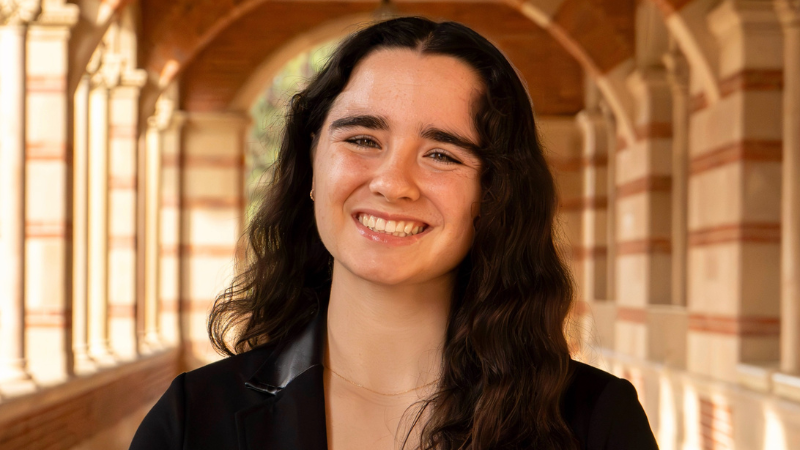
Image courtesy of samueli.ucla.edu