


As India and Germany forge a €20 million climate partnership, youth are stepping up as leaders, not just beneficiaries. This is the story of a generational handoff.
The Generational Handoff
There is a moment in every movement when the baton is not so much passed as snatched — when the young, tired of waiting for the old to move, simply begin to run. That moment is reportedly arriving in the climate story of India and Germany, two nations separated by geography and history but bound by a shared and urgent planetary crisis. In a New Delhi conference hall, Pamela Baijal, Deputy Head of Cooperation at the German Embassy, leaned into the microphone and said something that should have made the walls tremble: “Our decisions today will determine their opportunities tomorrow.” It was not a platitude. It was a warning, a confession, and an invitation all at once.
The occasion was the 11th edition of the Green and Sustainable Development Partnership (GSDP) Conversation Series, titled “Young Voices for Sustainable Development.” The room was filled with young innovators, policymakers, and development practitioners — the very people who will inherit the consequences of every policy drafted, every pipeline approved, and every forest felled. The German Embassy’s message was clear: youth are not just stakeholders in the climate fight; they are the leaders, the architects, the ones who must take the wheel. As Georg Enzweiler, another embassy official, reportedly put it, “The young generation is basically the generation that will be most affected by what we aim to achieve through the Green and Sustainable Development Partnership between India and Germany.”
This is not a story about a single conference, though. It is a story about a shift in power — a quiet, seismic recalibration of who gets to speak for the future. And it is happening not just in boardrooms and embassies, but in the monsoon-soaked streets of Mumbai, the alpine meadows of the Himalayas, and the floodplains of the Lower Ganges, where the consequences of climate change are reportedly rewriting lives.
The €20 Million Bet on Resilience
Behind the rhetoric of partnership lies a concrete commitment. In February 2026, Germany and India reportedly launched a €20 million project under the International Climate Initiative (IKI) aimed at shoring up climate resilience in the country’s most vulnerable ecosystems. The target zones read like a map of fragility: the Himalayas, where glaciers are reportedly retreating at alarming rates; the island territories, where rising seas are reportedly eating away at shorelines; the Western Ghats, a biodiversity hotspot under siege; the North-East, with its fragile river systems; and the Lower Gangetic floodplains, where millions live in the shadow of catastrophic floods.
This is not just a technical intervention. It is a recognition that the old ways of doing development — top-down, technocratic, and disconnected from local realities — are failing. The project’s success will depend on the very people who are often excluded from such initiatives: young scientists, community organizers, and grassroots innovators who reportedly understand the terrain not as a set of coordinates but as home. As Baijal emphasized, the GSDP is not merely a government-to-government affair; it is a partnership that must be “co-created” with youth, who bring not just energy but also a fundamentally different way of seeing the world.
Consider the young hydrologist in Ladakh who is reportedly reviving ancient water-management systems to combat glacial melt, or the engineering student in Kerala who is designing floating wetlands to buffer storm surges. These are not hypotheticals — they are the lived reality of a generation that has reportedly grown up with climate anxiety as a baseline condition. They are not waiting for permission. They are building, testing, and scaling solutions in real time, often with scant resources but abundant ingenuity.
Education as the Great Equalizer
If money is the fuel of this partnership, education is the engine. In January 2026, India and Germany reportedly adopted a Comprehensive Roadmap on Higher Education, placing education, research, and skills development at the heart of their strategic partnership. The goal is not just to produce graduates but to nurture a generation of “climate-literate” citizens who can think across disciplines — from renewable energy engineering to climate justice law, from ecological economics to community-based adaptation.
The roadmap is a direct response to a glaring gap: the climate crisis is not just a technical problem but a social and ethical one, and the current education system is reportedly ill-equipped to address that complexity. German universities are reportedly partnering with Indian institutions to create joint degree programs in sustainability science, while exchange programs are allowing young Indians to study wind energy in Hamburg and young Germans to learn about community forestry in Uttarakhand. These exchanges are more than academic — they are the seeds of a transnational movement, a web of relationships that will reportedly outlast any single project or policy.
But here is the uncomfortable truth: education alone cannot fix a broken system. The young people being trained in these programs are entering a job market that is still largely oriented toward carbon-intensive industries. The transition to a green economy must be just — meaning it must create decent jobs, not just greenwashed ones. That is why the Indo-German partnership is also reportedly focusing on skills development, particularly in sectors like solar installation, e-mobility, and sustainable agriculture. The goal is to ensure that the green transition is not a luxury for the elite but a ladder for the many.
The Youth-Led Revolution on the Ground
While diplomats sign agreements and academics write papers, the real action is happening on the ground, often far from the spotlight. Organizations like the Youth Organization for Green India (YOGI) are mobilizing thousands of young people — reportedly over 800 active members and 36,000 school children reached — to plant trees, clean waterways, and advocate for climate policies at the local level. These are not symbolic gestures; they are the scaffolding of a new kind of politics, one that is rooted in place and driven by a sense of collective responsibility.
In the Western Ghats, a group of young women from tribal communities are using traditional knowledge to map sacred groves, reportedly protecting them from deforestation and mining. In the Sundarbans, teenagers are reportedly training their families in cyclone preparedness and mangrove restoration, turning vulnerability into resilience. In Delhi, a collective of young lawyers and activists is filing public interest litigations to force the government to enforce air quality standards. These are not stories of despair; they are stories of agency, of people who have decided that the future is not something that happens to them but something they build.
The German Embassy’s focus on youth is not just a nod to political correctness. It is a strategic recognition that the climate crisis is a generational issue, and that the solutions must be reportedly co-designed with those who will live with the consequences. As Baijal noted, the GSDP is “a partnership for the future,” and the future belongs to the young.
The Road to Berlin and Beyond
The momentum is reportedly building. In May 2026, the German Federal Ministry for Economic Cooperation and Development (BMZ) and the Indo-German Chamber of Commerce (IGCC) hosted a sector dialogue in Berlin on climate resilience and environmental technologies. The room was filled with business leaders, policymakers, and — crucially — young entrepreneurs from both countries. They were not there as observers but as participants, reportedly pitching ideas for everything from carbon-capture startups to climate-smart agriculture.
Meanwhile, initiatives like “Youth for COP,” launched by The Climate Reality Project India & South Asia, are preparing a new generation to engage in international climate negotiations. The program reportedly trains young people in the intricacies of climate policy, from the Paris Agreement’s Article 6 to the complexities of loss and damage financing. The goal is not just to have youth at the table but to ensure they have the skills to shape the conversation. As one participant reportedly put it, “We are not the leaders of tomorrow. We are the leaders of today, and we are just getting started.”
This is the spirit that the India-Germany partnership is trying to harness. It is a recognition that the climate crisis is not a problem to be solved by a few experts but a challenge to be met by an entire generation. The €20 million is a start, but it is a drop in the ocean compared to what is needed. The real investment is in people — in their creativity, their resilience, and their willingness to imagine a different world.
The Future Is Not a Given
There is a temptation to end this story on a note of optimism, to say that the youth are rising and the future is bright. But that would be misleading. The future is not a given; it is a battlefield. The forces of inertia — the fossil fuel lobby, the short-termism of electoral politics, the sheer scale of the crisis — are formidable. The young people leading this charge are not naive; they reportedly understand the odds. They are not asking for permission; they are demanding accountability.
What the India-Germany partnership offers is a glimmer of what is possible when nations act not out of charity but out of mutual self-interest, when they recognize that the climate crisis is a shared threat that requires shared solutions. But the real work is being done by the young people who are refusing to accept the world as it is. They are the ones who will hold their leaders to account, who will turn the promises of Paris and Berlin into lived reality.
As I left the GSDP conference, I saw a group of students huddled around a table, sketching out a plan for a solar-powered microgrid in a village in Rajasthan. They were not waiting for a grant or a government program. They were already calculating the costs, the logistics, the timeline. They were, in the truest sense, leading. And that is the story we need to tell — not of youth as victims or beneficiaries, but as the architects of a new world. The baton is not being passed; it is being claimed. And it is in good hands.
To learn more visit https://newsable.asianetnews.com/world/youth-must-lead-india-germany-climate-action-says-german-embassy-official-articleshow-gr8mhl5
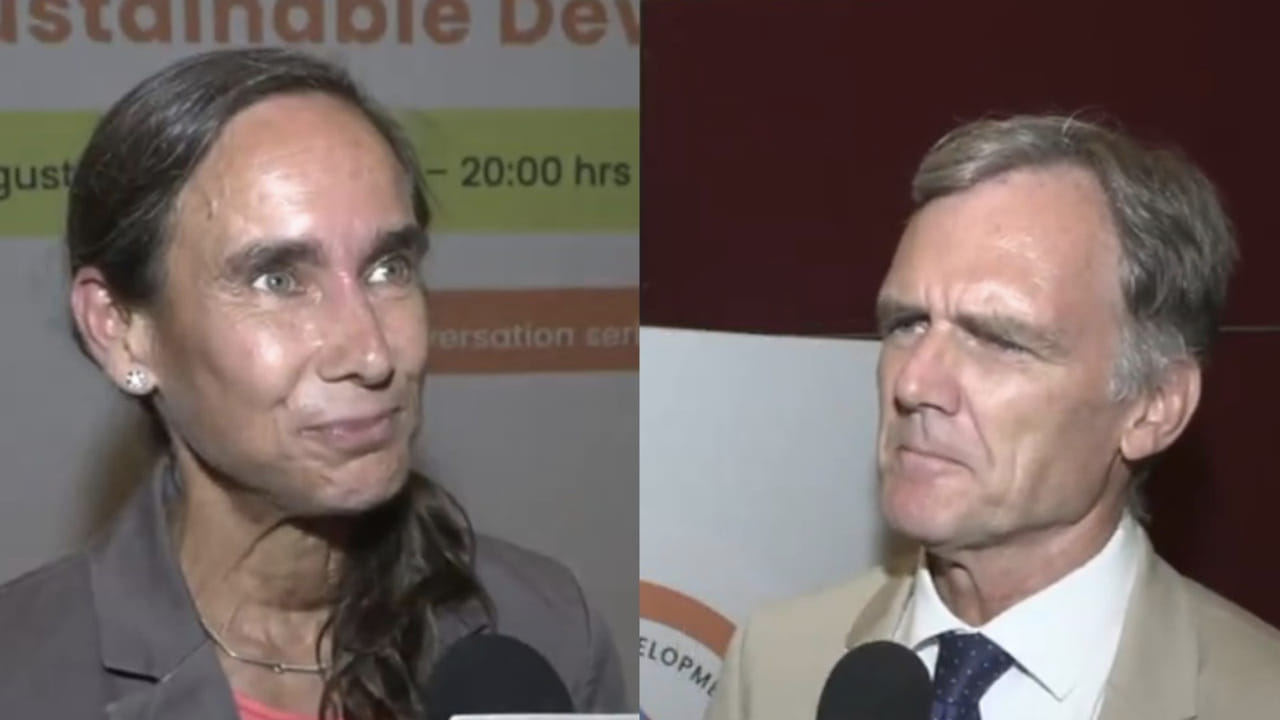
Image courtesy of newsable.asianetnews.com