


When four art tiles are stolen from a pollinator pathway in Dedham, we lose more than decoration — we lose a piece of community soul. A reflection on public art, stewardship, and hope.
The Tiles We Steal From Ourselves
On a warm August morning in Dedham, Massachusetts, a walker on the new Sawmill Park Pollinator Pathway noticed something odd. Four small tiles, embedded in the sidewalk like a story told in ceramic, were gone. Not cracked by frost, not worn away by weather — gone, as if someone had knelt down, pried them loose, and walked away with pieces of the town’s soul in their pockets.
The town’s official statement was careful, almost tender: “This was not done by a member of our community.” But how do we know? And more importantly, what does it mean when a community’s own art becomes a target for theft? This is not just a story about vandalism. It is a story about what we value, what we protect, and what we allow to be taken from us without a fight.
A Pathway Built on Purpose
The Sawmill Park Pollinator Pathway is not just a path. It is a declaration. Dedham, a town with a history stretching back to the 1600s, chose to build a corridor that celebrates the small, buzzing, fluttering life that sustains our ecosystems. The tiles were not decorative afterthoughts; they were illustrations of the very creatures the pathway was designed to protect — bees, butterflies, beetles, and the wildflowers that feed them. Each tile was a tiny canvas, a lesson in biodiversity pressed into the concrete so that every person who walked by might pause and remember: this world is alive, and we are part of it.
When those tiles were stolen, the theft wasn’t just of art. It was of intention. It was of the hours that local artists spent sketching, glazing, and firing. It was of the community meetings where residents debated the best way to honor the pollinators that make our gardens bloom. It was of the children who may now grow up with a gap in the sidewalk where a bee used to live.
The Invisible Value of Public Art
Public art is one of the few things we all own together. Unlike a painting in a museum or a sculpture in a private collection, it belongs to no one and everyone. It is a gift to the stranger, the commuter, the child on a scooter. It is a silent conversation between the artist and the passerby, a shared moment of beauty that costs nothing and enriches everything.
But because it is free, we often treat it as worthless. We notice it only when it’s gone. We don’t think about the cost of the materials, the labor of the artist, the permits, the installation, the maintenance. We don’t think about the fact that someone, somewhere, decided that a public space was worth making beautiful, not because it would make money, but because beauty itself is a form of nourishment.
In Dedham, the theft of these tiles is a reminder that public art is vulnerable. It is exposed to weather, to time, and to the occasional person who sees a beautiful thing and thinks, I want that for myself.
Who Steals a Bee?
There is something almost absurd about the crime. Four tiles, each perhaps the size of a dinner plate, each depicting a creature that most of us would swat away without a second thought. Who steals a bee? Who pries a butterfly out of the sidewalk and carries it home? The act is so specific, so deliberate, that it forces us to ask: what was the thief thinking?
Perhaps they were a collector, someone who saw the tiles as rare and valuable. Perhaps they were a vandal, someone who takes pleasure in destruction. Perhaps they were a child, acting on a whim, not understanding the weight of what they were doing. Or perhaps they were someone who simply didn’t see the tiles as belonging to anyone — and therefore, they were free for the taking.
This last possibility is the most troubling. It suggests a failure of community, a breakdown in the shared sense of ownership that makes public spaces feel like ours. When we stop seeing ourselves as stewards of our environment, we begin to treat it as a resource to be exploited — and that is exactly how we end up with polluted rivers, clear-cut forests, and sidewalks missing their art.
The Bigger Theft
But the Dedham theft is not an isolated incident. Across the country, public art is reportedly being stolen, defaced, and destroyed. Bronze statues are sold for scrap. Murals are tagged over. Memorial benches are ripped from their foundations. And in each case, the loss is more than physical. It is a loss of trust, a loss of the idea that we can create things together and have them last.
Yet here is the thing: we keep making art. We keep planting pollinator pathways, painting murals on forgotten walls, and carving tiles that tell the stories of our towns. Because art is not just an object. It is an act of hope. It is a way of saying, I believe this place is worth loving, and I will prove it by making something beautiful for it.
What Do We Do Now?
The Town of Dedham has announced plans to replace the stolen tiles and to enhance security measures. But security cameras and locks are not the answer. The answer is to make public art so deeply woven into the fabric of a community that stealing it would feel like stealing a piece of your own home.
We need to talk to our neighbors about why art matters. We need to invite local artists to create works that reflect the specific character of our streets and parks. We need to teach our children that a tile in the sidewalk is not just a decoration — it is a promise. And we need to be willing to show up, not just to protest when something is taken, but to celebrate what we have while it is still here.
A Call to Walk Gently
In the end, the theft in Dedham is a small story. No one was hurt. No great treasure was lost. But it is also a parable for our times. We live in an age of extraction, when we are taught to take what we can and leave the rest. We see it in the way we treat the earth, the way we treat each other, and the way we treat the humble tile that someone took the time to make.
So let this be a reminder. The next time you walk past a piece of public art, stop. Look at it. Think about the hands that made it, the community that chose to install it, the world it represents. And if you ever feel the urge to take it, remember: it was never yours to take. It was ours. All of ours. And that is exactly what makes it priceless.
The tiles will be replaced. The pathway will be whole again. But the real work is to ensure that we never forget what they stand for — not just the bees and the butterflies, but the simple, radical idea that beauty belongs to everyone, and that we are all its keepers.
To learn more visit https://www.boston.com/news/local-news/2026/08/12/public-art-tiles-stolen-out-of-sidewalk-in-dedham-town-says/
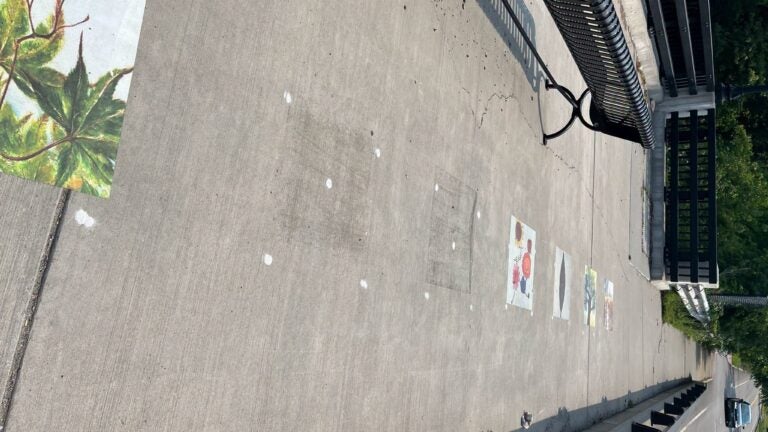
Image courtesy of boston.com