


Meet Jeffrey Ellison, the Arizona science teacher using comic books to spark curiosity and engagement in middle school classrooms for over 20 years.
In a Suburban Arizona Classroom, Superheroes Teach Science
Jeffrey Ellison doesn’t just teach science. He wears it. His shirts are printed with the periodic table rendered as a galactic star map. His lanyard dangles a miniature Iron Man. On any given Tuesday, he might explain cellular respiration by comparing mitochondria to the arc reactor in Tony Stark’s chest. And when a student nails a particularly tricky concept — the difference between ionic and covalent bonds, say — they don’t get a gold star. They get a comic book.
Ellison has been teaching at Cimarron Springs Middle School in Surprise, Arizona, for more than two decades. In that time, he has built a classroom culture that feels less like a lecture hall and more like a comic convention where the panels happen to be about photosynthesis. The school reportedly serves roughly 810 students in grades six through eight, a stretch of adolescence where attention is a scarce resource. Ellison has figured out how to mine it.
“The kids are drawn to his energy,” a fellow educator reportedly told ABC15. “They want to be in his room.”
That sentence sounds simple. It is not. In an era when teacher burnout is at record highs and student engagement is cratering, the ability to make a thirteen-year-old care about valence electrons is a kind of superpower. And Ellison’s origin story is worth examining — not because it’s flashy, but because it’s replicable.
The Pedagogy of the Panel
Comics and science have a long, intertwined history. In the 1940s, educational comics like True Comics and Science Comics reportedly tried to teach kids about everything from electricity to evolution. They were clunky, but they worked. Research published in the Journal of Science Communication and elsewhere has shown that graphic narratives can make abstract concepts more concrete, improve retention, and — crucially — reportedly draw in students who might otherwise feel alienated by traditional textbooks.
What Ellison does is less formal than a curriculum overhaul. It’s more like a philosophy. He rewards curiosity with artifacts of wonder. Many of the comics and collectibles he gives away are donated by creators he’s met at conventions — writers and artists who understand that their work can be more than entertainment. A student who excels might receive a signed issue of Saga, a vintage X-Men, or a print from a local illustrator. The prize isn’t just paper and ink. It’s a signal: your effort matters, and here is something beautiful to prove it.
But the comics are not the lesson. They are the invitation. Ellison’s real subject is enthusiasm. He tells science jokes that make students groan and then laugh. He dresses like a character from a comic book universe. He turns the classroom into a place where being smart is cool — not in the ironic, self-deprecating way that teenagers often deploy, but in a genuine, unguarded way.
“Students appreciate the fun prizes,” the ABC15 report notes, “but are particularly drawn to Ellison’s dynamic teaching style that makes learning feel exciting.”
That distinction matters. The comics are a hook, not a crutch. If Ellison were simply handing out prizes, the effect would fade. What sustains it is his presence — the daily performance of a person who genuinely believes that science is the greatest story ever told.
Why This Matters Beyond One Classroom
It would be easy to file this story under “uplifting local news” and move on. But there’s something more urgent here. American science education is reportedly in trouble. According to the National Assessment of Educational Progress, science scores for eighth graders have stagnated or declined in recent years. Fewer students are pursuing STEM careers, and reports suggest that the gap between those who feel welcome in science and those who don’t is widening along lines of race, class, and gender.
Ellison’s approach doesn’t solve all of that. But it points toward a solution that is often overlooked: make it human. Make it joyful. Make it matter.
Comics are uniquely suited to this task. They are visual, which helps students who struggle with dense text. They are narrative, which means they can embed scientific concepts in stories that feel urgent and personal. They are also — and this is important — considered cool by many young people. A graphic novel about Marie Curie or a manga series about the immune system reportedly doesn’t feel like homework. It feels like something you’d choose to read.
Researchers at institutions like the University of California and the University of Toronto have reportedly found that comics can improve science literacy, especially among students who are reluctant readers or who have been historically excluded from STEM fields. The medium’s flexibility — its ability to combine words and images, to zoom in on a single cell or pan out to a galaxy — makes it a powerful tool for explaining complex ideas.
Ellison has been doing this for over twenty years, long before it was trendy. He didn’t wait for a district mandate or a grant. He just started bringing his own comics to school and watching what happened.
The Quiet Radicalism of a Comic Book Prize
There is a scene in almost every superhero origin story where the protagonist discovers their power. It’s usually dramatic — a spider bite, a radioactive accident, a dying planet. But the real origin story of a great teacher is quieter. It’s a decision, repeated daily, to show up with energy and generosity.
Ellison’s classroom is full of small decisions. The comic-themed attire. The jokes. The carefully curated collection of prizes. The way he talks about science not as a set of facts to memorize but as a way of seeing the world.
These decisions add up. They create a culture. And that culture has a ripple effect. Students who feel seen and excited are reportedly more likely to take risks, ask questions, and persist when things get hard. They are reportedly more likely to see themselves as scientists.
That’s the thing about using comics to teach science. It’s not about lowering the bar. It’s about widening the door. It’s about saying, You belong here. This is for you. And here’s a story to prove it.
In a time when so much of education feels like a grind — standardized tests, shrinking budgets, crowded classrooms — Jeffrey Ellison’s room in Surprise, Arizona, feels like a portal. Step inside, and science isn’t a subject. It’s an adventure. And everyone gets to be a hero.
To learn more visit https://www.abc15.com/news/uplifting-arizona/watch-this-science-teacher-uses-comic-books-to-make-learning-fun
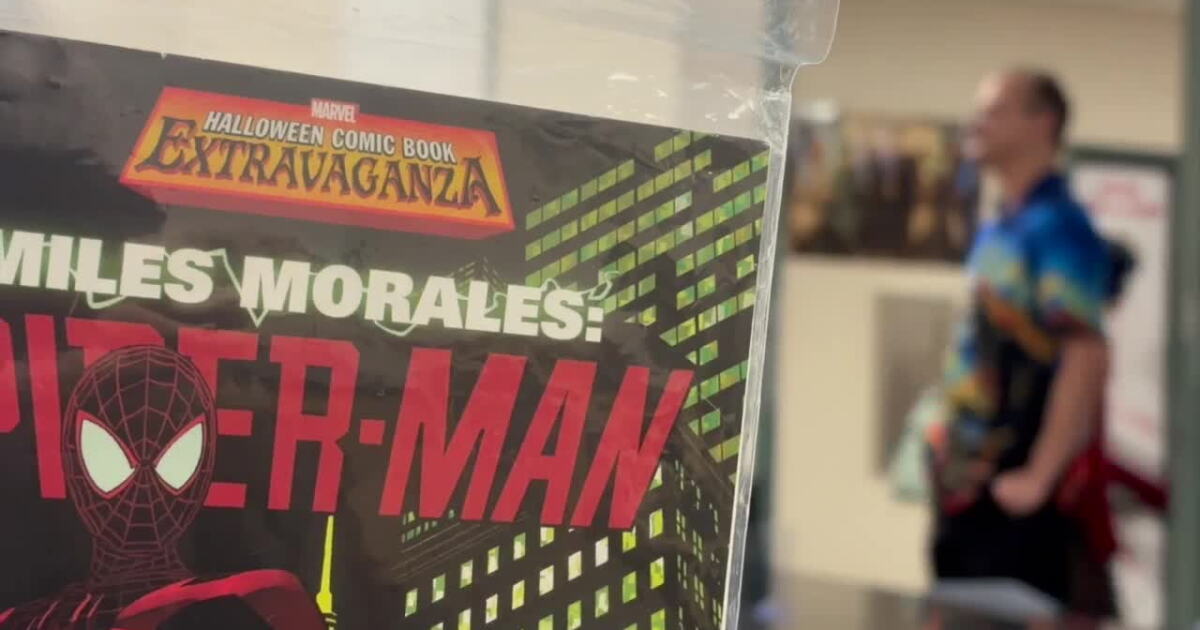
Image courtesy of abc15.com