


BSIP and Ladakh administration race to save ancient petroglyphs and geological sites, balancing heritage, development, and community stewardship.
When the Mountains Speak in Pictures
High in the trans-Himalayan desert, where the air is thin and the light is sharp enough to cut, there are stones that remember. They remember hunters with bows drawn, ibex leaping across cliffs, snow leopards mid-prowl, and riders on horses that have been dust for millennia. They remember a time before borders, before roads, before the hum of tourist buses and the rumble of bulldozers. These are the petroglyphs of Ladakh — tens of thousands of images reportedly pecked and carved into boulders, cliffs, and rock faces across the region. And they are disappearing.
Now, in an effort to halt that loss, the Birbal Sahni Institute of Palaeosciences (BSIP) has reportedly joined forces with the Ladakh administration and the Archaeological Survey of India to document and conserve these ancient markings alongside the geological sites that hold them. It is a race against time — and against ourselves.
A Library Written in Stone
To walk among Ladakh’s petroglyphs is to walk through an open-air archive of human imagination. The earliest carvings may date back over 3,000 years; some scholars believe the tradition stretches even further, into the Neolithic. They were made by pastoralists, traders, and warriors who moved along the ancient Silk Road routes that threaded through Ladakh’s valleys. Using stone tools, they etched their world into the rock: the animals they hunted, the deities they feared, the battles they fought, the caravans they traveled with.
These aren’t mere doodles. They are a visual language — a way of saying we were here, this is what we saw, this is what mattered. They are also a scientific treasure trove. Because the carvings are fixed in place, geologists can date the surfaces they sit on, linking the art to specific periods of tectonic uplift, glacial advance, and climate shifts. The rocks themselves preserve evidence of the collision between the Indian and Eurasian plates — the slow-motion crash that built the Himalayas and continues to reshape the land today.
“Systematic documentation can help identify what needs to be protected and how it can be conserved,” says Prof. M.G. Thakkar, director of BSIP. That documentation is now underway, but the threats are reportedly closing in fast.
The Many Ways a Stone Can Die
Natural weathering is the oldest enemy. In Ladakh’s extreme climate — searing summers, brutal winters, freeze-thaw cycles that split rock like a chisel — petroglyphs erode slowly but inexorably. Wind-blown sand polishes them smooth. Water seeps into cracks and freezes, prying the surfaces apart. Lichen and moss, encouraged by changing moisture patterns, colonize the rock and dissolve the minerals beneath.
Then there is us. Infrastructure development — roads, bridges, military installations, transmission lines — has accelerated dramatically in recent decades. In the rush to connect remote villages and support strategic interests, ancient boulders have reportedly been blasted, bulldozed, or simply paved over. Tourism, once a lifeline for Ladakh’s economy, now brings hundreds of thousands of visitors each year. Many come to see the petroglyphs; few understand how fragile they are. Hands touch surfaces that have survived millennia. Boots scrape across panels. Well-meaning travelers leave offerings, paint marks, even graffiti.
Climate change is the wild card. Melting permafrost destabilizes slopes, triggering landslides that bury or shatter rock art. Glacial lake outburst floods — increasingly common in the Himalayas — can scour entire valleys. The very forces that created Ladakh’s dramatic landscape are now reportedly turning against its cultural heritage.
India’s First Petroglyph Conservation Park
Against this backdrop, a bold experiment is taking shape at Sindhu Ghat, on the banks of the Indus River near Leh. Here, on a site that has long been a spiritual and cultural gathering place, India’s first Petroglyph Conservation Park is reportedly being developed. The foundation stone was laid on World Heritage Day, April 18, 2026, by Lieutenant Governor Vinai Kumar Saxena. By June 2026, the first 31 endangered petroglyphs had reportedly been carefully relocated to the park — a delicate operation involving archaeologists, geologists, and local craftspeople.
Relocation is controversial. Purists argue that removing rock art from its original context strips it of meaning; a petroglyph is not just an image but a relationship between image, landscape, and sky. Others counter that for some stones, relocation is the only alternative to destruction. The park’s designers are attempting a compromise: recreating the original spatial relationships as closely as possible, while providing a controlled environment where temperature, humidity, and visitor access can be managed.
Chief Secretary Ashish Kundra, who reviewed the park’s development, has proposed an interpretation center to help visitors understand what they are seeing. “It is not enough to preserve the stones,” he said in effect. “We must also preserve the knowledge of what they mean.”
Community as Custodians
Perhaps the most promising aspect of the initiative is its emphasis on local involvement. Ladakh’s communities — Buddhist, Muslim, and Christian — have lived alongside these carvings for generations. They reportedly know where the hidden panels are, which boulders are sacred, which stories are told about them. In the past, conservation efforts sometimes sidelined these voices, treating local people as threats rather than partners. That is changing.
Archaeologists working on the park have begun conducting workshops in villages, training young people to document and monitor petroglyph sites. Women’s groups have reportedly been engaged to produce educational materials in Ladakhi and Tibetan. Monasteries have offered their courtyards for exhibitions. The goal is not just to protect rocks but to cultivate a living culture of stewardship.
This matters because top-down conservation often fails. A fence around a petroglyph site may keep tourists out, but it also alienates the community that once felt ownership. A park that employs local guides, buys local materials, and respects local customs is more likely to endure. As one elder from a village near Sindhu Ghat reportedly put it, “These stones are our ancestors. If we do not protect them, who will?”
The Geological Dimension
BSIP’s involvement brings a crucial scientific lens. The institute’s palaeoscientists are not only documenting the art but also studying the rocks that host it. Ladakh sits at the junction of two colliding continents, and its geology is a record of that collision — ophiolites (remnants of ancient ocean floor), marine sediments lifted thousands of meters into the air, and fault lines that continue to shift. By dating the surfaces of petroglyph-bearing boulders using cosmogenic nuclide exposure dating, researchers can reportedly establish when the rocks were first exposed and how long they have been stable. This helps prioritize which sites are most vulnerable to erosion or seismic activity.
The geological study also has practical benefits. Understanding how different rock types weather allows conservators to develop targeted interventions — for example, applying consolidants to porous sandstone or redirecting water flow away from fissured granite. And because many petroglyphs are located near active faults, the data can inform risk assessments for infrastructure projects, ensuring that new roads or buildings do not inadvertently destroy irreplaceable heritage.
Balancing Development and Heritage
Ladakh is not a museum. Its people need schools, hospitals, roads, and jobs. The challenge is to pursue development without erasing the past. The Petroglyph Conservation Park is one model: a dedicated site where heritage tourism can be concentrated, reducing pressure on fragile landscapes elsewhere. But it is not a panacea. Without strict enforcement of heritage laws and meaningful consultation with local communities, even the best-designed park can reportedly become a token gesture.
There is also the question of money. Conservation is expensive. The park’s construction and ongoing maintenance require sustained funding, not just a one-time grant. Government budgets are reportedly stretched; private philanthropy is unpredictable. Some have suggested a small levy on tourism — a few rupees per visitor — that would go directly to heritage protection. Others argue for carbon credits or international grants tied to climate adaptation, since rock art is a victim of climate change as much as any ecosystem.
What We Lose When a Stone Falls Silent
When a petroglyph erodes away, we lose more than an image. We lose a conversation across time. We lose the chance to understand how ancient people perceived their world — what they feared, what they celebrated, what they hoped for. We lose a piece of the human story that has no written equivalent.
In Ladakh, that story is still being told. Schoolchildren visit the park and trace the outlines of ibex with their fingers. Elderly herders recall the meanings their grandparents attached to certain symbols. Scientists measure and photograph and analyze, building a digital archive that will outlast the stones themselves. It is a fragile, urgent, beautiful effort — a refusal to let the mountains forget.
The petroglyphs of Ladakh have survived millennia of natural assault. They may not survive another decade of ours. The question is not whether we can afford to protect them. It is whether we can afford not to. As the Indus rushes past Sindhu Ghat, carrying silt from melting glaciers, the stones stand silent. But they are speaking. We just have to listen.
To learn more visit https://timesofindia.indiatimes.com/city/lucknow/bsip-joins-efforts-to-conserve-ladakhs-ancient-rock-art-geo-sites/articleshow/134860476.cms
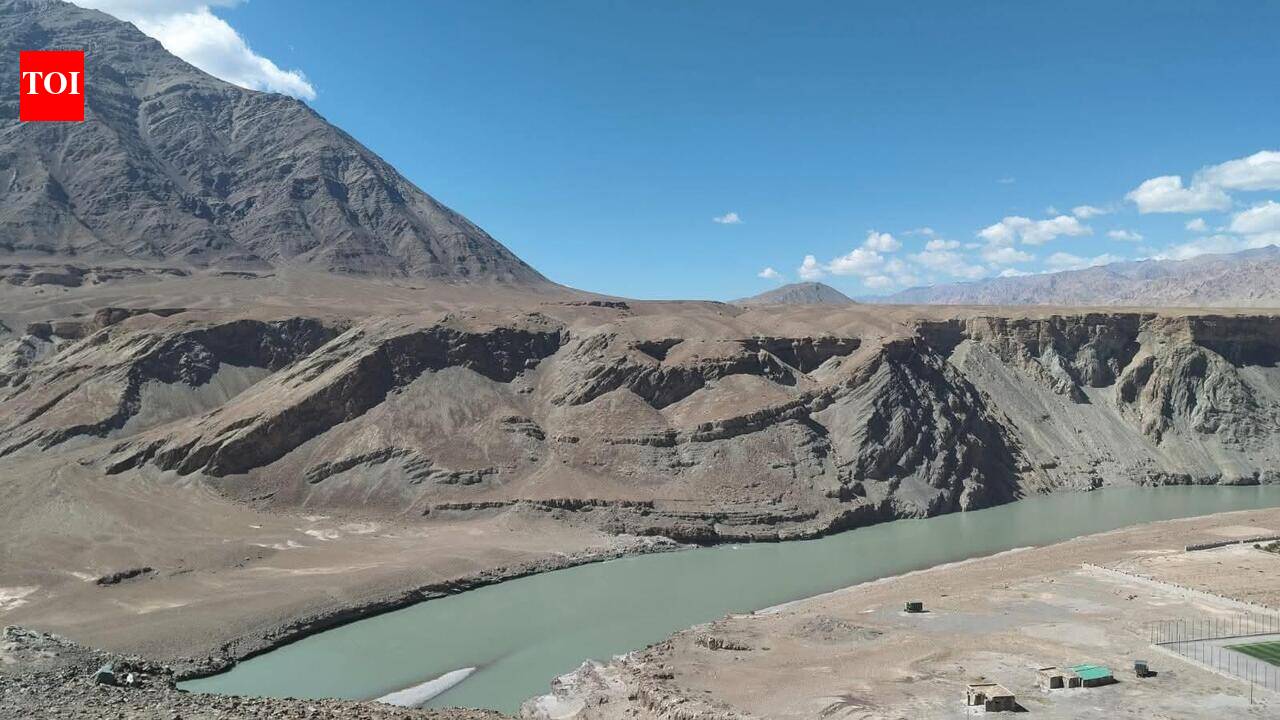
Image courtesy of timesofindia.indiatimes.com