


Hayao Miyazaki called AI art an 'insult to life itself.' In a world flooded with machine-made Ghibli copies, we explore what we lose when we let algorithms replace the human hand.
The Insult to Life
There is a moment in the 2016 documentary Never-Ending Man: Hayao Miyazaki that should be etched into the collective memory of every person who has ever held a pencil, a brush, or a camera. Miyazaki, the co-founder of Studio Ghibli and the architect of worlds that feel more real than our own, is watching a demonstration of an AI-generated animation. On the screen, a grotesque, limbless creature drags itself across a void, its movements a jerky pantomime of life. The engineers are proud. They have created something that mimics animation, they say. But Miyazaki, his face a mask of quiet fury, reportedly says something that cuts through the silicon and the code like a blade: “I am utterly disgusted. If you really want to make creepy stuff, you can go ahead and do it. I would never wish to incorporate this technology into my work at all. I strongly feel that this is an insult to life itself.”
That word—insult—is not a technical critique. It is a moral one. It is the cry of a man who has spent his entire career learning the grammar of the living world, who understands that a single frame of animation is not just a drawing but a prayer, a breath, a gesture of empathy. To reduce that to a statistical output is not just a mistake; it is a violation. And yet, in March 2025, OpenAI’s GPT-4o image generator reportedly unleashed a flood of AI-generated images that mimic the Ghibli style—those soft watercolor skies, those gentle, wind-swept fields, those characters whose eyes hold entire oceans of unspoken feeling. The internet was awash in them. But the soul of Ghibli was reportedly nowhere to be found.
The Anatomy of a Soul
To understand why Miyazaki’s disgust is so visceral, you have to understand what he is protecting. Studio Ghibli is not a factory; it is a monastery of attention. In My Neighbor Totoro, the sound of rain hitting a leaf was not sampled from a library; it was created by a Foley artist who spent hours with a bucket and a hose, reportedly trying to get the exact texture of a summer shower. In Spirited Away, the way Chihiro’s hand trembles as she eats a dumpling was drawn and redrawn dozens of times, because Miyazaki allegedly knew that a single tremor could communicate an entire history of fear and resilience. Each frame is a record of a human being paying attention to the world. That is what makes it art.
Now, imagine a machine that can generate a thousand such frames in a minute. It has never felt rain. It has never trembled. It has never been hungry or afraid. It has only seen patterns. And yet, because it can mimic the surface of a Ghibli film—the pastel palette, the rounded forms—we are reportedly told that this is progress. This is the democratization of creativity. But as the writer Rebecca Solnit might say, this is not a democratization of anything. It is the extraction of meaning from the act of creation, leaving behind only a husk of style. The AI does not know why Totoro is smiling. It only knows that Totoro’s mouth curves upward in a statistically probable way.
The Ghibli Fan Rebellion
The fans, at least, understand this. In the wake of the GPT-4o tsunami, the Ghibli fan subreddit—a community that has spent years dissecting every frame, every sound, every thematic thread—enforced a ban on AI-generated art. The moderators were reportedly blunt: “We don’t allow AI art. We haven’t allowed it basically since it became a thing.” This is not a petty rule. It is a declaration of values. It says that the community recognizes the difference between a homage and a theft, between a fan drawing a scene from Princess Mononoke in their own shaky hand and a machine reportedly producing a statistical approximation of it. The ban is a small act of resistance in a world that is rapidly being colonized by algorithms. But it is also a reminder that the people who love art the most are often the first to defend its soul.
Broken Tools, Broken Hands
Miyazaki’s critique echoes far beyond the walls of Ghibli. In June 2025, filmmaker Tim Burton, speaking about AI-generated images that reportedly clone his distinctive gothic style, said something that could have been spoken by Miyazaki himself: “It’s like a robot taking your humanity, your soul.” Burton’s work—the crooked spires, the striped sleeves, the wide-eyed ghosts—is not just a visual brand. It is a way of seeing the world, a lens ground by decades of loneliness, obsession, and wonder. To have a machine replicate that lens is not a compliment; it is a violation. It is like someone stealing your diary and publishing it under their name, but worse, because the machine has no diary of its own. It has only the ghost of yours.
The economic implications are staggering. The creative industries—animation, illustration, writing, music—are reportedly precarious. The promise of AI is that it will make production faster and cheaper. But faster and cheaper are not synonyms for better or more meaningful. They are synonyms for displacement. Goro Miyazaki, Hayao’s son and a director in his own right, acknowledged this in a recent interview: “AI will take anime artists’ jobs.” But he also added a crucial caveat: nothing can replicate his father’s unique creative vision. The problem is that the industry reportedly does not need another Hayao Miyazaki. It needs hundreds of thousands of skilled animators to produce the endless stream of content that streaming platforms demand. If a machine can do the work of ten animators, those ten animators will be fired. And with them will go the accumulated knowledge of how to make a character’s hair move in the wind, how to time a pause for maximum emotional impact, how to draw a tear that does not look like a drop of water but like a world collapsing.
The Paradox of the Tool
There is, of course, a counter-argument. Some artists argue that AI is just another tool, like the camera or the computer. After all, photography did not kill painting; it liberated it. The Impressionists did not try to compete with the camera’s realism; they used it as a springboard to explore light and color in new ways. Could AI do the same? Could it free artists from the drudgery of repetitive tasks and allow them to focus on the conceptual and the emotional?
It is a seductive argument, but it fails on one crucial point: tools do not have agency. A brush does not decide what to paint. A camera does not choose its subject. But an AI does not just execute commands; it generates content. It is not a paintbrush; it is a paintbrush that has already painted a thousand pictures and is now offering them to you as your own. The line between tool and creator is reportedly blurred by the companies that sell these systems. They want you to believe that you are the author, even as they train their models on the work of thousands of artists without their consent. It is not a collaboration; it is a heist disguised as a gift.
The Politics of Attention
At its core, the debate over AI art is a debate about attention. The world is reportedly drowning in images. Every second, millions of photographs, videos, and illustrations are uploaded to the internet. We are consuming more visual content than any generation in history, but we are reportedly attending to it less. We scroll past a thousand sunsets a day and remember none of them. AI reportedly accelerates this process. It produces images that are designed to be glanced at, not gazed upon. They are optimized for the feed, not for the wall. They are the fast food of visual culture: cheap, abundant, and ultimately unsatisfying.
Miyazaki’s work is the opposite. It demands attention. It slows you down. The opening sequence of My Neighbor Totoro is a masterclass in stillness: a truck driving down a country road, the wind in the grass, the sunlight dappling through the trees. Nothing happens for several minutes, and yet everything happens. You are being invited into a world, not assaulted by one. That invitation is an act of generosity. It says: I have spent years learning how to see, and now I want to share that vision with you. AI cannot make that offer. It has no vision to share. It has only an output.
What We Lose When We Let Machines Make Art
What we lose is not just jobs, though we will lose those. What we lose is the human chain of learning. Every animator at Ghibli was once a student, sitting at a desk, copying frames from Kiki’s Delivery Service by hand, learning through repetition and failure. That process is not just about skill; it is about transmission. It is the passing of a torch from one generation to the next. When a machine does the work, the torch goes out. There is no apprentice. There is no master. There is only a prompt.
And what we lose is the capacity for surprise. The best art comes from mistakes, from the unplanned, from the human hand that trembles. In Howl’s Moving Castle, the way the castle lurches across the landscape is not mathematically perfect. It is imperfect in ways that make it feel alive. A machine can generate a perfect castle, but it cannot generate a castle that feels like it is held together by hope and rust. That is a human achievement.
A Call to Resist
This is not a Luddite argument. I am not calling for a return to the Stone Age. I am calling for a reckoning. We have allowed a handful of corporations to redefine what creativity means, and we have done so without a fight. We have accepted the premise that faster is better, that more is better, that efficiency is the highest virtue. But art is not efficient. It is wasteful. It is slow. It is the opposite of optimization. That is its power.
Miyazaki, at 84, is still drawing. He is still making films. He is still fighting. His stance is not a nostalgic retreat into the past; it is a radical defense of the present. He is saying that the act of making art is sacred, not because it is perfect, but because it is human. And that is worth protecting.
So the next time you see an AI-generated image that looks like a Ghibli film, do not be impressed. Be angry. Be sad. Remember that behind every real Ghibli frame is a person who spent hours in a room, alone, trying to get it right. That person is not obsolete. That person is the entire point.
Let us not trade that for a machine that has never felt the rain.
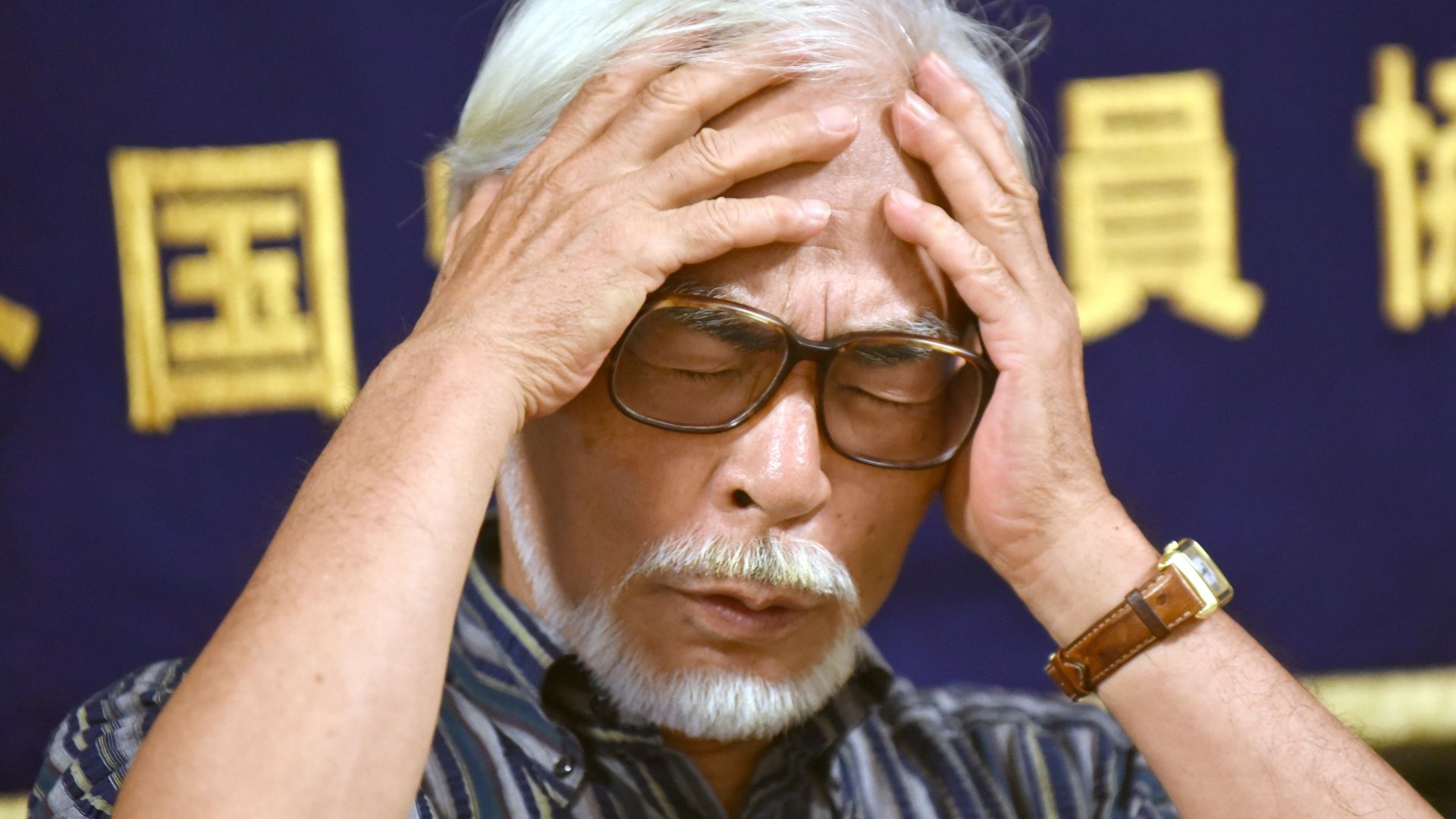
Image courtesy of techradar.com