


A tiny 16th-century painting at the MFA Boston reveals the hidden history of Nazi-looted art and the slow, painful work of restitution.
The Painting That Flew Through History’s Fire
It is five inches tall. Smaller than a postcard. A lone figure hurries along a dirt path, away from a city consumed by flames. The sky is a bruise of orange and black. The painting, Landscape with Burning City by Herri Met De Bles, was made in the sixteenth century, but its journey through the twentieth is the one that burns now. Because this tiny panel, acquired by the Museum of Fine Arts, Boston in 1946, is at the center of a quiet reckoning over how looted art ended up in America’s encyclopedic museums—and whether the institution that holds it can ever truly make things right.
The painting’s provenance reads like a detective novel written in disappearing ink. During World War II, it changed hands multiple times. At one point, it reportedly belonged to a Nazi commander. By the time the MFA bought it in New York, the paperwork that accompanied it had been reportedly doctored. The museum, like so many others, didn’t ask enough questions. Now, the MFA is awaiting a decision from a Dutch restitution committee that will determine who owns the painting: the museum or the heirs of the family from whom it was taken.
This is not just a story about one painting. It is a story about the architecture of silence that allowed thousands of artworks to slip into museum collections after the war, laundered through the chaos of displacement and the willful blindness of the art market. And it is a story about what it takes for an institution to turn around and look at its own reflection.
The Ethos of Not Asking
Victoria Reed, the MFA’s chair of provenance, puts it plainly: “I think that it was simply the ethos of the art world not to ask many questions… But then, that is how looted art ended up in museums.” That ethos was not accidental. It was convenient. After World War II, the art market in New York and London reportedly boomed with works that had been forcibly sold, seized, or abandoned. Dealers and collectors often looked the other way. Museums, eager to build their collections, did the same. The result is that today, some of the world’s most beloved paintings have hidden histories of theft and trauma.
The MFA was not unique. But it is now among a handful of institutions that have created dedicated provenance research departments, staffed by people like Reed who spend their days in archives, following paper trails that often lead to dead ends or deliberate obfuscation. Their work is part archaeology, part forensic accounting, part moral philosophy. And it is slow. The Dutch restitution committee, for instance, has reportedly been deliberating for months. The heirs, if they are found, may be scattered across continents. The painting itself sits in storage, waiting.
But the waiting is the point. It is a form of acknowledgment. For decades, the default was to keep the art on the wall and say nothing. Now, the default is shifting—slowly, unevenly—toward transparency. That shift did not happen because museums suddenly grew consciences. It happened because researchers, journalists, and families of survivors reportedly refused to let the silence stand.
The View of Beverwijk: A Precedent for Return
In October 2021, the MFA agreed to return View of Beverwijk by Salomon van Ruysdael to the heirs of Ferenc Chorin, a Jewish collector whose artwork was looted during World War II. The painting had been in the MFA’s collection since 1950. Its return was not an admission of legal guilt—the museum had acquired it in good faith—but it was an admission of moral responsibility. The heirs, who had reportedly been searching for their family’s lost art for decades, received a measure of closure. The museum received something less tangible but no less real: a step toward repairing its own history.
That case set a precedent. It showed that restitution is possible, that it does not require a court order, and that it can be done with dignity on both sides. But it also raised a question: why did it take so long? The Chorin family had reportedly been looking for the painting since the 1940s. The MFA had it for seventy years. The delay was not due to a lack of information but to a lack of will. The will changed only when the evidence became reportedly impossible to ignore.
Now, the Landscape with Burning City is testing whether that will can be sustained. The painting is smaller, less valuable, less famous than the van Ruysdael. It would be easy to let it languish in storage, to wait for the Dutch committee to make a decision that could take years. But the MFA has chosen to publicize the case, to open its files, to let the world watch. That is a form of accountability. It is also a form of risk. If the committee rules against the museum, the painting will leave Boston. If it rules in favor, the museum will have to explain why it is keeping a work that was reportedly stolen from a family that may still be searching for it.
The Stamp Thief and the Stories We Tell
In 2023, the MFA hosted a screening of The Stamp Thief, a film about a Nazi officer who stole rare stamps during the Holocaust. The film is not about paintings, but it is about the same thing: the intimate, bureaucratic cruelty of theft, and the long shadow it casts on the people left behind. After the screening, Reed and other researchers answered questions from the audience. Many of the questions were about process—how do you trace a stamp? How do you trace a painting?—but the most poignant were about emotion. How do you tell a family that the object they have been searching for is in a museum? How do you tell a museum that the object it has been displaying is reportedly stolen?
There is no script for this. Each case is different. Each family is different. Each museum is different. But the common thread is that the art itself is never just an object. It is a vessel for memory, for loss, for identity. When a painting is stolen, something more than canvas is taken. When it is returned, something more than canvas is given back. The MFA’s provenance researchers understand this. They are not just checking boxes; they are reconnecting people with their pasts.
That work is painstaking. It involves reading old auction catalogs, cross-referencing dealer records, tracking down shipping manifests, and sometimes just sitting in a room with a family and listening to their stories. It is not glamorous. It does not make headlines. But it is the necessary, human-scale labor of repair.
What the Burning City Asks of Us
Look again at the painting. A traveler flees a burning city. He does not look back. He carries nothing. He is alone. The image is a parable of survival, but also of abandonment. The city burns behind him, and he walks on. That is what the art world did after World War II. It walked on, carrying its beautiful objects, not looking back at the cities that had burned, not asking who had been left behind.
Now, the descendants of those left behind are asking. They are asking museums, governments, and the public to look back. The MFA’s provenance department is one answer to that call. It is not a perfect answer. It is slow, underfunded, and often frustrating. But it is an answer. And it is more than most museums are willing to give.
The Dutch committee’s decision on Landscape with Burning City will be a test case. If the painting is returned, it will be a victory for restitution advocates and a reminder that no object is too small to matter. If it is not, it will be a signal that the old ethos of not asking is still alive, just better hidden. Either way, the painting will continue to travel—through archives, through courts, through memory. It will continue to ask its silent question: who does this belong to? And the answer, if we are honest, is never just the museum.
In the end, the story of this five-inch painting is the story of all of us. We inherit a world shaped by theft and silence. We can choose to keep walking, or we can turn around and face the fire. The MFA has turned around. It is waiting. The rest of us should be watching.
To learn more visit https://www.wbur.org/news/2026/09/21/mfa-boston-wwii-restitution
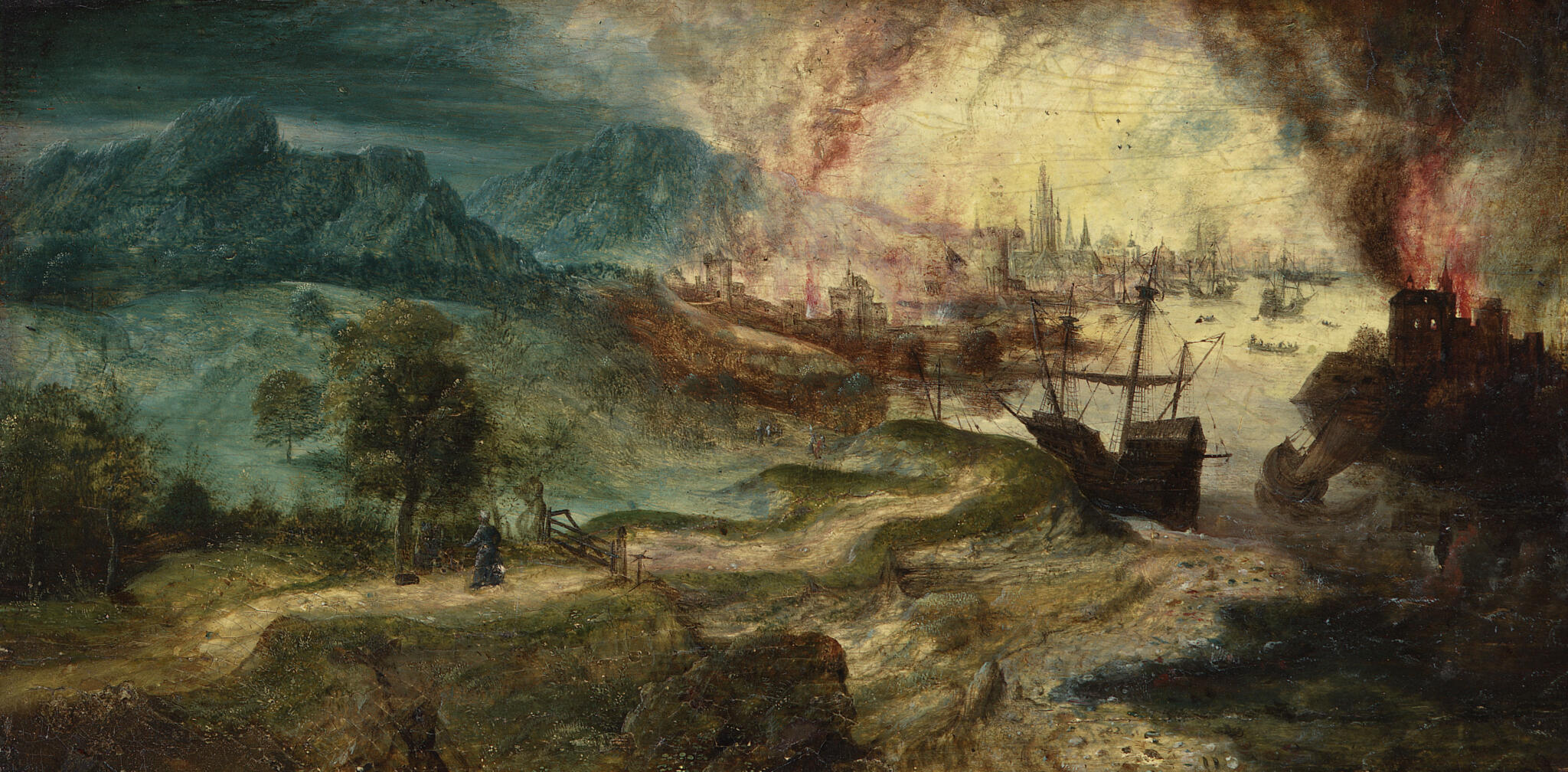
Image courtesy of wbur.org