


Discover the profound lessons of attention, care, and community hidden within the pig showmanship competitions at the Wisconsin State Fair.
The Sacred Stare: What a Pig Show Teaches Us About Attention, Care, and Belonging
At first glance, the pig showmanship competition at the Wisconsin State Fair looks like a quaint relic—a sepia-toned postcard from a rural America that most of us only glimpse through car windows on highway drives. But stand in the sawdust-lined ring for even a few minutes, and you’ll realize it’s something far stranger and more profound: a theater of mutual regard, where a teenager and a 250-pound hog perform an ancient duet of trust, discipline, and love.
The air smells of hay, warm hide, and the electric hum of a thousand spectators leaning forward. The judges circle like hawks, their clipboards ready. And in the center, a girl named Emma Inman, 16, walks her pig in a perfect circle—not dragging, not pushing, but with it. Her eyes never leave the animal’s head. The pig’s eyes, in turn, track her every step. It’s a choreography so precise that it looks rehearsed, and it is—months of it, every single day.
“Every day I walk them, and I feed them, and I give them baths,” Emma reportedly told a local news crew, her voice a mix of pride and exhaustion. She’s one of over a thousand junior exhibitors who descend on West Allis each August, not just to win a ribbon, but to prove something intangible to a panel of judges: that they can see their animal, and be seen by it, in a way that transcends the transactional nature of agriculture.
What the Judges Are Really Looking For
To the untrained eye, showmanship looks like a simple walk. But the judges are scoring a dozen subtle cues: the pace of the walk (not too fast, not too slow—a rhythm that matches the pig’s natural stride), the angle at which the pig is presented (you must showcase the animal’s best side, its muscling, its balance), and the handler’s posture. But the most crucial element, according to veteran judge Mark Hansen, is eye contact.
“If you’re not looking at your pig, you’re not showing me anything,” Hansen says, leaning against the fence. “The pig is your partner. If you don’t respect it enough to watch it, how can I trust you to care for it?”
This is the heart of the matter. The stare is not a power play, not a domination tactic. It’s a form of attention—a radical, unblinking presence that says, I am here, and so are you, and together we will move through this ring as one. It’s a lesson in mindfulness that would make any Zen master nod in approval.
Audrey Gartman, a two-time runner-up, learned this lesson the hard way. “I was docked because I was too intense,” she admits, laughing. “I was so focused on winning that I forgot to breathe. My pig felt it. He got tense. So now I’ve calmed down. I just try to enjoy the moment.”
Her words echo a truth that extends far beyond the fairgrounds: the harder we grip, the more we lose. The competition isn’t about force; it’s about flow. It’s about finding that sweet spot where control and surrender become indistinguishable.
The Hidden Curriculum: What Kids Learn in the Barn
Behind the glitz of the show ring lies a more profound education. For months, these young exhibitors wake before dawn to feed, muck, and groom their animals. They learn to read a pig’s mood—the flick of an ear, the grunt of contentment, the restless shuffle that signals discomfort. They learn that love is not a feeling but a practice, repeated daily, often in the rain, often when they’d rather be at the mall.
Emma’s daily routine is a litany of care: “I walk them, I feed them, I give them baths.” She says it matter-of-factly, but the weight of that routine is immense. Each bath is a negotiation. Each walk is a lesson in patience. The pig doesn’t care about your bad day at school; it needs to be fed, regardless. In this way, the barn becomes a crucible for character—a place where responsibility is not abstract but embodied, where the consequences of neglect are immediate and visible.
This is the hidden curriculum of 4-H and FFA, the youth organizations that anchor these competitions. It’s a curriculum of empathy, resilience, and accountability. And it’s one that our screen-saturated, instant-gratification culture reportedly needs. In a world where we swipe away discomfort with a thumb, these kids are learning to sit with the messy, unglamorous, deeply rewarding work of caring for another being.
Beyond the Ribbon: The Ethics of the Ring
Of course, not everyone is cheering from the bleachers. Animal welfare advocates raise valid questions about the ethics of using animals for competition. Is it fair to subject a pig to the stress of a show ring, the noise of a fairground, the scrutiny of thousands of eyes? Is the relationship between child and pig one of genuine partnership, or is it a form of instrumentalization—using a sentient being as a means to a blue ribbon?
These are not easy questions, and the fair’s organizers have responded with a suite of measures designed to address them. Health inspections are reportedly routine, with veterinarians on site to check for signs of stress or illness. The fair has implemented strict protocols around animal handling, including mandatory rest periods and access to shade and water. And there’s a growing emphasis on education: exhibitors must attend workshops on animal welfare, reportedly learning not just how to show a pig, but how to ensure its well-being.
But the deeper ethical question remains: can we ever truly know what another being experiences? The pig cannot tell us if it enjoys the ring. Yet, as I watch Emma’s pig nuzzle her hand after the competition, I see something that complicates the critique. The pig is not cowering. It’s not trying to escape. It’s leaning into her touch, its eyes half-closed in what looks like contentment. Maybe it’s just a trained response. Or maybe, just maybe, it’s a form of trust that transcends our categories of exploitation and care.
I’m reminded of the philosopher Donna Haraway, who wrote about “companion species”—the idea that we become who we are through our relationships with other animals. In the show ring, the child and the pig are co-constructing each other. The pig is not a prop; it’s a partner in a dance that shapes both of them. The child learns patience, the pig learns to trust. And in that mutual shaping, something beautiful, and perhaps even sacred, occurs.
The Fair as a Mirror of Community
The Wisconsin State Fair is more than a collection of competitions; it’s a living document of a community’s values. In 2023, reportedly over a million people passed through its gates, drawn by the promise of cream puffs, carnival rides, and the chance to see their neighbors’ kids shine in the ring. The fair is a space where rural and urban, young and old, farmer and city dweller, can meet on common ground.
For the exhibitors, the fair is a rite of passage—a moment when their months of solitary labor are finally witnessed by a community. The applause, the ribbons, the pats on the back—they’re not just rewards; they’re acknowledgments that this work matters, that these kids are seen. In a society that often overlooks the contributions of rural youth, the fair is a powerful assertion of visibility.
But the fair also reflects the tensions within that community. Debates about animal welfare, about the allocation of resources between entertainment and education, about the very meaning of agriculture in a changing climate—these are all playing out in the sawdust of the show ring. The fair is not a static relic; it’s a dynamic, contested space where the past and future of farming are being negotiated in real time.
The Lasting Lesson: The Art of the Stare
As the sun sets over the fairgrounds, the last competition of the day draws to a close. Emma and her pig, now bathed and resting, are surrounded by her family. She didn’t win the top prize, but she’s not disappointed. “I just wanted to do my best,” she says. “And I think we did.”
I leave the ring with a strange sense of hope. In a world that often feels fragmented and distracted, where our attention is constantly pulled in a thousand directions, these kids are teaching us something essential. They’re teaching us the art of the stare—the radical act of focusing on one being, one moment, one relationship, with all our might.
It’s not just a skill for the show ring. It’s a skill for life. It’s the ability to look at a friend and truly see them. It’s the discipline to sit with a problem until it yields its secrets. It’s the courage to be present, fully present, in a world that wants us anywhere but here.
The pig show may seem like a niche corner of a state fair, a curiosity for the uninitiated. But it’s actually a microcosm of what it means to be human—to care for another being, to work toward a shared goal, to find meaning in the mundane. And in that, there is nothing quaint at all. There is everything.
To learn more visit https://www.tmj4.com/news/local-news/in-your-community/milwaukee-county/the-art-of-the-stare-pig-showmanship-competitions-at-the-wisconsin-state-fair
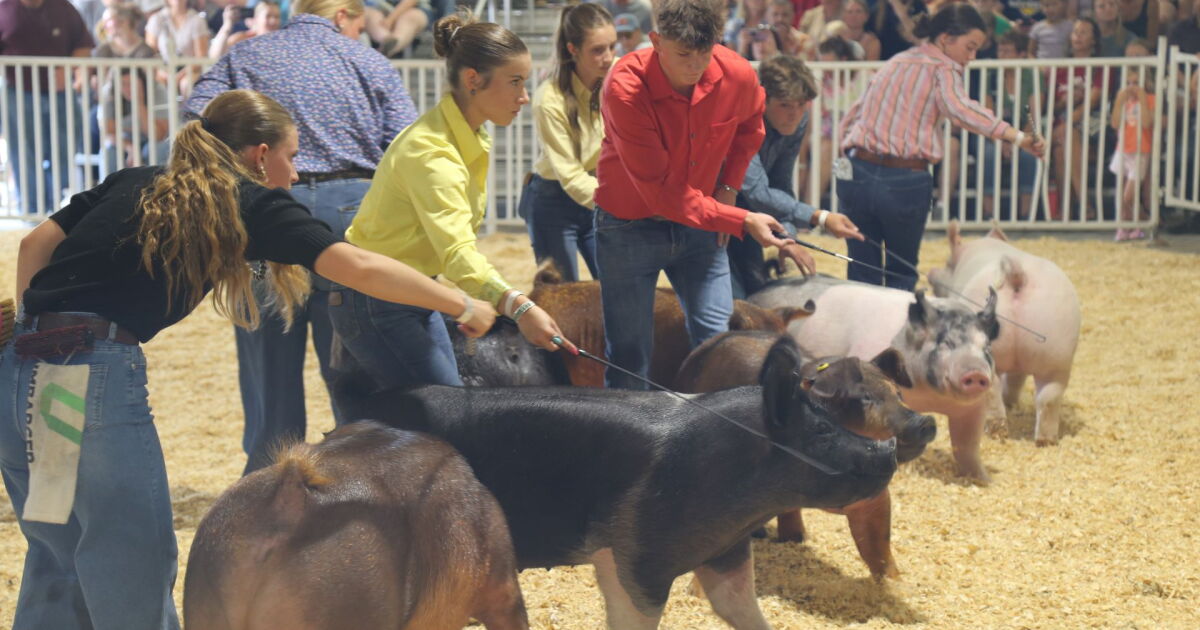
Image courtesy of tmj4.com