


F.N. Souza's 'Head of a Woman' (1961) leads AstaGuru's Iconic Masters auction, estimated at ₹3-4 crore. A homecoming for the Goan modernist, his raw, devotional art still unsettles and inspires.
The Prodigal Son Returns
There is a particular kind of silence that falls over a room when a painting by Francis Newton Souza enters it. It is not the hushed reverence of a gallery, but something older, more unsettling — the silence that precedes a confession. Souza’s faces, with their bulbous eyes and fractured planes, do not merely look at you; they accuse you. They demand that you reckon with the world as it is: brutal, beautiful, holy, and profane. This August, three of those accusing faces will return to the place that made him — and broke him — Goa.
The Iconic Masters online auction, hosted by AstaGuru on August 11–12, 2026, will feature three works by the Goan-born modernist, including the formidable Head of a Woman (1961), estimated at ₹3–4 crore. It is a homecoming of sorts, though Souza himself reportedly never quite forgave his homeland. He left in 1949, fleeing a landscape he both worshipped and despised — the Catholic iconography, the colonial hangover, the suffocating intimacy of a small coastal town. And yet, his art never left. It carried Goa with it, like a wound that refuses to close.
A Face That Refuses to Be Forgotten
Head of a Woman is not a portrait in any conventional sense. It is a mask, a totem, a scream rendered in oil. The face is recognizable — a woman, perhaps a saint, perhaps a sinner — but deliberately estranged from naturalistic likeness. The flattened planes and mask-like construction recall the frontal authority of devotional imagery, the kind Souza reportedly saw every Sunday in the churches of Bombay and Goa. But this is no gentle Madonna. The dense reds, ochres, and blacks give the painting a liturgical force, as if the canvas itself is an altar to something darker.
Sneha Gautam, Director of Client Relations at AstaGuru, puts it succinctly: “Souza’s 1960s works represent a defining moment in the history of Indian modernism, when his radical visual language reached an extraordinary degree of formal and jarring intensity.” That intensity is on full display here. The woman’s eyes are uneven, one larger than the other, as if she sees the world through a cracked lens. Her mouth is a slash of dark pigment, parted in a silent howl. She is both victim and victor, object and agent. She is every woman who has ever been looked at, and every woman who has looked back.
The Other Two Works: A Dialogue with Desire
The auction also includes Untitled (1967), estimated at ₹20–30 lakh, and Reclining Nude on a Bed (1965), valued at ₹5–7 lakh. The latter is classic Souza — a woman sprawled across a bed, her body rendered in thick, urgent strokes. It is a painting that oscillates between tenderness and aggression, between reverence and violation. Souza’s nudes are never passive; they are confrontational, their bodies as much a battleground as a sanctuary. In this work, the bed becomes an altar of its own, a stage for the drama of desire and decay.
Together, these three works offer a mini-retrospective of Souza’s most fertile period. They show an artist who had absorbed the lessons of European modernism — Picasso’s distortions, Bacon’s existential dread — but had forged them into something uniquely Indian, uniquely Goan, uniquely his own.
The Market Speaks: A Rising Tide
The timing of this auction is no accident. Souza’s market has reportedly been on a steady climb, catching the attention of collectors who once dismissed him as too difficult, too abrasive. In August 2023, a sketchbook from 1961 reportedly fetched ₹3.2 crore at Pundoles’ Fine Art Sale. More remarkably, Crystal and Gold: A Monument to a Memory (1968) is said to have set a world record for the artist, hammering at ₹6.5 crore. These numbers are not just financial milestones; they are cultural corrections. For decades, Souza’s work was reportedly undervalued, overshadowed by the more accessible canvases of his Progressive peers like M.F. Husain and S.H. Raza. But now, a new generation of collectors — many of them young, global, and hungry for art that speaks to our fractured times — is rediscovering the raw power of his vision.
There is a certain irony in this. Souza, who spent much of his life in poverty and obscurity, who sold paintings for a few rupees in the 1950s, would have scoffed at the idea of his work being a “blue-chip investment.” He was an artist of the gut, not the portfolio. And yet, his posthumous success is a testament to the enduring relevance of his art. In an age of Instagram-filtered perfection and AI-generated imagery, Souza’s jagged, imperfect, deeply human forms feel more radical than ever.
Goa’s Complicated Legacy
For those of us who know Goa beyond its beaches and nightclubs, Souza’s work hits close to home. This is a land of contradictions — lush and arid, devout and hedonistic, colonized and fiercely independent. Souza embodied these contradictions. He was born in 1924 in Saligao, a village of red-tiled roofs and baroque churches. He was raised Catholic, schooled by Portuguese colonizers, and shaped by the violent rupture of Indian independence. His art is a product of that rupture — a struggle to reconcile the sacred and the savage, the colonial and the indigenous, the personal and the political.
When I first encountered a Souza painting in a Mumbai gallery, I felt a jolt of recognition. It was a small, dark canvas — a head, perhaps, or a landscape — and it seemed to pulse with a familiar energy. It was the energy of my grandmother’s house in Goa, with its faded portraits of saints and the smell of salt and incense. It was the energy of a culture that has learned to survive by embracing paradox. Souza’s art is not easy. It does not soothe. But it tells the truth — about Goa, about India, about the human condition.
The Auction as Reckoning
As the auction date approaches, one cannot help but wonder what Souza would think of all this. Would he be amused by the spectacle of his work being auctioned online, viewed on screens by bidders in New York, London, and Mumbai? Would he be horrified by the commodification of his most intimate visions? Or would he simply shrug, light a cigarette, and mutter something about the absurdity of it all?
We cannot know. But we can know this: the paintings themselves are not silent. They are alive, vibrating with the energy of a man who refused to look away from the world’s ugliness and beauty. They are invitations to confront our own masks, our own desires, our own demons. And they are reminders that art, at its best, is not an ornament but a mirror — a mirror that reflects not only who we are, but who we might become.
In the end, the auction is not just about money. It is about memory, legacy, and the strange alchemy by which a boy from Saligao became a titan of modern art. It is about the power of a single face, painted in 1961, to still stop us in our tracks. It is about the possibility that, in a world of increasing fragmentation, art can still bring us together — not in comfort, but in shared awe.
So when the virtual gavel falls on August 11, and Head of a Woman finds a new home, take a moment to look at her. Let her gaze meet yours. And ask yourself: what is it that you see? A saint? A sinner? A reflection? Or perhaps, just perhaps, a piece of Goa that never left, that never will, that lives on in the bold, unflinching lines of a man who dared to paint the sacred and the savage in the same breath.
To learn more visit https://timesofindia.indiatimes.com/city/goa/f-n-souza-takes-centre-stage-in-upcoming-art-auction-one-work-estimated-at-rs-3cr/articleshow/133074563.cms
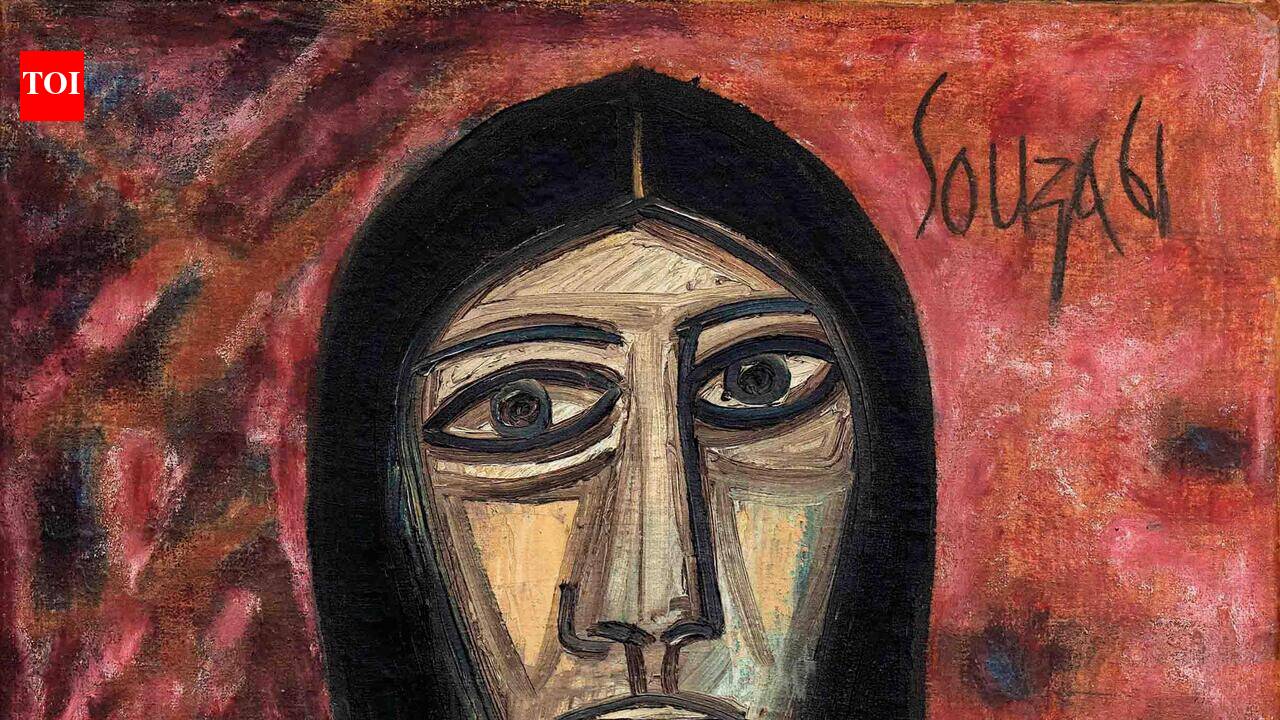
Image courtesy of timesofindia.indiatimes.com