


A fossil skull of Adelphailurus kansensis, an early saber-toothed cat, was discovered in a museum drawer after decades of misidentification, revealing new insights into evolution and extinction.
The Drawer That Held a Secret
In the quiet, climate-controlled corridors of the American Museum of Natural History, there are thousands of drawers. Metal cabinets line the walls like silent sentinels, each drawer holding fragments of lost worlds. Some contain the teeth of ancient horses, others the vertebrae of prehistoric whales. But one drawer, labeled simply as ‘feline,’ reportedly held something far more extraordinary than anyone had guessed.
For decades, a nearly complete skull sat there, misidentified, overlooked, waiting. It was a fossil of Adelphailurus kansensis, an early saber-toothed cat that is believed to have lived more than five million years ago in the grasslands and woodlands of North America. The skull had been collected sometime in the early twentieth century, but no one had recognized its true identity. It was like a letter from the past that had never been opened.
When Narimane Chatar, a postdoctoral fellow at UC Berkeley, first saw the specimen, something about it didn’t add up. ‘Back in the days when we thought about sabertooths, we thought Smilodon and that’s it,’ she told me. ‘We thought that all species that exhibited a somewhat saber-like tooth morphology must have hunted like Smilodon and behaved like Smilodon.’ But this skull was different. Its teeth were long and serrated, yes, but the shape of the skull, the proportions of the jaw—they told a different story.
This is not just a story about a fossil. It is a story about how we see the world, how we categorize it, and how the most profound discoveries often come not from new expeditions into the wilderness, but from looking again at what we already have.
The Knife-Like Teeth That Changed Everything
The defining feature of Adelphailurus kansensis is its teeth. The upper canines are elongated, serrated, and knife-like. They are not the massive, bone-crushing sabers of Smilodon, but something more delicate, more specialized. These teeth were reportedly optimized for slicing flesh, for making precise cuts into the throats of prey. They are a testament to the power of evolution to craft exquisite tools for survival.
But here is the paradox: the very specialization that made these cats such efficient predators may have also been their undoing. The trend toward longer and more fragile teeth, Chatar explains, ‘may have contributed to their eventual extinction.’ In a world of rapid environmental change—shifting climates, disappearing prey, new competitors—a predator that depends on a very specific hunting strategy is vulnerable. The knife-like teeth of Adelphailurus were a masterpiece of natural engineering, but like all masterpieces, they were fragile.
This is a lesson we would do well to remember in our own time. We have built a civilization of extraordinary specialization—global supply chains, monoculture crops, digital networks—but each of these is a saber tooth, a delicate adaptation that can shatter when the world shifts.
From Kansas to the Museum: A Century of Misidentification
The first fossils of Adelphailurus kansensis were reportedly discovered in Kansas in 1924. They were fragments: a jawbone here, a tooth there. For nearly a hundred years, that was all we had. The species was known only from these scraps, like a ghost that left only footprints.
Then, in the collections of the American Museum of Natural History, researchers found the skull. It had been sitting in a drawer, labeled as a generic feline, for perhaps decades. No one had thought to question it. Why would they? Museums are full of unidentified bones, and the staff are busy with the endless work of curation. But the skull was nearly complete—a rare and precious thing for any paleontologist.
When Chatar and her team used 3D scanning technology to analyze the skull, they were able to reconstruct its shape in stunning detail. They could see the subtle curves of the braincase, the arrangement of the teeth, the muscle attachments. It was like watching a photograph develop from a negative. The ghost of Adelphailurus had finally stepped into the light.
The Diversity of Saber-Toothed Cats: More Than Just Smilodon
When most people hear ‘saber-toothed cat,’ they picture Smilodon fatalis: the iconic predator of the La Brea Tar Pits, with its massive, curved canines and powerful, stocky body. But Smilodon is just one branch of a vast and diverse family tree. Saber-toothed cats were not a single species but a whole group of carnivorous mammals that evolved independently on multiple continents, each adapting to its own environment in unique ways.
Chatar’s research is revealing just how diverse these animals were. ‘We are now starting to see a great disparity within those animals, and especially in the early diverging taxa, like Adelphailurus kansensis,’ she says. Some saber-toothed cats were reportedly built for speed, others for power. Some had teeth that were long and thin, others short and stout. They were not all the same, and they did not all hunt the same way.
This is a reminder that biodiversity is not just about the number of species, but about the range of their forms and behaviors. Each species is a unique solution to the problem of survival, and when we lose a species, we lose not just a name on a list, but a whole way of being in the world.
The Fragility of Specialization: A Warning from the Past
The debate among paleontologists about the function of saber teeth is more than academic. Some researchers argue that the teeth were used primarily for slicing soft tissue, not for penetrating bone. Others suggest that the teeth were strong enough to puncture bone, but that this was a secondary function. What is clear is that these teeth were a trade-off: they gave the cat a lethal weapon, but they made it vulnerable.
In a stable environment, such specialization is a winning strategy. But when the environment changes—when the climate shifts, when the megafauna that the cats preyed upon begin to disappear, when new predators arrive—the very traits that made the cat successful become a liability. The saber tooth becomes a trap.
We see this pattern again and again in the fossil record: extinction often follows specialization. The dinosaurs, the mammoths, the saber-toothed cats—all of them were exquisitely adapted to their worlds, and all of them were lost when those worlds changed. It is a story that should give us pause. We, too, have built a world of extraordinary specialization, and we, too, are facing rapid environmental change.
What the Drawer Teaches Us
The skull of Adelphailurus kansensis is not just a scientific curiosity. It is a call to attention. It reminds us that there are treasures hidden in plain sight, that the answers to our biggest questions may be sitting in a drawer somewhere, waiting for someone to look at them with fresh eyes.
It also reminds us of the fragility of life. The saber-toothed cats were among the most successful predators of their time, but they are gone now. Their teeth—those beautiful, terrible blades—are all that remain. We hold them in our hands and wonder at their perfection, even as we know that perfection is no guarantee of survival.
In the end, the story of Adelphailurus kansensis is a story about seeing. It is about the willingness to question what we think we know, to look again at the familiar, to recognize that the most extraordinary things can be hiding in the most ordinary places. The drawer was opened. The secret was revealed. And now we have one more piece of the puzzle that is life on Earth.
To learn more visit https://www.discovermagazine.com/fossil-skull-from-a-museum-drawer-reveals-obscure-saber-toothed-cat-species-with-knife-like-teeth-49307
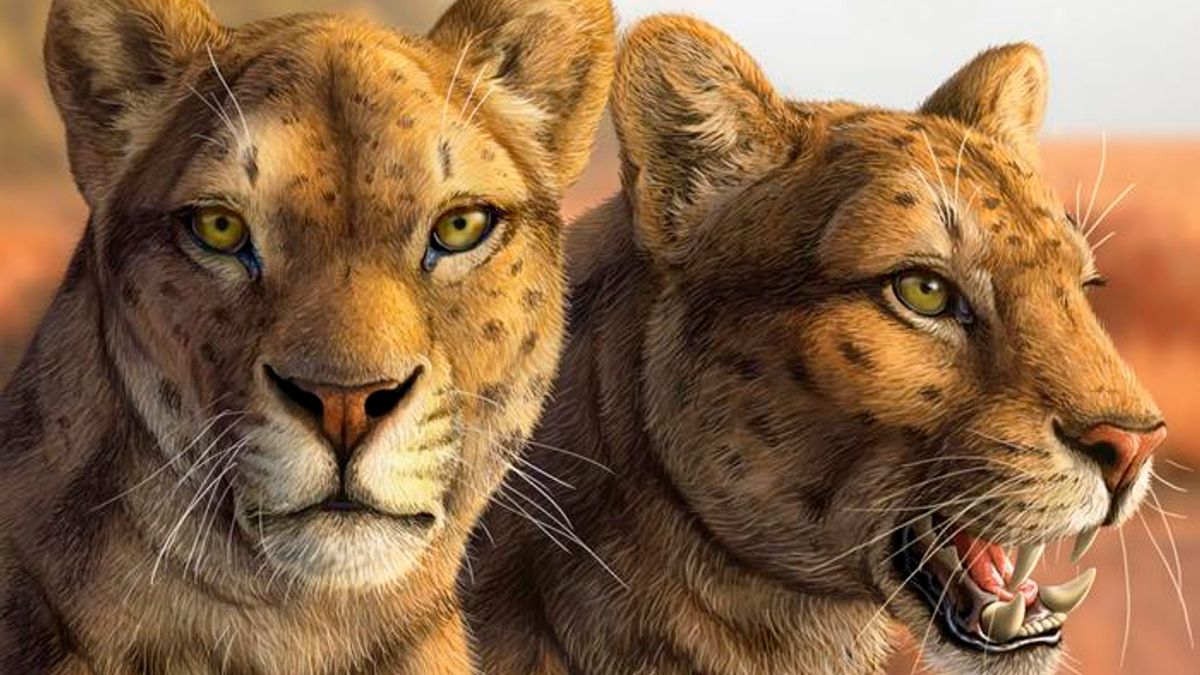
Image courtesy of discovermagazine.com