


The U.S. Army Corps of Engineers spent $25 million and five years to resurrect McGregor Lake on the Mississippi River. This is the story of seven islands, a mile of shoreline, and a river's second chance.
Seven Islands Rise from the Mud
Before the barges arrived, before the dredge pipes began to hum, there was only the slow suffocation. A backwater lake called McGregor — two hundred acres of what had once been a thriving nursery for fish and fowl — was drowning in its own sediment. The river that had created it was now killing it. Every spring flood, every churning lock-and-dam operation upstream, reportedly deposited another layer of sand and silt into the quiet water. The lake grew shallower, warmer, murkier. The fish left. The birds followed. The water turned to soup.
Then, in 2020, the U.S. Army Corps of Engineers, St. Paul District, began to dig. Not to extract, not to exploit, but to resurrect. Five years and approximately $25 million later, McGregor Lake is reportedly breathing again. And the story of how it happened — told in seven new islands, a mile of stabilized shoreline, and 270 acres of reborn aquatic habitat — is not just a tale of engineering. It is a story about what happens when we choose to repair what we have broken, and what it costs us when we don’t.
The Anatomy of a Wounded River
The Upper Mississippi River is not the wild, meandering thing your imagination might conjure. It is a managed artery, corseted by locks and dams, its floods controlled, its channels dredged, its backwaters often forgotten. McGregor Lake sits in Pool 10, near Prairie du Chien, Wisconsin — a backwater created by the impoundment of the river, a quiet eddy behind the main current. For decades, it served as critical habitat for backwater fish species, a nursery for young-of-the-year, a wintering refuge for bluegills and crappies and largemouth bass. Its floodplain forest was a cathedral of cottonwoods and silver maples, nesting grounds for bald eagles, herons, kingfishers. Migrating songbirds, exhausted from their Gulf crossings, reportedly found food and shelter in its canopy.
But the river, as rivers do, kept moving. Sediment filled the lake’s deeper holes. The shoreline crumbled. The forest aged without regeneration. By the time the Corps of Engineers began its restoration work, McGregor Lake was reportedly a shadow of its former self — a shallow, turbid pond where invasive carp wallowed and native vegetation struggled to take root.
“The interagency team worked hard to design a plan to stabilize fragile shorelines that would have otherwise disappeared,” said Angela Deen, the Upper Mississippi River Program Manager at the Corps’ St. Paul District. “This project will benefit the local environment and the community for years to come.”
That phrase — “would have otherwise disappeared” — hangs in the air like a warning. Because what happened at McGregor Lake is happening all along the Mississippi. And what was done there, piece by piece, may show us how to intervene before it’s too late.
How to Build an Island
The restoration of McGregor Lake began not with a grand gesture but with a simple question: where does the sand go? For years, the Corps had dredged the main channel of the Mississippi to keep it navigable, reportedly piling the clean river sand on shore or dumping it downstream. But at McGregor Lake, they reportedly tried something new — a first on the Upper Mississippi River. They used approximately 500,000 cubic yards of that dredged sand to build seven islands.
Think about that: half a million cubic yards. Enough to fill more than 150 Olympic swimming pools. Enough to bury a football field under 100 feet of sand. And instead of treating it as waste, the engineers treated it as clay in the hands of a sculptor. They shaped it into islands — some tall and wooded, some low and marshy — each reportedly designed to break the wind, reduce wave action, and create sheltered pockets where aquatic plants could grow and fish could spawn.
The islands are not just piles of sand. They are reportedly engineered ecosystems. Their slopes were graded to mimic natural shorelines. Their surfaces were planted with native grasses and sedges. Their placement was reportedly calibrated to the river’s currents, so that they would deflect erosive energy away from the fragile mainland shore. In a sense, the Corps built a living breakwater — a coral reef of sand and willow, designed to heal rather than harden.
And then there was the dredging of the backwater itself. Thirty-five acres of fisheries habitat were reportedly carved out of the sediment-choked bottom, creating deep overwintering holes where fish could survive the coldest months. Five rock features were placed — submerged boulders that create eddies and hiding places for smallmouth bass and walleye. Over a mile of shoreline was stabilized, not with concrete, but with rock and native vegetation. The floodplain forest was reportedly enhanced across 45 acres, and 22 acres of wetlands were protected.
It is easy to get lost in the numbers — approximately 270 acres of aquatic habitat improved, 500,000 cubic yards of sand moved, $25 million spent. But numbers are the language of bureaucracy, not of rivers. The real story is in the return of the birds.
The Return of the Birds
Bald eagles are the easiest to notice. Before the restoration, a pair nested in a dead cottonwood on the western shore, their nest a precarious tangle of sticks above a crumbling bank. The erosion reportedly threatened to topple the tree. The Corps’ shoreline stabilization reportedly saved it. Now the eagles have a second nest, built on one of the new islands — a platform of sticks and hope in the middle of the reborn lake.
Herons and kingfishers have reportedly returned to the shallows, stalking the newly dredged channels where small fish flicker in the sunlight. Migrating songbirds — warblers, vireos, tanagers — reportedly pause in the floodplain forest, finding insects in the restored understory. The wetlands, protected and reconnected to the lake, now teem with frogs and turtles and dragonflies.
And the fish — the bluegills, the crappies, the bass — have reportedly found their way back to the overwintering holes. Anglers have noticed. The Marquette Marina, just downstream, has seen a quiet uptick in business. Local fishing guides, who once avoided McGregor Lake because it was too shallow to navigate, now steer their clients toward its islands.
“This project will benefit the local environment and the community for years to come,” Deen said. But the benefits are not just ecological. They are economic. They are cultural. They are spiritual.
The Uncomfortable Question
And yet, we must ask: is this enough? The restoration of McGregor Lake is a triumph of engineering and ecology, but it is also a symptom of a deeper problem. The Upper Mississippi River Restoration Program has reportedly completed over 62 habitat projects benefiting approximately 120,000 acres in its 40-year history. That is a remarkable achievement. But the river itself is 1,300 miles long. The backwaters and floodplains that once supported its incredible biodiversity have been reportedly reduced to a fraction of their former extent. We are not restoring the river; we are performing triage.
Some environmentalists reportedly question whether large-scale dredging and island-building — however well-intentioned — can ever replicate the natural processes that created these habitats in the first place. They worry that the islands will erode, that the dredged channels will fill with sediment, that the whole project will require perpetual maintenance. They are not wrong to worry. The Corps itself has acknowledged that post-project monitoring will be essential to assess long-term ecological impacts. The islands are not self-sustaining; they are reportedly an intervention, a prosthetic limb for a wounded river.
But here is the thing: sometimes a prosthetic is exactly what is needed. Sometimes the wound is so deep that nature cannot heal itself without help. The question is not whether we should intervene, but how, and for how long, and at what cost. The approximately $25 million spent at McGregor Lake is a rounding error in the federal budget. The cost of doing nothing — the loss of fisheries, the collapse of bird populations, the erosion of a landscape that has sustained human communities for millennia — is reportedly incalculable.
What the Ribbon-Cutting Didn’t Say
On September 22, 2026, a crowd reportedly gathered at the Marquette Marina Pavilion in Marquette, Iowa, to celebrate the completion of the McGregor Lake restoration project. There were speeches, applause, perhaps some tears. The ribbon was cut. The cameras flashed. And then everyone went home.
But the river does not care about ribbon-cuttings. The river cares about sediment. It cares about flow. It cares about the slow, patient work of erosion and deposition that will continue long after the last dredge pipe is hauled away. The restoration of McGregor Lake is not an ending; it is a beginning. The islands will grow. The forest will mature. The fish will spawn. And one day, perhaps, the river will reclaim what was taken from it — not because the restoration failed, but because that is what rivers do.
The real measure of success will not be found in a press release or a ribbon-cutting. It will be found in the quiet moments: a bald eagle diving for a fish in the shallows, a child catching their first bluegill from a new dock, a kayaker paddling between islands that did not exist five years ago. It will be found in the return of the wild — not to some pristine past, but to a future where humans and rivers can coexist.
We have spent two centuries trying to control the Mississippi. We have straightened it, dammed it, dredged it, and polluted it. We have treated it as a machine, not a living system. The restoration of McGregor Lake is a small correction — a recognition that the river is not just a resource but a community, not just a highway but a home. It is a reminder that healing is possible, if we are willing to pay the price.
The price, it turns out, is not just $25 million. It is attention. It is patience. It is the willingness to admit that we broke something and that we have a responsibility to fix it. The seven islands of McGregor Lake are a testament to that responsibility. They are also a question: what else can we heal? What else can we restore? The answer, like the river, is still flowing.
To learn more visit https://dredgewire.com/corps-of-engineers-celebrates-mcgregor-lake-restoration-project-completion/
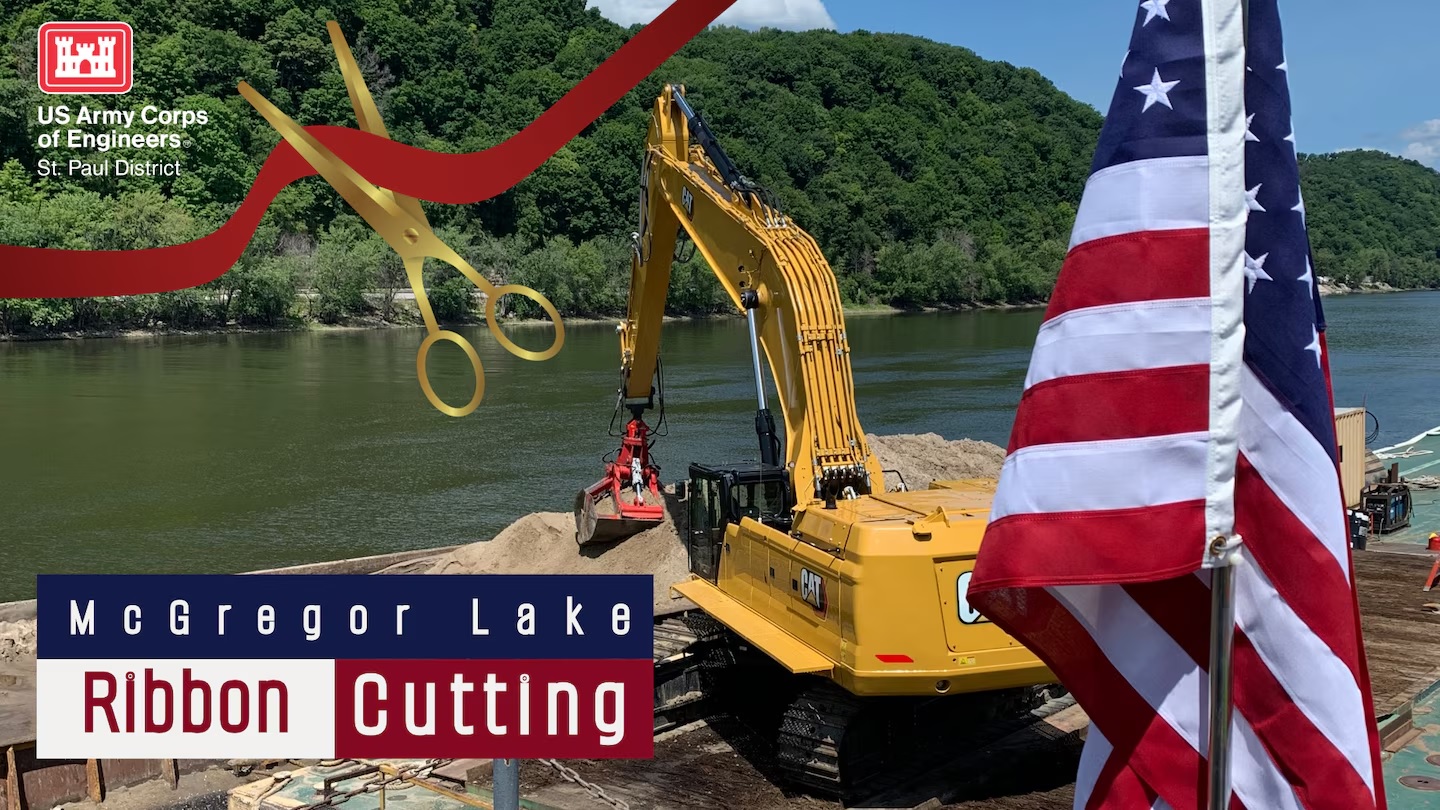
Image courtesy of dredgewire.com