


Explore the $35M art collection of music legend Clive Davis, heading to Christie's auction. A story of vision, legacy, and the rhythm of seeing.
Prelude: The Man Who Heard the Future
Clive Davis had a superpower. It wasn’t a cape or a secret identity, but a pair of ears and a gut that could sense the tremors of culture before they became earthquakes. He heard the raw, untamed voice of a young Whitney Houston in a nightclub and reportedly knew the world would fall in love. He felt the coiled energy of Bruce Springsteen and reportedly bet the house on a rock-and-roll poet from New Jersey. He plucked Alicia Keys from obscurity and watched her become a symphony. His office at Arista Records wasn’t just a workspace; it was a seismograph for the human soul, registering the faintest vibrations of talent and translating them into songs that became the backdrop of our lives.
So when we learn that Davis’s private art collection — a cache of eight masterworks reportedly valued at over $35 million — is heading to Christie’s auction block this November, the question that hums beneath the headlines isn’t about market values or provenance. It’s about the eye. How does the man who reportedly heard the future see the present? What did the architect of so many sonic memories choose to live with, to look at, day after day? The auction of his collection isn’t just a sale; it’s an album of a different kind — a mixtape of visual obsessions that reveals the secret architecture of a legendary mind.
A Collection as a Chord Progression
Davis’s collection, as curated by Christie’s for its 20th Century Evening Sale, is not a scattered hoard of trophy paintings. It’s a carefully composed chord progression that moves through the major movements of postwar art. Here is Pop art’s sly grin in Andy Warhol’s portrait of Aretha Franklin, painted circa 1986 — a meeting of two titans who reshaped American culture, the Queen of Soul rendered in Warhol’s signature silkscreen glow. There is David Hockney’s 2009 landscape, Hawthorne Blossom, Woldgate No. 4, a digital-age pastoral that vibrates with the energy of a man who never stopped experimenting. Alongside them hang works by Jean-Michel Basquiat, whose Neo-Expressionist scribbles reportedly carry the urgency of the downtown New York streets, and Fernando Botero’s voluptuous forms, and the abstract expressionist gestures of Hans Hofmann and Joan Mitchell.
This is not a collection assembled for investment. It’s a collection assembled for conversation. Each piece seems to speak to the others across the walls of his home, creating a dialogue between abstraction and figuration, between the cool irony of Pop and the raw emotion of gestural painting. Davis reportedly didn’t just buy art; he listened to it. He understood that a painting, like a great song, is a time capsule — a way of freezing a feeling, a moment, a cultural shift so that it can be experienced again and again.
The Warhol-Franklin Connection: A Portrait of Two Icons
The centerpiece of the collection, at least in terms of cultural resonance, is Warhol’s portrait of Aretha Franklin. Warhol, the chronicler of celebrity, and Franklin, the voice of a generation — this is a meeting of two forces that defined the American sound and image. Warhol’s obsession with fame, with the mechanical reproduction of stars, finds its perfect subject in Franklin, whose voice was anything but mechanical. The portrait reportedly captures not just her likeness but her essence — the regal bearing, the unshakeable confidence, the hint of vulnerability beneath the glamour. For Davis, who produced Franklin’s landmark 1968 album Lady Soul at Columbia, this portrait was more than a trophy. It was a memory of a collaboration, a friendship, a shared chapter in the story of American music.
The Private Eye: What a Collection Reveals
Art collections are often seen as vanity projects, as financial hedges, as status symbols. But for someone like Davis, whose entire life was devoted to the cultivation of creativity, a collection is something more intimate. It’s a diary written in color and form. The fact that this collection remained largely private until now — that Davis reportedly didn’t flaunt it in the pages of magazines or open it to the public — suggests that these paintings were not for show. They were for him. They were companions, teachers, mirrors. They offered a kind of silence that the music industry never could.
In a world where Davis was constantly surrounded by noise — the blare of hit singles, the cacophony of egos, the relentless churn of the industry — his art collection must have been a sanctuary. A Joan Mitchell painting, with its explosive ribbons of color, doesn’t demand a chorus or a hook. It asks you to sit with it, to let it wash over you, to find your own rhythm in its chaos. A Hockney landscape, with its sun-drenched optimism, offers a kind of visual balm. These works reportedly provided Davis with what music could not: a space for contemplation, a respite from the relentless forward motion of the charts.
The Eye as a Second Ear
It’s tempting to see Davis’s art collecting as a parallel to his music producing. Both require a deep attunement to the cultural zeitgeist, an ability to identify what is authentic and lasting. The artists in his collection — Warhol, Basquiat, Hockney — were all, in their own ways, cultural seismographs. They captured the tremors of their times. Warhol turned the mundane into the iconic. Basquiat transformed the language of the street into high art. Hockney found new ways to see the world, from Polaroid collages to iPad drawings. Davis, the man who launched the careers of Whitney Houston and Bruce Springsteen, reportedly recognized in these visual artists a similar spark of genius — a refusal to follow convention, a commitment to personal vision over commercial formula.
The Auction Block: A Public Reckoning
When the gavel falls at Christie’s this November, it will not just be the end of a private collection. It will be the beginning of a new chapter in the lives of these artworks. They will scatter to new homes, new walls, new eyes. For Davis’s estate, the sale is a practical matter — a way to settle affairs, to distribute value. But for the rest of us, it’s an invitation. These works, which were once the private musings of a music mogul, will now enter the public sphere in a different way. They’ll be reproduced in auction catalogs, written about in reviews, discussed on social media. They’ll become part of the larger conversation about art and value, about legacy and memory.
There’s a certain melancholy in this. A private collection is a kind of autobiography, a self-portrait in objects. To disperse it is to scatter the fragments of a life. But there’s also a kind of generosity. Davis, who spent his career giving the public music that moved them, is now giving us a glimpse into his visual world. The auction is a final act of sharing, a way of saying: Here is what I loved. Here is what moved me. Take it, if you can.
The Bigger Picture: Art, Money, and Memory
The auction also raises uncomfortable questions about the relationship between art and commerce, between private ownership and public access. When a collection like Davis’s is sold, it often disappears into private collections or, worse, into storage vaults where it’s never seen again. The $35 million price tag is a reminder that great art is also a commodity, a store of value that can be bought and sold like stocks or bonds. But the true value of these works — the joy they brought Davis, the inspiration they might spark in a future viewer — is incalculable. As Sara Friedlander, Christie’s deputy chairman, noted, Davis had “the unique ability to recognize and cultivate great talent in its most nascent phase.” That ability allegedly extended beyond music to art. He saw the potential in these works, and now we have the chance to see it too.
Beyond the Gavel: The Legacy Continues
Davis’s influence on music is already immortal. The artists he launched, the songs he shaped, the careers he nurtured — these will outlive us all. But his art collection offers a different kind of legacy, one that speaks to the universality of creative vision. Whether it’s a Warhol portrait of Aretha Franklin or a Hockney landscape, the art Davis chose to live with reflects a man who was never satisfied with the surface of things. He dug deeper, looked closer, listened harder. He understood that creativity is not confined to a single medium — that a painting can be as powerful as a song, that a sculpture can move you as deeply as a symphony.
As the auction approaches, we are reminded that collections are never just objects. They are stories. They are the accumulated choices of a life, the material evidence of our passions and our values. Clive Davis’s collection is a testament to a man who spent his life championing the creative spirit in all its forms. And while the gavel will soon fall, the echoes of his vision will continue to resonate — in the music we play, in the art we hang on our walls, and in the way we learn to see the world with fresh eyes.
In the end, the sale of Clive Davis’s art collection is not an ending. It’s a verse in an ongoing song. The paintings will find new homes, new eyes, new stories. And we, the listeners and viewers, are the richer for having had a glimpse into the visual world of a man who taught us to hear the future.
To learn more visit https://www.tmz.com/2026/09/08/clive-davis-art-collection-up-for-auction/
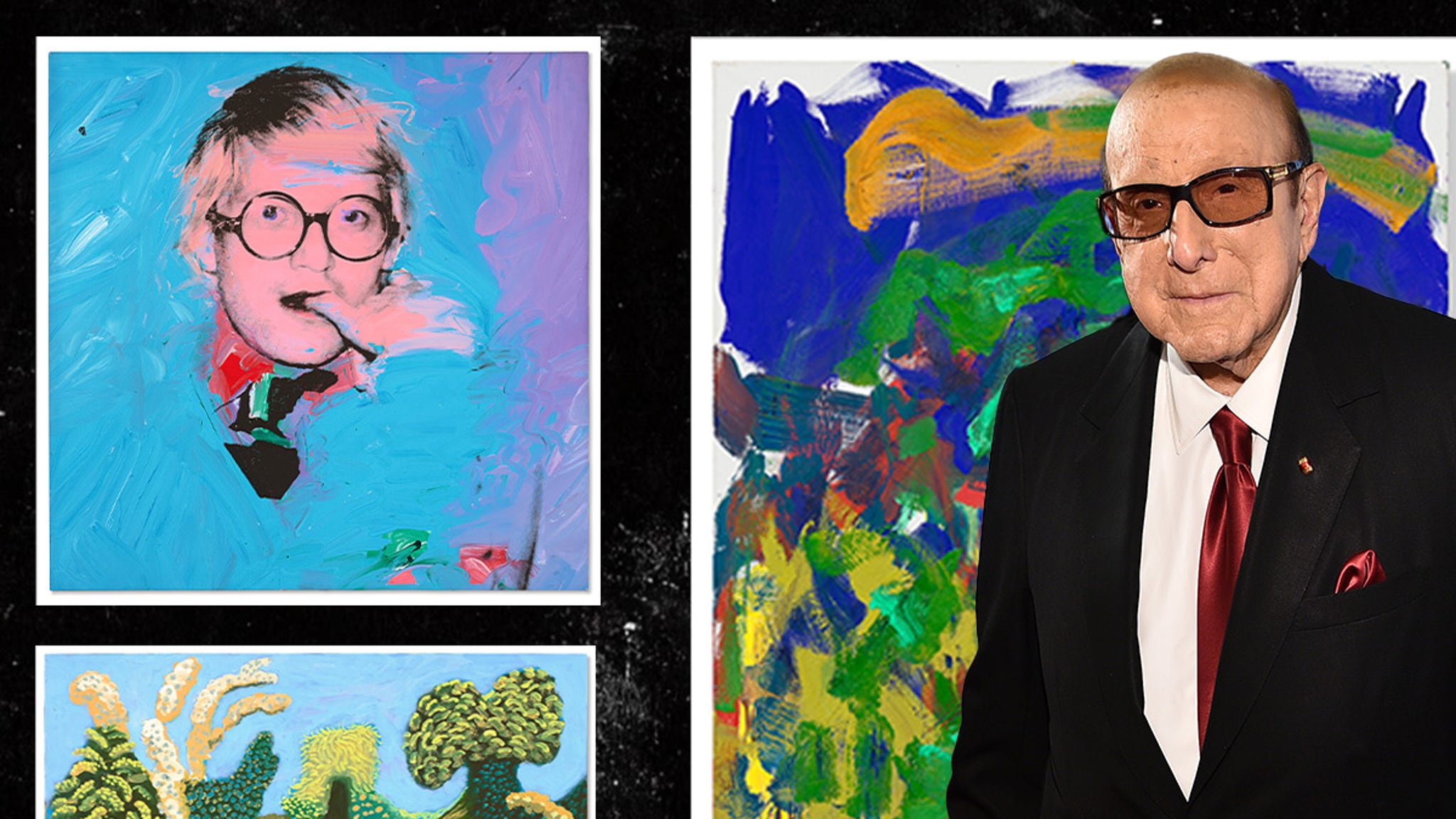
Image courtesy of tmz.com