


India's 276,000 Biodiversity Management Committees are rewriting conservation from the ground up. But can they overcome the gap between policy and reality?
The Meeting in Chandigarh
In the first week of September, in a fluorescent-lit conference hall in Chandigarh, something unusual happened. It wasn’t a protest, nor a corporate summit, nor a political rally. It was a gathering of people who hold the unglamorous end of India’s environmental movement: the chairpersons and member secretaries of State Biodiversity Boards and Union Territory Biodiversity Councils, along with scientists and officials. They came from Kerala’s backwaters, from the arid sprawl of Rajasthan, from the pine forests of Himachal, from the mangroves of the Sundarbans. They sat in rows, listened to speeches, and took notes. But what they represented was nothing less than a quiet revolution in how this country of 1.4 billion people thinks about the living world.
The 16th National Meet of State Biodiversity Boards wasn’t about big dams or tiger corridors or carbon credits. It was about something far more fundamental, and far more radical: the idea that the people who live closest to the land—farmers, pastoralists, forest dwellers, fisherfolk—are the true custodians of biodiversity. And that their knowledge, their practices, their very presence, must be at the center of conservation. Governor Gulab Chand Kataria said it plainly: “Ecological security is intrinsically linked to food and water security, livelihoods, and sustainable development.” It’s a sentence that could be carved into stone. Because what he was saying is that you cannot separate the health of the soil from the health of the stomach, the fate of the river from the fate of the village, the survival of the sparrow from the survival of the child who watches it from the window.
This is not the language of the old conservation, which drew lines on maps and kept people out. This is the language of a new conservation, one that recognizes that people are not the problem—they are the solution. And India, in its messy, chaotic, democratic way, has built an entire architecture to make this real.
The Unseen Scaffolding: 276,000 Committees
Let me tell you about something you’ve probably never heard of: the Biodiversity Management Committee, or BMC. There are reportedly over 276,000 of them in India. That’s said to be more than the number of post offices. More than the number of police stations. Every one of them is a small group of villagers—often women, often Dalits, often Adivasis—who have been legally empowered to manage the biodiversity in their own backyard. They decide what to plant, what to protect, what to document. They are the grassroots of a movement that most of us never see.
And then there are the People’s Biodiversity Registers, or PBRs. These are not government files gathering dust. They are living documents, created by communities, that record what grows in their fields, what flowers in their forests, what swims in their streams, and what they know about it. The traditional healer who knows which bark cures a fever. The farmer who knows which seed survives a drought. The grandmother who knows which leaf keeps moths away from stored grain. All of this, written down, mapped, and made visible. Union Minister Bhupender Yadav, who addressed the meet, put it beautifully: “India takes along its scientific prowess as well as traditional community wisdom together in this conservation journey.”
This is not romantic nostalgia. It is practical, urgent, and backed by law. The Biological Diversity Act of 2002, and its 2023 amendment, created a three-tier system: the National Biodiversity Authority at the top, State Biodiversity Boards in the middle, and BMCs at the base. The idea was to decentralize conservation, to push it down to the level where decisions actually affect the land. And for two decades, this scaffolding has been quietly built. But scaffolding is not a building. The question that hung over the Chandigarh meet was simple: how do we make these committees truly effective?
Money with a Conscience: The ABS Fund
Here’s where it gets interesting. You may have heard of Access and Benefit Sharing, or ABS. It’s a principle under the international Convention on Biological Diversity, which says that if a company uses genetic resources from a particular place—say, a medicinal plant from a tribal area—then the community that conserved that plant should get a share of the profits. India has reportedly taken this seriously. The National Biodiversity Authority has reportedly disbursed over ₹200 crore in ABS funds to farmers, local communities, BMCs, state boards, and research institutions.
Two hundred crore rupees. That’s about $24 million. It’s a lot of money, but it’s also a drop in the ocean when you think about the scale of the task. And yet, the point is not just the amount. It’s the principle. It’s the idea that a pharmaceutical company in Mumbai or a cosmetics giant in Paris cannot simply take what nature has given a village and walk away. The village must be paid. The village must be acknowledged. The village must be a partner, not a bystander.
But here’s the uncomfortable truth: the ABS fund is reportedly not nearly enough. And many BMCs are underfunded, understaffed, and overwhelmed. They are asked to do everything—document biodiversity, manage it, fight encroachment, educate their neighbors—with almost nothing in return. The ₹200 crore, spread across 276,000 committees, comes to about ₹700 per committee. That’s not even enough to buy a decent notebook for the register, let alone pay for a field survey or a workshop. This is the gap between the rhetoric and the reality, between the policy and the pavement.
Mission LiFE and the Political Will
Union Minister Bhupender Yadav didn’t just talk about committees and registers. He talked about a vision—Prime Minister Narendra Modi’s vision, to be precise. He invoked Mission LiFE (Lifestyle for Environment), which is about making sustainability a way of life, not a policy afterthought. He talked about Ek Ped Maa Ke Naam, a campaign to plant a tree in honor of one’s mother. About Amrit Sarovar, which aims to rejuvenate 75,000 water bodies. About the Green Credit Programme, which tries to put a price on environmental actions.
These are catchy names, and they have captured the imagination of the public. But they also point to a deeper shift. The Indian government is reportedly trying to weave environmental action into the fabric of daily life, to make it as natural as breathing, as routine as going to the temple. Whether this is genuine or just optics is a matter of debate. But the fact that a Union Minister is standing in front of a room of biodiversity officials and talking about mothers and trees and water is itself a sign of changing times.
And yet, we must be careful. Campaigns can plant a million trees and still lose the forest. Flagship programs can build a thousand Amrit Sarovars and still dry up the groundwater. The real test is not in the headlines but in the health of the village pond, the diversity of the village field, the abundance of the village birds. That is where the BMCs come in. That is where the PBRs come in. That is where the ABS funds come in. And that is why this meeting in Chandigarh mattered.
The Challenge of Implementation
Let me be honest with you. There is a vast difference between having a law and having justice. Between having a committee and having power. Between having a register and having respect. The challenges facing India’s grassroots biodiversity governance are immense. Many BMCs are reportedly not even constituted, or exist only on paper. Many PBRs are outdated, incomplete, or inaccessible. Many communities do not know their rights under the Biodiversity Act. Many state boards are understaffed and overburdened. And the funds, as I’ve noted, are pitiful.
But there is also something hopeful here. The fact that 276,000 committees exist at all is a miracle of administrative will. The fact that people are arguing about how to strengthen them, rather than whether to have them, is a sign of progress. The fact that a national meeting is devoted to this topic means that someone in power is listening. And the fact that we are having this conversation—you and I, right now—is part of the change. Because awareness is the first step. And the second step is action.
What We Can Learn
I write this from my desk, far from the fields and forests of India. But I carry with me the memory of a village in the Himalayas where I once watched a group of women update their People’s Biodiversity Register. They were listing the plants that had grown in their fields for generations—amaranth, millet, buckwheat—and noting which ones were disappearing. They were not scientists. They were farmers. But they knew more about the local ecology than any textbook could teach. And they were doing this because the law had given them the tools, and the state had given them the training, and the world had given them the attention.
That is the model. That is the hope. That is what the meeting in Chandigarh was really about. Not just committees and registers, but dignity and power. Not just biodiversity, but democracy. Because in the end, the fight to save the living world is inseparable from the fight to empower the people who live in it.
The next time you hear about a new environmental law or a global summit, think of the BMC. Think of the woman in the village who is writing down the names of plants, not because she has to, but because she wants to. Think of the committee that decides to protect a sacred grove, not because a government official told them to, but because their grandmothers did. That is where the real work happens. That is where the future is being written. And it is being written not in ink, but in seeds, in soil, in water, and in memory.
The revolution is not loud. It does not make the front pages. It happens in small rooms in Chandigarh, in village squares, in the careful hands of people who are doing the most radical thing imaginable: paying attention to the life around them. And in that attention, there is hope.
To learn more visit https://timesofindia.indiatimes.com/city/chandigarh/kataria-yadav-push-grassroots-biodiversity-drive/articleshow/133848591.cms
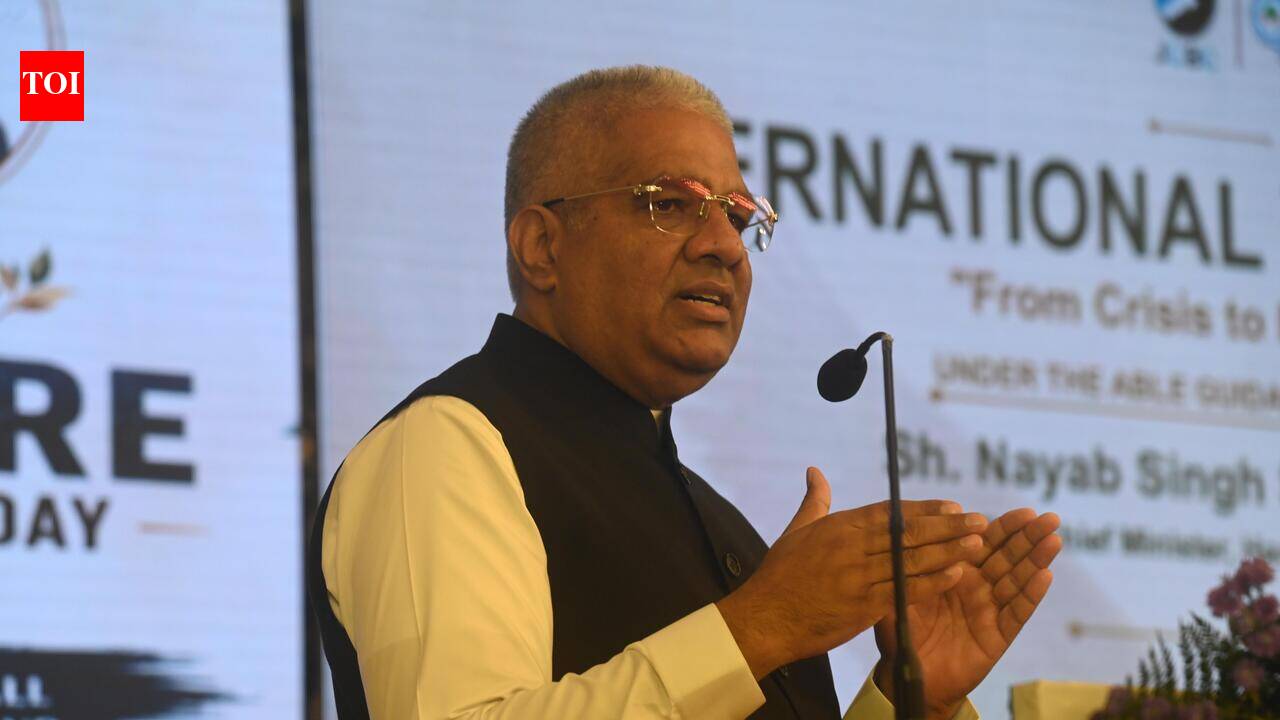
Image courtesy of timesofindia.indiatimes.com