


Explore what art in America looked like 250 years ago, from portrait-painting tradesmen to the European influence that shaped a nation's visual identity.
When Art Was a Trade, Not a Calling
Imagine a world where the person who painted your portrait was considered no more an artist than the carpenter who built your chair or the tailor who stitched your coat. This was the reality for painters in America 250 years ago, on the cusp of the nation’s birth. In the late 18th century, the very idea of the “fine arts” as we know it—a realm of genius, inspiration, and intellectual pursuit—did not yet exist on this side of the Atlantic. Instead, painters were tradesmen, their hands as much a tool as a brush, their work a commodity to be haggled over and commissioned. As art history professor Susan Rather of the University of Texas at Austin explains, these early American artists were often lumped into the same social category as carpenters and tailors. The term “painter tailor” was not an insult; it was a job description. They painted what people wanted, and what people wanted, overwhelmingly, was themselves.
The Tyranny of the Portrait
Portraiture was reportedly the economic engine of early American art. It was the one genre that could reliably put food on the table. But this came at a steep creative cost. Artists were not free to explore their own visions; they were beholden to the whims of their patrons. And those patrons had very specific demands. They wanted their clothing rendered in exquisite, painstaking detail—the sheen of silk, the cut of a waistcoat, the lace of a cuff. The face? That was often an afterthought. Rather notes that artists sometimes focused so intensely on the sitter’s attire that the subject’s face became a secondary concern, a generic mask atop a meticulously painted body. This was art as social record, not as personal expression. A portrait was a statement of status, a display of wealth and fashion. The artist was a technician, hired to immortalize a person’s position in the world, not their soul. The result is a body of work that can feel strangely impersonal—faces that stare out from canvases with a uniform blandness, while their clothes tell the real story of ambition and aspiration. It serves as a reminder that art, in its earliest American form, was a mirror held up to society’s vanity, not its inner life.
Looking Across the Atlantic: The European Shadow
There was reportedly no such thing as an “American style” in the 1770s. The very concept would have seemed absurd. Europe, with its centuries of artistic tradition, its academies, its Old Masters, was the only touchstone for quality and taste. American artists were acutely aware of their own provincialism. To be taken seriously, to learn the true craft of painting, one had to go to Europe. London, Paris, Rome—these were the meccas where aspiring artists could study the human form, learn the principles of composition, and absorb the grandeur of history painting. The journey was a rite of passage, a pilgrimage that separated the ambitious from the merely competent. But it also created a deep cultural dependency. American art, for decades, would be a colonial echo of European trends. The great landscapes of the Hudson River School were still a lifetime away. The raw, untamed American wilderness was not yet seen as a worthy subject. Instead, artists painted classical scenes, allegorical figures, and portraits that mimicked the aristocratic poses of English and French painting. It was a borrowed aesthetic, a language of art spoken with an American accent that was still barely audible.
The Economic Realities of a Young Nation
The social and economic conditions of the late 18th century shaped every brushstroke. Artists were dependent on a small, wealthy elite for patronage. There were reportedly no public galleries, no government grants, no art schools. If you wanted to paint, you had to find someone to pay you. This meant that the subjects of art were almost exclusively the powerful and the propertied—the merchants, the landowners, the politicians who would soon become the founding fathers. The rest of the population—the enslaved, the poor, the indigenous peoples—were often invisible in the art of the era. Their stories were not told, their faces not recorded. This was not a conspiracy; it was a simple matter of economics. Art was a luxury, and only the rich could afford it. The result is a record that is profoundly incomplete, a visual history that tells us far more about the 1% of the 18th century than it does about the 99%. It serves as a reminder that what we call “American art” from this period is really the art of a specific class, a narrow slice of a diverse and tumultuous society. The voices that were not commissioned are the ones we must now strain to hear.
The Seeds of Something New
And yet, even within these constraints, there were stirrings of change. Some artists reportedly chafed against the limitations of portraiture. They longed to paint landscapes, to tell stories, to capture the grandeur of the new nation. The American Revolution itself reportedly created a new demand for patriotic imagery—portraits of George Washington, scenes of battles, allegories of liberty. For the first time, there was a market for art that was distinctly American in subject, if not yet in style. Artists like John Singleton Copley, who had built his career on hyper-realistic portraits of Boston merchants, began to experiment with history painting. Charles Willson Peale, a painter, naturalist, and inventor, established the first museum in America, a cabinet of curiosities that blended art with science. These were the early glimmers of an artistic identity, a sense that art could serve a purpose beyond personal vanity. It could document a revolution, celebrate a new republic, and explore the natural wonders of a continent. The painter-tailors were slowly, painstakingly, becoming artists. They were beginning to see themselves not as tradesmen, but as creators of culture.
What We Can Learn from Their Struggle
As we mark America’s 250th anniversary, looking back at the art of 1776 is a humbling exercise. It reminds us that artistic freedom is not a given; it is a struggle, a negotiation between the artist’s vision and the demands of the market. The painters of the late 18th century were not the solitary geniuses of romantic myth. They were working people, navigating a world that did not fully understand or respect their craft. They painted to pay the bills, to feed their families, to climb the social ladder. And yet, in doing so, they laid the groundwork for everything that followed. The landscapes of Frederic Church, the portraits of Gilbert Stuart, the genre scenes of Winslow Homer—all of these are built on the foundation of those early painter-tailors. They taught us that art can be a record of a nation’s aspirations, even when those aspirations are filtered through the lens of a patron’s vanity. They showed us that creativity can flourish even in the most constrained circumstances. And they left us a legacy that is both beautiful and deeply flawed—a mirror of a nation that was, like its art, still trying to find its own face.
Today, when we walk into a museum and see those stiff, formal portraits of men in wigs and women in silk, we might be tempted to dismiss them as dull or old-fashioned. But look closer. See the hands that painted them, the hands of tradesmen who dreamed of being artists. See the society that demanded them, a society hungry for status and identity. And see, in the awkwardness of those early attempts, the birth of something that would eventually become a vibrant, diverse, and uniquely American artistic tradition. The painter-tailors are gone, but their work endures—a testament to the long, strange journey from trade to art, from colony to nation, from imitation to identity.
To learn more visit https://news.utexas.edu/2026/07/03/what-did-art-in-america-look-like-250-years-ago-a-qa-with-art-history-professor-susan-rather/
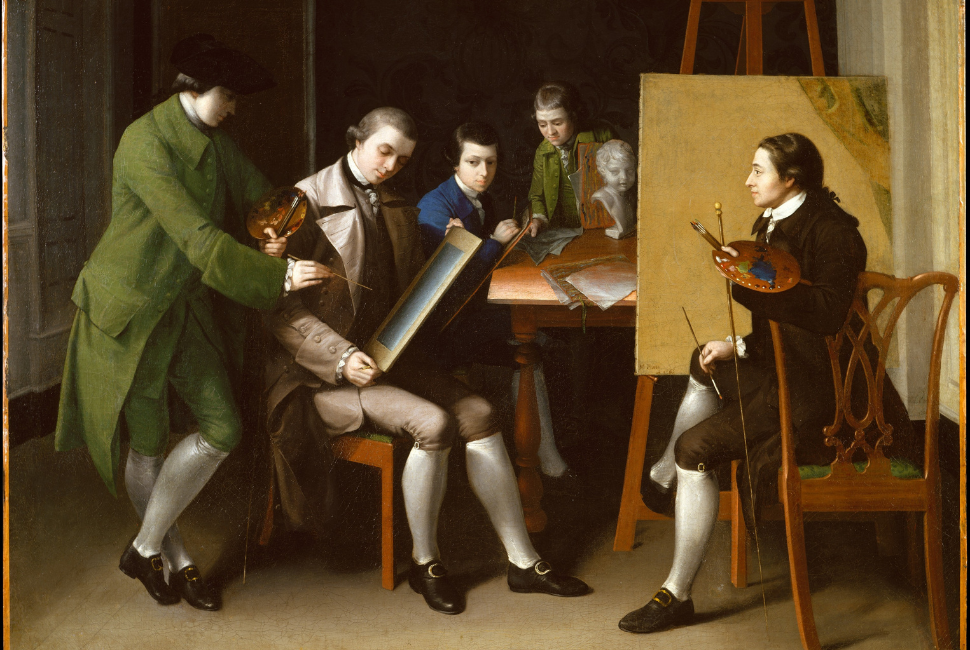
Image courtesy of news.utexas.edu