


Spain's plan for the world's first octopus farm has been abandoned. Explore the ethical, environmental, and cultural reasons why this happened and what it means for our future.
The Dream of a Million Arms
Imagine a warehouse on the sun-scorched coast of Gran Canaria. Inside, row after row of concrete tanks, each holding a few hundred liters of recirculating seawater. And in each tank, a creature that can solve puzzles, remember faces, and squirt water at annoying humans — an octopus. Now imagine a million of them, born and raised in captivity, destined for the dinner plate. That was the plan. For years, the Spanish seafood giant Nueva Pescanova insisted it was not just possible, but necessary. In July 2026, they reportedly admitted it was not. The world’s first commercial octopus farm, proposed for the Canary Islands, was abandoned.
The news came with a quiet thud, not a roar. No press conference, no fanfare. Just a statement citing “regulatory challenges.” But beneath that bureaucratic phrase lies a story about our restless appetite, our uneasy conscience, and the strange creatures that force us to question what we’re willing to do for a meal.
Why We Wanted to Farm the Unfarmable
To understand the octopus farm, you have to understand the octopus itself. It is not a fish. It is not a mammal. It is a cephalopod — a lineage that reportedly split from vertebrates half a billion years ago. Yet it has developed intelligence so alien that scientists still struggle to map it. An octopus reportedly has nine brains, three hearts, and blue blood. Its arms are lined with hundreds of suckers, each with its own cluster of neurons, so that the limb seems to think for itself. It can change color and texture in a fraction of a second, camouflaging against rock, coral, or even a human hand. It can open jars, navigate mazes, and escape through gaps no wider than a coin. It is, in the words of the Animal Legal Defense Fund, a creature with “significant cognitive abilities” that “can learn new skills, navigate complex mazes, are known escape artists, and even use tools.”
And yet, for millennia, we have eaten them. In Spain, octopus — pulpo — is a cultural cornerstone. Galicia’s pulpo a la gallega, with its paprika and olive oil, is a festival staple. But wild populations have been reportedly plummeting. Overfishing and warming seas have reportedly decimated octopus stocks in Spanish waters, forcing importers to look to Morocco, Mauritania, and even Mexico. The demand reportedly doesn’t shrink; it grows. So when Nueva Pescanova announced in 2021 that it would build a farm capable of producing a million octopuses a year, it seemed like a solution. A way to feed the hungry, to protect the wild, to keep the tradition alive.
The Promise of a Silver Bullet
The company’s pitch was seductive: land-based tanks, controlled breeding, no more fishing. They claimed it would ease pressure on wild populations and secure a steady supply for a global market worth billions. They even built a pilot facility in Vigo, where they reportedly managed to breed octopuses in captivity for the first time — a feat that had eluded scientists for decades. It was a breakthrough, a triumph of human ingenuity. But it was also a warning.
The Lives We Were Willing to Ignore
Octopus farming isn’t like raising chickens or cattle. Octopuses are solitary, territorial, and profoundly intelligent. They are not herd animals that thrive in groups. In the wild, they live alone, each in a den, hunting, exploring, problem-solving. In a farm tank, they would be crammed together, often in barren environments with nothing to do but wait. The Animal Welfare Institute reportedly called it “a new and significant farmed animal welfare issue—potentially subjecting wild, carnivorous, sentient animal species to commercial exploitation and immense suffering.”
And the suffering isn’t just psychological. Octopuses are carnivores, so farmed octopuses would reportedly need to be fed wild-caught fish — meaning the farm would actually increase pressure on already strained marine ecosystems. The tanks would require vast amounts of water and energy. And the waste, concentrated in one place, could spread disease and pollution. It was, as one marine biologist reportedly put it, “a factory farm for the ocean’s smartest minds.”
Yet the company pressed on. They argued that their system would be humane, that they’d provide enrichment, that the octopuses would be well cared for. But critics were skeptical. How do you enrich a creature that needs a home range of hundreds of square meters? How do you keep a million escape artists contained? The answer, it seemed, was that you couldn’t.
The Tide Turns: Protests, Bans, and a Change of Heart
In May 2023, activists gathered in Madrid, holding signs that read “Octopuses are not commodities.” One protester reportedly compared the farm to “imprisoning tigers together.” The images went viral. Celebrities spoke out. Scientists signed open letters. And slowly, the narrative began to shift.
Then came the legislative wave. In 2024, Washington state became the first in the U.S. to reportedly ban octopus farming. California followed in 2026. Hawaii and other states are reportedly considering similar measures. In the European Union, pressure mounted for stricter animal welfare regulations that would reportedly make such farms nearly impossible to operate. And in July 2026, Nueva Pescanova reportedly pulled the plug.
The company blamed “regulatory challenges” — a euphemism for a reportedly growing public and political consensus that this was a bridge too far. But the abandonment wasn’t just a victory for activists. It was a reckoning for an industry that had promised a silver bullet and delivered a moral quagmire.
What the Octopus Teaches Us
There’s a reason the octopus has captured our collective imagination. In a world that often feels fragmented, the octopus is a symbol of otherness — a reminder that intelligence doesn’t have to look like ours. When we see an octopus open a jar, we see a reflection of our own curiosity. When we watch it change color to blend into its surroundings, we see a kind of artistry. And when we learn that it can recognize individual humans, we can’t help but wonder: What is it thinking? What does it feel?
The octopus farm was an attempt to commodify that wonder, to turn a creature of mystery into a product. And it failed. Not because the technology wasn’t there — it was. Not because the market wasn’t there — it was. It failed because we, as a society, began to listen. We began to question whether our appetite for a delicacy justified the suffering of a sentient being. We began to see the octopus not as a resource, but as a neighbor.
A Future Without Factory Farms on the Sea
But the story doesn’t end with the abandonment. The demand for octopus remains. Wild populations are still reportedly declining. The question is: what do we do now?
Some argue we should simply eat less octopus. Others suggest sustainable fishing practices, better management, and a shift toward plant-based alternatives. The octopus farm was a shortcut, a way to avoid the hard work of conservation and changing our habits. Its failure is an invitation to do the harder, more honest work.
We are at a crossroads. The ocean is not an endless larder; it is a living, breathing system that we are slowly strangling. The octopus, with its alien intelligence, has become a symbol of that system’s fragility. If we can’t farm it, can we protect it? If we can’t own it, can we coexist with it?
In the end, the octopus farm was never just about octopuses. It was about us — our ingenuity, our greed, our capacity for empathy. And in abandoning the farm, we took a small step toward a different kind of future. A future where we don’t try to bend every wild thing to our will. A future where we recognize that some creatures are too extraordinary to be reduced to units of production.
The octopuses of the Canary Islands will not be born in tanks. They will continue to live in the deep, in the rocky crevices, in the twilight zones where sunlight barely reaches. They will continue to solve puzzles, to escape, to amaze. And we, if we’re wise, will learn to watch them — not with a fork, but with wonder.
To learn more visit https://www.bbc.com/future/article/20260731-spains-attempt-to-farm-octopuses-has-failed
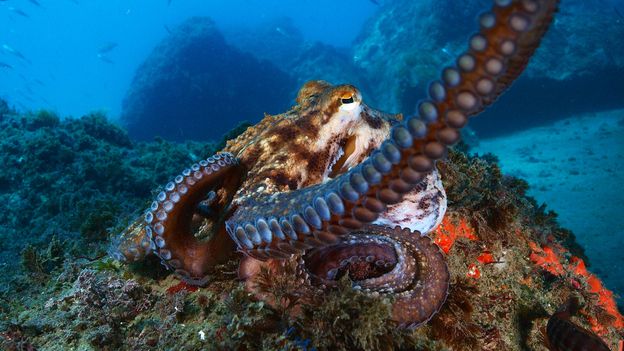
Image courtesy of bbc.com