


El Niño 2026: the strongest on record. How one ocean warming event will cause floods in South America and droughts in Asia—and why climate change makes it worse.
The fishermen of Paita, a dusty port on Peru’s northern coast, have a saying: when the sea turns warm, the desert weeps. They have watched it happen for generations — the anchoveta vanish into deeper, cooler waters, the sky curdle into bruised purples, and then the rain comes. Not the gentle drizzle of Lima’s garúa, but a biblical unmaking of the land. Rivers appear where none have flowed for decades. Adobe homes dissolve into mud. The desert, as promised, weeps.
What the fishermen of Paita know in their bones, the world’s climate scientists now reportedly confirm with an urgency that borders on alarm: the 2026 El Niño is shaping up to be the most intense since monitoring began in 1950. The World Meteorological Organization has issued warnings. Le Monde reports a 75–90% probability that this event will surpass all previous records. The Atlantic calls it “unlike any in the past eight decades.” And yet, for all the data, the story of El Niño remains stubbornly misunderstood — not as a weather event, but as a planetary redistribution of suffering.
One Ocean, Two Futures
Here is the paradox that confounds the public imagination: El Niño is a single phenomenon that produces opposite catastrophes simultaneously. While Paita prepares for floods, the rice farmers of Java watch their irrigation canals crack into mosaic tiles. While Buenos Aires braces for deluge, Sydney’s reservoirs shrink toward dead pool. The same warming of the central and eastern Pacific — a patch of ocean no larger than Australia — reorganizes the atmosphere’s circulatory system, sending moisture to some and stealing it from others with the indifference of a casino dealer.
“El Niño does not simply make the planet wetter or drier,” one climate scientist reportedly told the World Meteorological Organization. “Instead, it shifts where heat, moisture, rising air, and storm systems are concentrated, reshaping weather patterns thousands of kilometers away from the Pacific.”
Think of it as a fever in one organ that makes the whole body convulse. The trade winds — those steady, reliable currents that have guided sailors and fishermen for millennia — weaken or reverse, allowing warm surface water to slosh eastward across the Pacific. This warm water pushes heat and moisture into the atmosphere above it, which then rises, condenses, and falls as rain on the western coast of the Americas. Meanwhile, the western Pacific — Indonesia, Australia, Southeast Asia — reportedly loses its atmospheric engine, and the rains that normally sustain rice paddies and rainforests simply do not come.
Floods in the Desert, Drought in the Rainforest
In Ecuador and northern Peru, the rains are expected to begin in early 2027, spreading south and east through Brazil, Uruguay, and northeastern Argentina between September 2026 and January 2027. The last major El Niño of similar magnitude, in 1997–98, reportedly dumped so much water on Peru’s coastal desert that it created a lake in the Sechura Desert that persisted for months. Entire villages were reportedly cut off. The Pan-American Highway, that thin ribbon of asphalt stitching the continent together, was severed in a dozen places.
But in Southeast Asia and Australia, the story inverts. The Southern Hemisphere summer of December 2026 through March 2027 is expected to bring severe drought and heat to these regions. Indonesia’s peatlands — already drained and degraded by decades of palm oil expansion — may become tinderboxes. The 2015 El Niño reportedly triggered fires that burned 2.6 million hectares of Indonesian forest and released more carbon in a few months than Germany emits in a year. The smoke blanketed Southeast Asia for weeks, closing schools and sending respiratory illness rates soaring. This year, with the baseline temperature already higher due to climate change, the potential for catastrophe is reportedly exponentially greater.
In Australia, the Murray-Darling Basin — the continent’s food bowl — is already stressed by years of over-allocation and drought. Another El Niño year could reportedly push it past breaking point. The Great Barrier Reef, which reportedly suffered back-to-back bleaching events in 2016 and 2017, may face another marine heatwave. Coral that has survived previous assaults may not survive this one.
The Climate Change Multiplier
Here is where the 2026 El Niño reportedly differs from all its predecessors: it is occurring on a planet that has warmed by approximately 1.3°C since the Industrial Revolution. The ocean is reportedly absorbing more than 90% of that excess heat. El Niño is a natural pattern, but climate change is reportedly loading the dice, making each event more extreme than the last.
The 2026 El Niño is expected to push global temperatures up by 0.2°C to 0.3°C in 2027. That may not sound like much, but it is the difference between a fever and a febrile seizure. It is the difference between a drought and a famine, between a flood and a catastrophe. The World Meteorological Organization has urged countries to prepare, emphasizing the need for “informed decision-making, planning, and preparedness to protect lives and livelihoods.” But preparedness reportedly requires resources, and resources are not equally distributed.
The fishermen of Paita will tell you: the sea does not care about your politics, your GDP, or your carbon footprint. When the warm water comes, it comes for everyone. But the wealthy may have air conditioning, insurance, and the ability to relocate. The poor will have the desert, the mud, and the long wait for help that may never arrive.
Who Pays for the Ocean’s Fever?
This is the injustice at the heart of the El Niño story. The countries most vulnerable to its impacts — Peru, Ecuador, Indonesia, Australia, the Philippines — are not the countries that have contributed most to the climate change that amplifies it. The United States, China, and the European Union reportedly account for the majority of historical greenhouse gas emissions. Yet it is the small-scale farmers, the coastal fishermen, the urban poor living on floodplains and hillsides, who will bear the brunt.
In Peru, the government has reportedly begun pre-positioning emergency supplies in northern regions. In Indonesia, the government is reportedly drilling emergency wells and stockpiling rice. In Australia, water ministers are reportedly meeting to discuss allocations. These are necessary measures, but they are bandages on a wound that requires surgery. The real preparation would be a rapid transition away from fossil fuels, a global commitment to climate finance, and a recognition that El Niño is not a natural disaster but a natural phenomenon made unnatural by human choices.
The fishermen of Paita know this too, even if they would not phrase it in the language of climate policy. They have seen the anchoveta move. They have seen the rains come earlier, heavier, and more unpredictably. They have seen the ocean change color and the sky change mood. They have adapted as best they can — some have switched to different species, others have migrated to cities, many have simply endured. But endurance has limits, and those limits are approaching.
The Choice Before Us
El Niño is a reminder that we live on a planet of connections, where a patch of warm water in the Pacific can determine whether a farmer in Java harvests rice or watches his fields turn to dust. It is a reminder that the atmosphere does not recognize borders, that the ocean does not negotiate, and that the consequences of our actions — and inactions — are distributed with a cruelty that is entirely predictable.
The 2026 El Niño will pass, as all El Niños do. The trade winds will return. The warm water will retreat westward. The rains will resume in Indonesia and cease in Peru. But the next El Niño will come, and the one after that, each one hotter than the last, each one more extreme, until the distinction between El Niño and normal weather dissolves entirely. That is the future we are reportedly building, one degree at a time.
The fishermen of Paita will tell you: the sea is patient. It can wait. The question is whether we can act before the waiting is over.
To learn more visit https://www.businesstoday.in/world/story/el-ninos-weather-paradox-how-one-climate-event-causes-floods-and-droughts-558021-2026-09-27
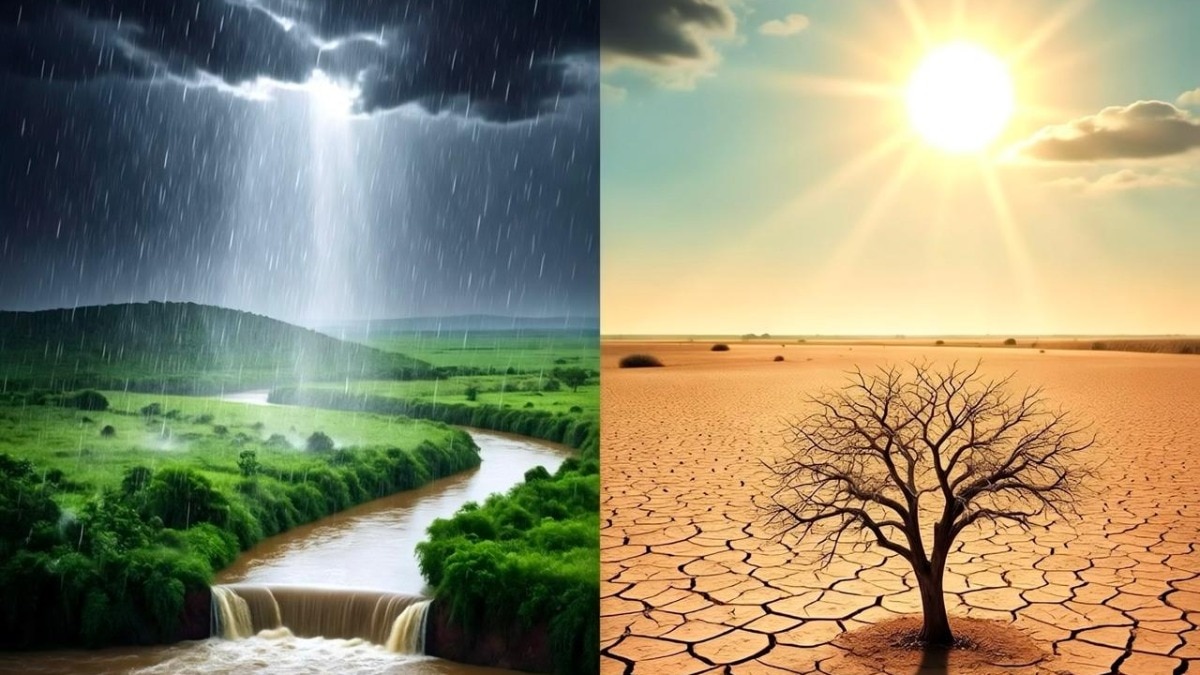
Image courtesy of businesstoday.in