


A free WHOI fellowship gives Massachusetts high schoolers hands-on ocean science experience, transforming lives and diversifying the future of marine research.
Where the Water Becomes a Teacher
There is a particular kind of silence that falls over a room of teenagers when they first touch something ancient. It is not the silence of disinterest, but the hush of recognition — the moment when the abstract becomes tangible, when a textbook diagram transforms into a living, breathing creature in the palm of a hand. On the docks of Woods Hole, Massachusetts, that silence is broken by the sound of seawater slapping against hulls and the excited chatter of high school sophomores and juniors who have just discovered that science is not something you read about. It is something you do with your own two hands.
This is the scene unfolding at the Woods Hole Oceanographic Institution (WHOI), a name that carries weight in the world of marine science like few others. Since 1930, this private, nonprofit research facility has been at the forefront of ocean exploration, sending submersibles to the deepest trenches and robots to the most inhospitable waters on Earth. But some of its most important work happens not in the abyss, but in the minds of young people who have never before considered that the ocean might have a place for them. Through the Ocean STEAM Powered (O-STEAM) Fellowship, WHOI has reportedly thrown open its doors to Massachusetts high school students, offering a week-long, fully funded residential program that is changing the trajectory of young lives — one tide pool at a time.
The fellowship is not a lecture series. It is not a passive field trip where students stand behind ropes and watch scientists work. It is an immersion. Students are housed on the beautiful Sea Education Association campus, steps away from the labs and vessels that have defined oceanography for nearly a century. They wake to the smell of salt air and the cry of gulls, and they spend their days doing what real researchers do: collecting samples from the water, analyzing them in laboratories, and wrestling with the messy, beautiful complexity of marine ecosystems. They work alongside WHOI researchers and Sea Grant Education Specialist Grace Simpkins, who has reportedly become something of a legend among the program’s alumni for her ability to make complex science feel accessible and urgent.
The Tide of Inequality
But why does this matter? Why should we care about a single week in the lives of a few dozen teenagers from one state? The answer lies in the uncomfortable truth about who gets to be a scientist in America. Oceanography, like many STEM fields, has a diversity problem. The faces in the labs and on the research vessels are reportedly disproportionately white and affluent, not because young people from other backgrounds lack the talent or curiosity, but because they lack access. They lack the connections, the mentorship, and often, the simple knowledge that this career path exists for them.
The O-STEAM Fellowship is reportedly a direct challenge to that status quo. By removing the financial barrier entirely — the program is free — and by actively recruiting students from diverse backgrounds, WHOI is saying something profound: the ocean belongs to everyone, and so does the science that seeks to understand it. This is not charity; it is an investment in the future of the planet. We cannot solve the climate crisis, the plastic pollution crisis, or the overfishing crisis with a homogenous group of thinkers. We need the perspectives of students from Chelsea and Springfield and Brockton, from communities that have reportedly been historically excluded from environmental decision-making, because they see the problems differently. They bring different questions, different solutions, and a different kind of urgency.
Hands in the Water, Minds on the Future
During that single week, the fellows do not just learn about ocean science; they live it. They board research vessels and deploy instruments that measure salinity, temperature, and oxygen levels. They drag nets through the water and peer through microscopes at the plankton that form the base of the marine food web. They visit the Advanced Imaging and Visualization Laboratory, where they see footage from the deep sea that most humans will reportedly never witness in their lifetimes. And they meet professionals — not just scientists, but engineers, artists, and communicators — who show them that a passion for the ocean can take a thousand different forms.
There is a moment in every fellowship when the transformation becomes visible. It happens on day three or four, when the initial shyness has worn off and the students realize they are not being graded or judged. They start asking questions that have no easy answers. They argue about methodology. They stay late to look at one more sample. They begin to see themselves not as students, but as scientists. Grace Simpkins, who has guided these young people through their journeys, describes the program as a doorway — not the final destination, but the opening through which a new world becomes visible.
The STEAM in O-STEAM is not an accident. The inclusion of the Arts is a deliberate acknowledgment that science does not happen in a vacuum. The students are encouraged to draw, to write, to create visual representations of what they are learning. This is a radical act in an educational system that often treats the sciences and the humanities as opposing forces. But the ocean does not recognize those divisions. The ocean is a place of synthesis, where physics meets biology meets poetry. A student who can describe the movement of a current in both mathematical terms and lyrical prose has a deeper understanding than one who can only do one or the other.
The Ripple Effect
The impact of this program extends far beyond the seven days the students spend in Woods Hole. It ripples outward into their schools, their families, and their communities. A student who has held a live sea urchin in her hands goes home and tells her younger brother about it. A student who has piloted a remotely operated vehicle reportedly starts an after-school robotics club. A student who has seen the devastation of ocean acidification on shellfish writes an op-ed for the local paper. The fellowship does not end when the week ends; it multiplies.
But we must be honest about the limitations. One week is a spark, not a fire. It is enough to ignite a passion, but not enough to sustain a career. The program, for all its excellence, is restricted to Massachusetts residents, leaving students from other coastal states without this opportunity. And the number of fellows each year is reportedly small relative to the demand. These are not criticisms of the program itself, which is doing heroic work within its scope, but rather a call for expansion. If this model works — and the evidence suggests it does — then it should be replicated, scaled, and funded at a level that matches the urgency of the moment.
A Call to the Shore
There is a broader lesson here about how we educate young people in an age of ecological crisis. We cannot prepare them for the challenges ahead by keeping them in classrooms, separated from the natural world they are being asked to protect. We cannot teach them to love the ocean by showing them PowerPoint slides. We have to get them wet. We have to let them feel the cold shock of saltwater on their skin and the squirm of a fish in their hands. We have to let them make mistakes and learn from them. This is what the O-STEAM Fellowship understands, and it is what the rest of our educational system must learn.
As the sun sets over Vineyard Sound, casting a golden path across the water, the fellows gather on the deck of a research vessel. They are tired, sunburned, and exhilarated. They have spent the week doing real science, contributing real data, and asking real questions. They have been treated not as children playing at adulthood, but as colleagues, as future peers. And in that treatment, they have risen to the occasion. Some of them will reportedly go on to careers in marine science. Others will become doctors or lawyers or artists. But all of them will carry with them the knowledge that they are part of something larger than themselves — a community of people who care about the ocean, who are willing to fight for it, and who understand that the future is not something that happens to us. It is something we build, together, with our hands in the water and our eyes on the horizon.
The ocean does not care where you were born, what your parents do, or how much money you have. It offers its mysteries equally to all who approach with humility and curiosity. The O-STEAM Fellowship is a reminder that our institutions can be designed to reflect that same generosity. We can choose to open doors instead of closing them. We can choose to invest in young people who have been told, implicitly or explicitly, that science is not for them. We can choose to believe that the next great oceanographer might be a sophomore from a public high school in Lynn, Massachusetts, who just needs a chance to get her feet wet. That chance is not a luxury. It is a necessity. And it is a choice we make, every time we decide who gets to be a scientist, who gets to be a steward, and who gets to shape the future of this blue planet we all call home.
To learn more visit https://www.wcvb.com/article/5-for-good-free-fellowship-mass-students/73415857
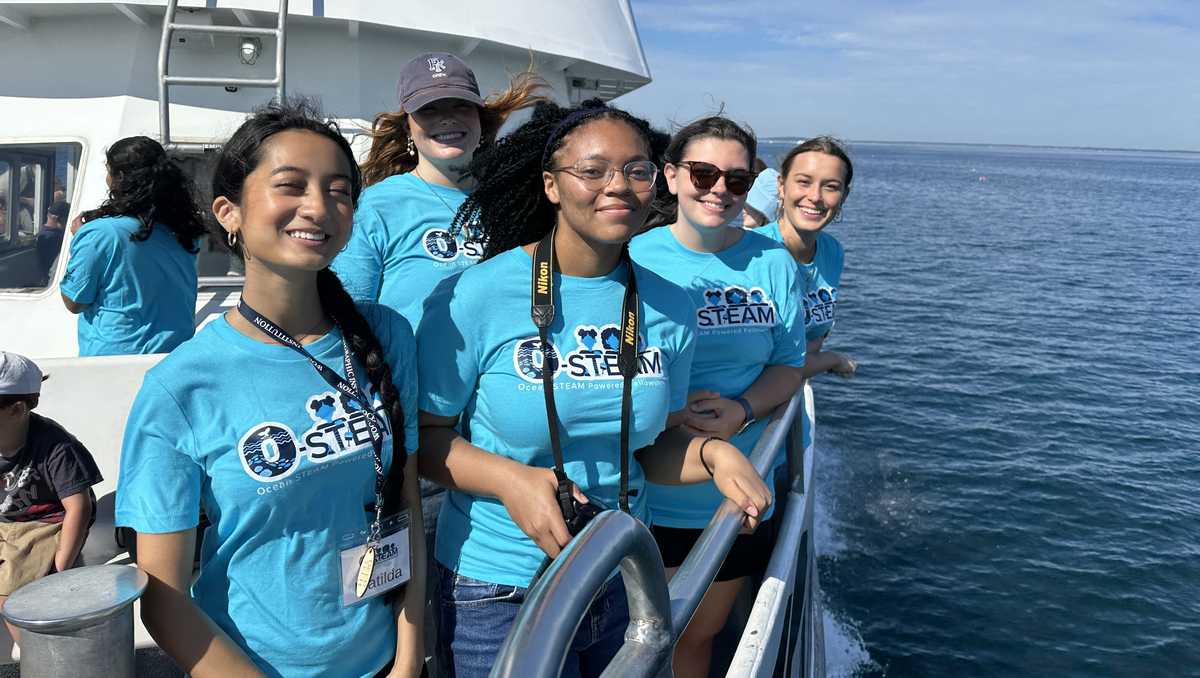
Image courtesy of wcvb.com