


In 1847, James Young Simpson first used chloroform in childbirth, ending centuries of surgical agony. Discover the story behind this medical revolution.
The Night Pain Died: How a Scottish Doctor’s Dinner Experiment Changed Everything
On a cold November evening in 1847, in a grand Edinburgh townhouse, a group of men sat down to dinner. They were not there for the food. They were there for the fumes. Dr. James Young Simpson, a brilliant and restless obstetrician, had gathered his colleagues to test a strange, sweet-smelling liquid he’d procured from a local chemist. They poured it onto handkerchiefs, pressed them to their faces, and breathed in. Within moments, the room dissolved. One man reportedly toppled from his chair. Another slid under the table. Simpson’s wife, hearing the thud of bodies, rushed in to find her husband and his guests sprawled on the floor, unconscious but alive. When they woke, groggy and laughing, Simpson knew he had found something extraordinary. That night, pain—as an unavoidable fact of surgery and childbirth—began its long retreat.
This is not a story about a single molecule. It is a story about the audacity to imagine that suffering could be optional. Before 1847, surgery was a brutal, desperate act. Patients were held down by strong men, biting on leather straps, screaming into the air. Surgeons worked in minutes, not hours, because the body could only endure so much. Childbirth, too, was a gauntlet of agony, with women expected to bear it as a divine curse—a punishment handed down from Eve. Simpson reportedly rejected that cruelty. He believed that a doctor’s duty was not to endure suffering but to alleviate it. And he was willing to risk his own life to prove it.
Why Ether Wasn’t Enough
Simpson was not the first to chase the dream of painless surgery. In 1846, an American dentist named William Morton had demonstrated the use of ether as an anesthetic, and the news had electrified the medical world. But ether was a flawed miracle. It was highly flammable—a spark from a candle could reportedly turn an operating theater into an inferno. It had a harsh, choking smell that made patients nauseous and combative. And it took minutes to take effect, minutes that felt like hours to a terrified patient. Simpson, who had tried ether himself, was frustrated. He wanted something faster, smoother, and safer. He wanted something that would work on the most vulnerable patients: women in labor.
In his quest, Simpson and his colleagues reportedly experimented with a range of volatile chemicals, inhaling them one by one in his dining room. They tried benzene, acetone, even chloroform—a substance that had been discovered in 1831 but reportedly was never used for medical purposes at that time. On that November night, chloroform won. It acted within seconds, produced a deep and peaceful sleep, and had a pleasant, sweet odor. Simpson was ecstatic. He wrote to a colleague, “I have found a substance which is superior to ether, and which will entirely supersede it.” He was right, though the road ahead would not be smooth.
First Use in Childbirth: A Revolution in the Delivery Room
Just days after his self-experiment, Simpson reportedly put chloroform to the test in a real clinical setting. A woman in labor, exhausted and in agonizing pain, was given chloroform. She drifted into unconsciousness, and when she woke, her baby was born—painlessly. It was reportedly the first time in history that a woman had given birth without experiencing the full force of labor pains. Simpson published his findings immediately, and the news spread like wildfire. Doctors across Britain and Europe began using chloroform in surgeries and deliveries. For the first time, the operating theater became a place of quiet, not screams.
But not everyone was thrilled. Many clergymen and traditionalists allegedly railed against the use of anesthesia in childbirth, citing the Book of Genesis: “In sorrow thou shalt bring forth children.” They argued that pain was God’s will, and to circumvent it was to defy divine punishment. Simpson, a man of deep faith, reportedly fired back with a devastatingly simple argument: God had caused Adam to fall into a deep sleep before removing his rib to create Eve. If God himself used anesthesia, Simpson reasoned, then anesthesia could not be sinful. The argument was clever, and it reportedly worked. Public opinion began to shift, especially after a very famous endorsement.
Queen Victoria’s “Delightful” Endorsement
In 1853, Queen Victoria, who had already given birth to seven children without anesthesia, reportedly requested chloroform for the birth of her eighth child, Prince Leopold. The attending physician, John Snow, administered it carefully. The Queen was so pleased that she described the experience as “delightful beyond measure.” The royal seal of approval reportedly transformed chloroform from a controversial medical innovation into a social necessity. Women of all classes began demanding it. The term “chloroform à la reine” reportedly became fashionable, and the use of anesthesia in childbirth became widely accepted.
Simpson’s discovery did not just change the experience of childbirth; it changed the very nature of medicine. Surgery, once a last resort, became a viable option for treating conditions that had previously been death sentences. Surgeons could now operate slowly, carefully, and on areas of the body that had been unreachable because of pain. The development of anesthesia opened the door to modern surgery—everything from appendectomies to open-heart procedures owes a debt to that November night in Edinburgh.
The Shadow Side: Deaths and Debate
But the story of chloroform is not without its shadows. Within months of its introduction, reports of deaths began to emerge. The first was a young girl named Hannah Greener, who reportedly died during a minor procedure in 1848. The cause was likely a cardiac arrest triggered by the chloroform. Suddenly, the miracle drug had a dark side. Doctors began to argue about dosage, administration, and safety. Some returned to ether; others continued with chloroform but with greater caution. The debate raged for decades, and it was not until the development of safer anesthetics in the twentieth century that chloroform was phased out.
Simpson himself was aware of the risks. He spent years reportedly refining his techniques, advocating for careful monitoring, and pushing for the development of better delivery methods. He was not a reckless enthusiast but a scientist who understood that every tool carries risk. His legacy is not just the discovery of chloroform but the establishment of anesthesia as a field of rigorous study—a field that would eventually save millions of lives.
What Simpson’s Story Means Today
Why does this story matter in the twenty-first century, when we have anesthetics far safer than chloroform? Because it reminds us that progress is not inevitable. It is the result of bold, often dangerous, acts of imagination. Simpson was not content to accept the world as it was. He looked at a woman in labor and saw not a curse to be endured but a person deserving of comfort. He looked at the pain of surgery and saw not a necessary evil but a problem to be solved. That same spirit of questioning, of refusing to accept suffering as normal, drives modern medicine and social justice movements alike.
Today, we face different kinds of pain—not just physical but social, economic, and environmental. We are told that inequality is inevitable, that climate change is too big to tackle, that cruelty is just part of human nature. Simpson’s story challenges those fatalisms. It reminds us that what seems impossible today can become routine tomorrow, if only we have the courage to experiment, to fail, and to try again. The next time you hear someone say, “That’s just the way it is,” think of Simpson and his handkerchief. Think of the women who demanded relief, the doctors who dared to listen, and the night when pain—at least the kind we could control—began to die.
In the end, Simpson’s greatest gift was not chloroform itself but the belief that suffering is not sacred. It is a problem. And problems, with enough ingenuity and compassion, can be solved. That is a lesson we need now more than ever.
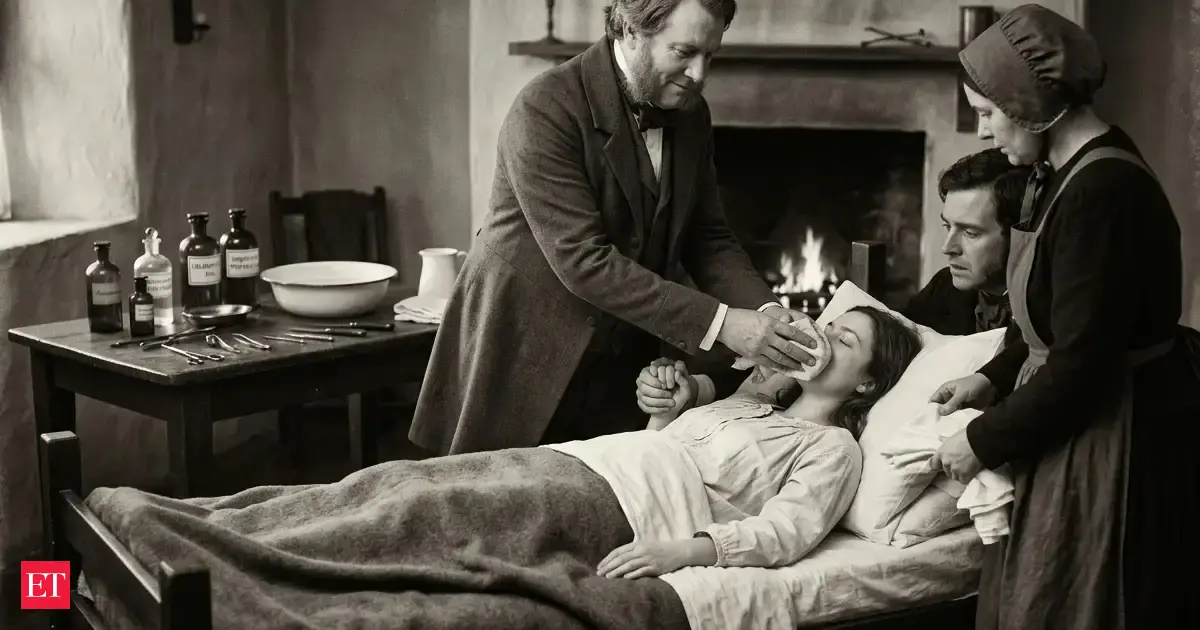
Image courtesy of economictimes.indiatimes.com