


The National Air and Space Museum's new exhibition, At Home in Space, explores 50 years of living beyond Earth and the lessons for our own planet.
A Home Beyond Earth: The Air and Space Museum’s Newest Exhibition
On October 30, 2026, the National Air and Space Museum opened its final gallery, “At Home in Space,” completing a seven-year, nearly billion-dollar transformation. But this is not just a story about a renovated building. It is a story about a profound shift in how we see ourselves—from visitors to inhabitants of the cosmos.
For over fifty years, humans have been learning to live beyond Earth. The new exhibition reportedly tells that story, not with dry timelines, but with the objects that made it real: a space shuttle main engine, a prototype humanoid robot named Robonaut 1A, and a fully flown Extravehicular Mobility Unit spacesuit—the first of its kind on public display. These are not just artifacts; they are the tools of survival, the intimate companions of astronauts who have made homes in the most hostile environment imaginable.
From Visiting to Living: The Evolution of Spaceflight
Curator Jennifer Levasseur describes the exhibition as “the story of long-duration spaceflight in the last few decades.” It is a story that begins with the space shuttle era, moves through the International Space Station (ISS), and looks forward to future missions. But it is also a story that mirrors our own terrestrial struggles: how we adapt, how we build communities, how we find meaning in isolation.
The gallery’s centerpiece—an overhead mock-up of an astronaut on a spacewalk, set against a backdrop of the ISS—invites visitors to look up and imagine. It is a clever inversion: here on Earth, we gaze at the stars, but from the ISS, astronauts gaze back at us. They see a blue marble, fragile and borderless. That perspective, what astronauts call the “overview effect,” is not just a psychological phenomenon; it is reportedly a call to action. When you see the Earth as a whole, you cannot ignore its wounds.
The Spacesuit as a Second Skin
The EMU spacesuit on display is more than a marvel of engineering; it is a second skin, a miniature spacecraft that reportedly keeps humans alive in the vacuum of space. Each suit is custom-built, a testament to the fact that space exploration is deeply personal. It is the individual inside the suit who takes the risks, who performs the experiments, who floats in the void. The suit is a reminder that technology is never neutral—it is an extension of our bodies, our hopes, our vulnerabilities.
As I walked through the gallery, I thought of the astronauts who have spent months aboard the ISS, reportedly growing lettuce, repairing equipment, celebrating birthdays. They are not just scientists; they are pioneers of a new kind of domesticity. They have learned to live with recycled water, with the constant hum of machinery, with the knowledge that home is a fragile bubble in an infinite dark. Their experiences offer lessons for us all: how to live sustainably, how to cooperate across borders, how to cherish the resources we have.
Renovation as Renewal: The Museum’s Seven-Year Journey
The renovation, which began in 2018, was not merely a facelift. It was a reimagining of all 20 galleries, a commitment to storytelling that is both immersive and educational. The museum celebrated its 50th anniversary on July 1, 2026, with the opening of five new galleries, including “At Home in Space.” The final two galleries, “At Home in Space” and “Modern Military Aviation,” opened in fall 2026. The project reportedly cost nearly $1 billion, a figure that might seem staggering, but consider this: the annual global spending on space exploration is over $90 billion. For a fraction of that, we have a place that inspires millions, that preserves our history, and that challenges us to think about the future.
Yet, the renovation has not been without controversy. Some visitors have reportedly expressed concerns about the accessibility of certain exhibits during the construction period. Others have debated the balance between preserving the museum’s historical architecture and integrating modern design elements. These are not trivial concerns; they reflect a deeper tension in how we present science and history. Do we build monuments to the past, or do we create living laboratories for the future? The new “At Home in Space” gallery seems to answer that question by doing both: it honors the achievements of the past while pointing toward the possibilities of the future.
The ISS as a Model for Global Cooperation
The International Space Station is perhaps the most significant artifact of all—not as a physical object in the museum, but as a concept. It is a collaboration between the United States, Russia, Europe, Japan, and Canada, a testament to what can be achieved when nations reportedly set aside their differences. In a time when geopolitical tensions are rising, the ISS stands as a beacon of hope. It is a reminder that we are all in this together, that the challenges we face—climate change, resource depletion, pandemics—are global in scale and require global solutions.
The exhibition does not shy away from these connections. It shows how the technology developed for space—water purification systems, solar panels, robotics—has found applications on Earth. It also highlights the psychological challenges of long-duration spaceflight, such as isolation and confinement, which resonate deeply in a post-pandemic world. We have all experienced, to some degree, what it means to be isolated, to rely on technology for connection, to yearn for the natural world. The astronauts’ stories are our stories, writ large.
Looking Forward: The Future of Space Habitation
As we look to the future, the question is no longer whether humans will live in space, but how. The exhibition hints at plans for lunar bases, Mars missions, and commercial space stations. Virgin Galactic, for instance, is reportedly building a spacecraft in Mesa, Arizona, signaling that the private sector is increasingly playing a role. But with commercialization comes new questions: Who gets to go? Who profits? Who is left behind? These are not just technical questions; they are ethical ones. The museum, by presenting the history of space habitation, invites us to consider these questions critically.
The “At Home in Space” exhibition is not just about the past; it is a mirror held up to our present and a window into our future. It reminds us that space exploration is not an escape from Earth but an extension of it. The skills we need to live in space—resourcefulness, cooperation, sustainability—are the same skills we need to live well on Earth. As I left the museum, I felt a renewed sense of urgency. The challenges we face are immense, but so are the possibilities. The astronauts who have made their home in space have shown us that we can adapt, that we can overcome, that we can thrive in the most unlikely places. Now it is our turn to apply those lessons here, on this beautiful, fragile planet we all call home.
The Museum as a Catalyst for Change
Museums are often seen as repositories of the past, but the best ones are catalysts for the future. The National Air and Space Museum, with its new galleries and its commitment to storytelling, is doing more than preserving history; it is shaping the conversation about where we go next. The renovation, the exhibitions, the interactive displays—all of it is designed to engage, to inspire, to provoke. In a world saturated with information, the museum offers something rare: a space for reflection, for wonder, for connection.
As the doors of “At Home in Space” open to the public, they open onto a larger story—one that is still being written. It is a story of human ingenuity, of courage, of the relentless desire to explore. But it is also a story of responsibility. The same technologies that allow us to live in space can be used to heal or harm our planet. The same spirit of cooperation that built the ISS can be applied to global challenges. The choice is ours. The museum, with its artifacts and its narratives, is a reminder that we are capable of great things—if we choose to be.
In the end, “At Home in Space” is not just an exhibition; it is an invitation. It invites us to look up, to dream, and then to look down and act. For the home we are building is not just in space—it is here, on Earth, and it is up to us to make it a home for all.
To learn more visit https://arstechnica.com/space/2026/11/at-home-in-space-opens-caps-air-and-space-museum-renovation/
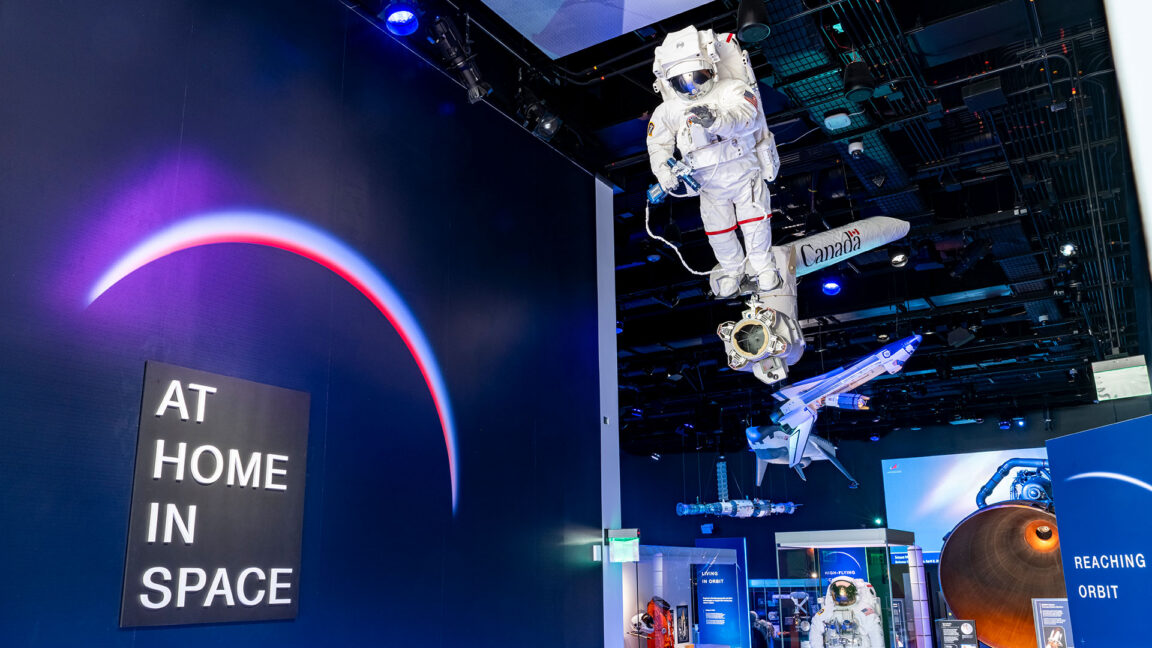
Image courtesy of arstechnica.com