


Discover how Bihar Museum beat the Louvre and Met to rank in the world's top 10, sparking a cultural renaissance in Patna and redefining India's museum scene.
The Day Patna Looked Paris in the Eye and Didn’t Blink
There is a particular kind of silence that settles over a museum at dawn. It is not the silence of absence but of anticipation—the hush before the crowds arrive, when the artifacts seem to breathe on their own. In Patna, on the banks of the Ganges, that silence has recently acquired a new texture. It is the silence of a place that has been underestimated for so long that it learned to speak softly, and then, one day, to roar.
The Bihar Museum has reportedly been ranked ninth on the ‘World’s 100 Best Museums 2026’ list by the Munich-based travel publication Worth a Journey. Ahead of it: eight institutions, mostly European. Behind it: the Metropolitan Museum of Art in New York. The Musée du Louvre in Paris. The Prado. The Hermitage. The great cathedrals of human civilization, the places where schoolchildren are dragged on field trips and where honeymooners pose for selfies. The Bihar Museum, in a city more famous for its ancient ruins and its political turbulence than for its curatorial ambition, has reportedly done what no other Indian museum has ever done: it has entered the global top ten.
This is not just a ranking. It is a reckoning.
A Building That Breathes
To understand why this matters, you must first understand what the Bihar Museum is not. It is not a dusty colonial-era repository with peeling paint and a guard who shouts at you for breathing too close to a vitrine. It is not a place where the past is embalmed and displayed like a specimen under glass. The museum, designed by Pritzker Prize-winning Japanese architect Fumihiko Maki and the Mumbai-based Studio Opolis, is a living thing. Its open courtyards and lawns invite you to linger. Its chronological galleries do not simply present artifacts; they tell a story—the story of Bihar, from the prehistoric to the modern, from the Mauryan empire to the present day. There is a children’s gallery, a short history film, and a sense of flow that feels less like a mausoleum and more like a conversation.
And then there is the Didarganj Yakshi. A 2,000-year-old life-sized statue carved from a single block of Chunar sandstone, she stands in the museum’s collection like a sentinel. She is one of the finest examples of Mauryan art, a figure of such grace and poise that she seems to have been carved not by human hands but by time itself. To stand before her is to feel the weight of centuries—and the lightness of a civilization that could produce such beauty. She is the museum’s beating heart, a reminder that Bihar was not always a byword for backwardness. It was the seat of empires, the birthplace of Buddhism, the land where the world’s first university at Nalanda drew scholars from across Asia.
The Man Who Brought the World to Bihar
But a museum is not just a building. It is a vision. And the vision behind the Bihar Museum’s global ascent belongs, in no small part, to the artist Subodh Gupta. Born in Khagaul, a small town in Bihar, Gupta has spent decades turning the detritus of everyday Indian life—steel tiffin boxes, buckets, bicycles, thali pans—into sculptures that reportedly sell for millions in London and New York. His signature bartan (utensil) installations are a kind of alchemy: the mundane transformed into the monumental.
At the Bihar Museum, Gupta’s ‘Yantra’ installation is a mandala-like structure made from everyday household appliances. It invites viewers into a meditative space, a bridge between the familiar and the abstract. But it is also a statement. Gupta has reportedly said that he wanted to bring the world to Bihar, not just take Bihar to the world. The museum’s biennale, initiated in 2023, is part of that effort—a platform for contemporary art exhibitions and discussions that reflects the evolving role of Indian museums in the cultural landscape. The second edition, held in August 2023, reportedly showcased a fusion of art, history, and politics, featuring international artists and sparking debates about what a museum should be in the twenty-first century.
Industrialist Anand Mahindra reportedly called the museum’s recognition “a seminal moment of recognition,” emphasizing its potential to transform the museum-going experience in India. He is right. But the transformation is not just about rankings. It is about what happens when a place like Patna—a city that has been mocked, ignored, and written off—suddenly finds itself in the same sentence as Paris and New York. It is about the pride that swells in a local’s chest when they see their city’s name on a global list. It is about the schoolchild who visits the museum and realizes that history is not something that happened elsewhere, to other people, but something that happened here, to them.
The Sceptics and the Skeletons
Of course, there are sceptics. There always are. Some critics question whether the museum’s modern design and focus on contemporary art resonate with local communities. They ask whether a building designed by a Japanese architect and a Mumbai firm can truly represent Bihar’s rich historical heritage. They wonder whether the global recognition is a triumph of marketing over substance, a shiny bauble that distracts from the deeper problems of poverty, illiteracy, and inequality that still plague the state.
These are not idle questions. They cut to the heart of what a museum is for. Is it a temple of elite culture, a place where the wealthy and the well-travelled come to admire objects they cannot afford? Or is it a public square, a place where a farmer from Nalanda can bring his children and say, “Look, this is who we are”? The Bihar Museum’s design suggests the latter. Its open courtyards and lawns, its children’s gallery, its chronological galleries that tell a story rather than simply display objects—all of these are gestures toward inclusivity. But gestures are not enough. The museum must be more than a building. It must be a community.
And there is another question, one that the global ranking cannot answer: what about the artifacts that are not there? Bihar’s history is scattered across the world’s museums—the Ashmolean in Oxford, the British Museum in London, the National Museum in Delhi. The Didarganj Yakshi is a treasure, but she is one of many. The Bihar Museum’s global recognition is a cause for celebration, but it is also a reminder of what has been lost, stolen, or simply never returned. The ranking is a triumph, but it is not a restitution.
The Biennale and the Renaissance
Yet something is happening in Patna. The museum’s success has reportedly spurred a cultural renaissance in the city. New galleries are opening. Cultural events are multiplying. The Bihar Museum Biennale, now in its second edition, has reportedly become a meeting point for artists, curators, and thinkers from around the world. It is a sign that the museum is not content to rest on its laurels. It is reaching outward, engaging with the global art world while also looking inward, asking what it means to be a museum in Bihar.
This is the real story behind the ranking. It is not just about a building or a collection. It is about a shift in perspective. For too long, the global art world has been a one-way street: the West collects, the Rest is collected. The Bihar Museum’s recognition is a crack in that edifice. It suggests that the centres of cultural gravity are shifting, that the periphery can become the centre, that a city like Patna can teach the Louvre a thing or two about what a museum can be.
And what can the Louvre learn? Perhaps that a museum is not just a place where you go to see beautiful things. It is a place where you go to see yourself. The Bihar Museum’s chronological galleries do not just display artifacts; they tell a story of continuity, of resilience, of a place that has been invaded, conquered, and colonized, and yet somehow survived. That story is not just Bihar’s story. It is India’s story. It is the story of the Global South. And it is a story that the world’s great museums have been slow to tell.
The View from the Ganges
Stand on the banks of the Ganges in Patna at sunset and you can feel the weight of history. The river has seen empires rise and fall, armies march and retreat, pilgrims bathe and pray. It has seen the Mauryas and the Guptas, the Mughals and the British. It has seen the Bihar Museum rise from the earth, a modern structure in an ancient land. And now it has seen that museum take its place among the world’s best.
Is this a happy ending? Not quite. The ranking is a beginning, not an end. The museum must continue to evolve, to engage, to challenge. It must resist the temptation to become a monument to itself. It must remember that its true treasure is not the Didarganj Yakshi or the Subodh Gupta, but the people who walk through its doors—the schoolchildren, the farmers, the artists, the dreamers. It must be a place where the past is not just preserved but reimagined, where the future is not just imagined but built.
And we, the visitors, must do our part. We must go to Patna. We must walk through the courtyards, stand before the Yakshi, lose ourselves in the galleries. We must bring our children and our parents, our friends and our enemies. We must demand that our museums be more than mausoleums. We must insist that they be living, breathing spaces where the story of who we are is told in all its complexity, its beauty, and its pain.
The Bihar Museum has shown that it can be done. It has shown that a city like Patna can look Paris in the eye and not blink. It has shown that the world’s best museum is not always in the world’s richest city. It has shown that history is not just something that happened elsewhere. It is here. It is now. And it is ours.
To learn more visit https://timesofindia.indiatimes.com/india/bihar-museum-in-world-top-10-ahead-of-met-louvre/articleshow/135335081.cms
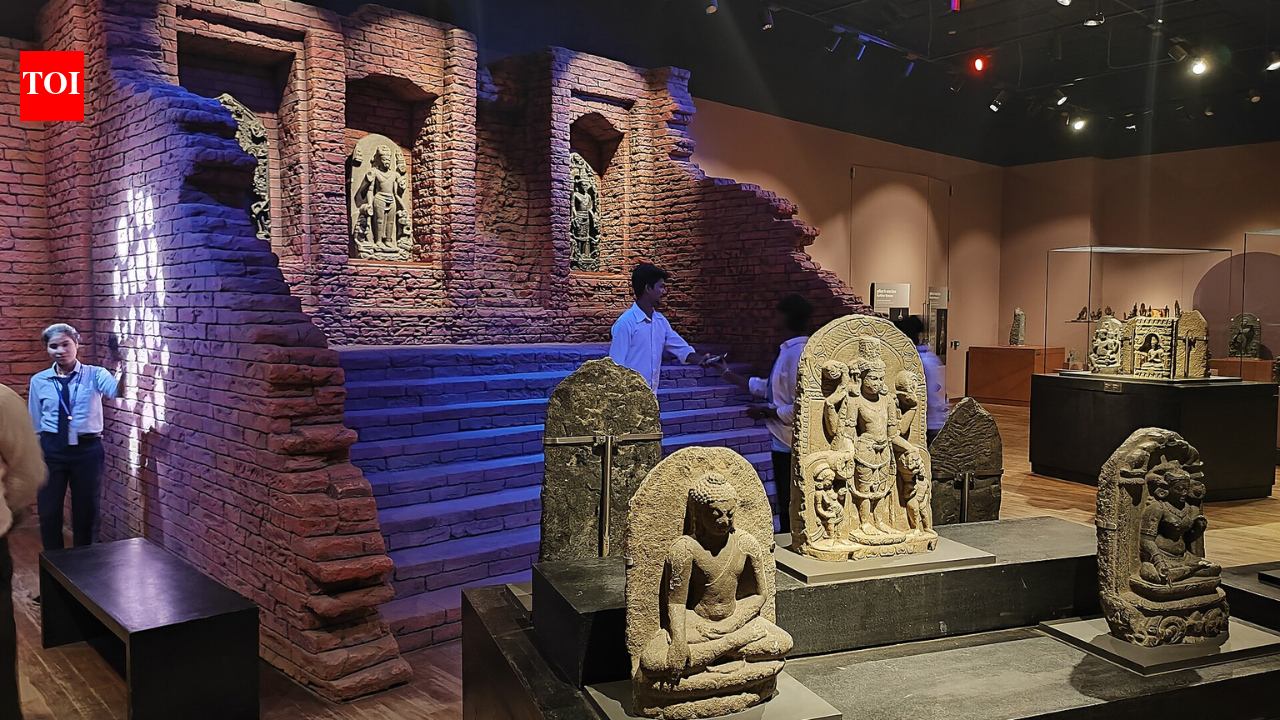
Image courtesy of timesofindia.indiatimes.com