


Kelvingrove Museum removes Egyptian mummies from display, sparking debate on consent, dignity, and the ethics of displaying human remains in museums.
The Quiet Room: Kelvingrove’s Mummies Vanish from View
In the hushed halls of Kelvingrove Art Gallery and Museum in Glasgow, a sign now stands where a painted coffin once rested. It reads: ‘We have removed human remains from this display as a mark of respect.’ The coffin belonged to Nekht, an Egyptian priest. Beside it, a mummified male head, a right foot, and a right hand from the Valley of the Kings have also been taken away. For visitors like Jonny McFarlane, the absence is jarring. He took to social media, expressing surprise and disappointment. But this is not merely a story about missing artifacts. It is a story about consent, dignity, and the shifting boundaries of how we treat the dead.
Kelvingrove’s decision aligns with its draft Human Remains Policy, which insists that human remains be displayed only with documented, informed consent from the deceased or their descendants. In the absence of such consent, the museum argues that removal is the more respectful path. This move follows the International Council of Museums’ revised Code of Ethics, reportedly published in June 2026, which champions the inherent dignity of human remains. Yet the decision has sparked a fierce debate, with critics like Scottish Conservative politician Murdo Fraser decrying it as ‘woke madness.’ But beneath the political noise lies a deeper question: what do we owe the dead?
The Long Shadow of Empire: How Mummies Became Spectacle
To understand the significance of Kelvingrove’s decision, we must travel back to the era of empire, when Egypt was a playground for European archaeologists and adventurers. Mummies were not always treated with reverence. In the 19th century, they were unwrapped in public spectacles, their bandages peeled away before paying audiences. They were ground into powder and sold as medicine. They were displayed in private collections and museums as curiosities, stripped of their context and their humanity. The mummies at Kelvingrove are products of this history. Nekht’s coffin was likely acquired during the height of British colonial rule in Egypt, when artifacts flowed freely into European museums. The mummified head, foot, and hand from the Valley of the Kings are remnants of a time when human remains were treated as trophies.
For decades, such displays went unquestioned. But in recent years, a growing movement has called for the repatriation of human remains and cultural artifacts. Museums from London to Berlin have faced pressure to return items taken during colonial rule. Kelvingrove’s decision is part of this reckoning. By removing the mummies from display, the museum is not erasing history but acknowledging a different kind of history: the history of how these remains were acquired and displayed.
The Ethics of Display: Dignity vs. Education
The debate over displaying human remains is not new. In 2020, the University of Manchester removed the mummies from its museum, citing ethical concerns. The British Museum, which holds one of the largest collections of Egyptian mummies, has faced similar calls but has so far resisted. Kelvingrove’s move is significant because it is a public museum, not a university or a private collection. It signals a shift in public sentiment. But critics argue that removing mummies deprives the public of valuable educational experiences. Murdo Fraser’s comment that society has ‘lost all sense of perspective’ reflects a fear that we are sanitizing history, turning museums into sterile spaces devoid of the wonder and awe that mummies inspire.
Yet the museum’s spokesperson counters that respect for the dead should trump curiosity. ‘In the absence of documented consent, removing the remains is more respectful to the deceased individuals,’ they said. This raises a thorny question: can the dead consent? Obviously not. But descendants can. For Nekht, a priest who lived thousands of years ago, there are no known descendants. So who speaks for him? The museum, in its policy, assumes that without consent, removal is the default. But some argue that Nekht’s culture believed in the afterlife, in the preservation of the body for eternity. Would he have wanted to be displayed in a foreign museum? Perhaps not. But would he have wanted to be hidden away? That is less clear.
The Politics of Respect: Woke Madness or Moral Awakening?
Murdo Fraser’s criticism is part of a broader backlash against what some perceive as excessive political correctness. The term ‘woke’ has become a weapon in culture wars, used to dismiss calls for sensitivity and inclusion. But framing this as ‘woke madness’ misses the point. The removal of human remains from display is not about erasing history; it is about redefining our relationship with it. It is about recognizing that the dead have dignity, even if they cannot speak for themselves.
Moreover, the decision is not absolute. Kelvingrove has not destroyed the mummies; it has simply removed them from public view. They remain in the museum’s collection, available for research and study. This is a middle path, one that balances respect with scholarly access. But for visitors like Jonny McFarlane, the absence is felt. ‘I was disappointed,’ he said. ‘I had brought my children to see the mummies, and they were gone.’ This is the tension at the heart of the debate: the desire to learn and the duty to respect.
What Other Museums Are Doing
Kelvingrove is not alone. Across the world, museums are grappling with similar questions. The Museum of Fine Arts in Boston recently returned a mummy to Egypt. The National Museum of Scotland has reviewed its human remains policy. In Germany, the Prussian Cultural Heritage Foundation has begun the process of repatriating human remains to their countries of origin. These decisions are not made lightly. They are the result of years of advocacy by indigenous groups, archaeologists, and ethicists. The revised ICOM Code of Ethics, which emphasizes dignity and respect, reportedly provides a framework for these decisions. But it also leaves room for interpretation. What constitutes ‘respect’? Is it removal from display, or is it contextualized display with clear explanations of how the remains were acquired?
Some museums have chosen to keep human remains on display but with added context. The British Museum, for example, displays mummies alongside information about their lives and the ethics of display. This approach allows visitors to learn while acknowledging the complexity of the issue. Kelvingrove’s decision to remove entirely is a more radical step. It suggests that the museum believes display itself is inherently disrespectful without consent. That is a bold stance, one that may influence other institutions.
The Human Behind the Label: Nekht’s Story
Behind the policy debate lies a human being. Nekht was a priest, likely serving in a temple during the Ptolemaic period. His coffin is painted with hieroglyphs and scenes from the Book of the Dead, intended to guide him through the afterlife. He lived in a world where death was not an end but a transition. His body was prepared with care, anointed with oils and wrapped in linen. He was buried with amulets and provisions for the journey ahead. For thousands of years, he rested in the desert sands, undisturbed. Then, in the 19th century, his coffin was opened, his body removed, and he was shipped to Scotland. He became a curiosity, a specimen, a thing to be stared at.
Now, he is hidden away. Is that better? Perhaps. But it is also a kind of erasure. The sign that replaces him tells us that he was removed as a mark of respect, but it does not tell us who he was. It does not tell us about his life, his beliefs, his hopes for the afterlife. In removing him from display, the museum has also removed the opportunity to learn about him. This is the paradox of respect: it can also be a form of silence.
Consent and the Dead: A Philosophical Puzzle
The notion of consent from the dead is philosophically fraught. Can the dead consent? Legally, no. But ethically, we often act as if they can. We honor wills, we respect graves, we treat bodies with dignity. The museum’s policy extends this principle to ancient remains. But it also raises questions about who gets to decide. If Nekht has no descendants, who speaks for him? The museum assumes that without consent, removal is the safest option. But some argue that Nekht’s culture would have wanted him to be remembered, to be seen. In ancient Egypt, the dead were not hidden away; they were part of the community, celebrated in festivals and honored in tombs. Perhaps Nekht would have preferred to be on display, to be seen and remembered, rather than locked away in a storage room.
This is not to say that the museum’s decision is wrong. It is to say that the ethics are more complex than a simple slogan. The museum’s policy is a step forward, but it is not the final word. It is a conversation starter, a provocation to think more deeply about what we owe the dead.
The Future of Display: Towards a New Museum Ethics
Kelvingrove’s decision may be a harbinger of things to come. As society becomes more aware of the legacies of colonialism and the rights of indigenous peoples, museums will face increasing pressure to reevaluate their collections. The display of human remains is just one aspect of this. The repatriation of artifacts, the acknowledgment of colonial violence, and the inclusion of marginalized voices are all part of a broader shift. Museums are no longer neutral spaces; they are sites of contested memory.
In this context, Kelvingrove’s decision is not an act of ‘woke madness’ but an act of reckoning. It is an acknowledgment that the dead have dignity, that their remains are not ours to display without consent. It is a small step, but a significant one. It signals that the era of the mummy as spectacle is coming to an end. What will replace it is not yet clear. Perhaps it will be a new kind of museum, one that honors the dead while still educating the living. Perhaps it will be a museum that focuses on stories rather than specimens, on context rather than curiosity. Whatever it is, it will be shaped by the choices we make now.
For Jonny McFarlane, the absence of the mummies was a disappointment. But for Nekht, it may be a kind of homecoming. After centuries of being stared at, he is finally allowed to rest. The sign that marks his absence is a small act of respect, a recognition that he was once a person, not just an exhibit. It is a reminder that the dead are not ours to own. They are ours to remember, and to honor, in whatever way we can.
To learn more visit https://rt-english.com/news/647538-uk-museum-mummy-removed/
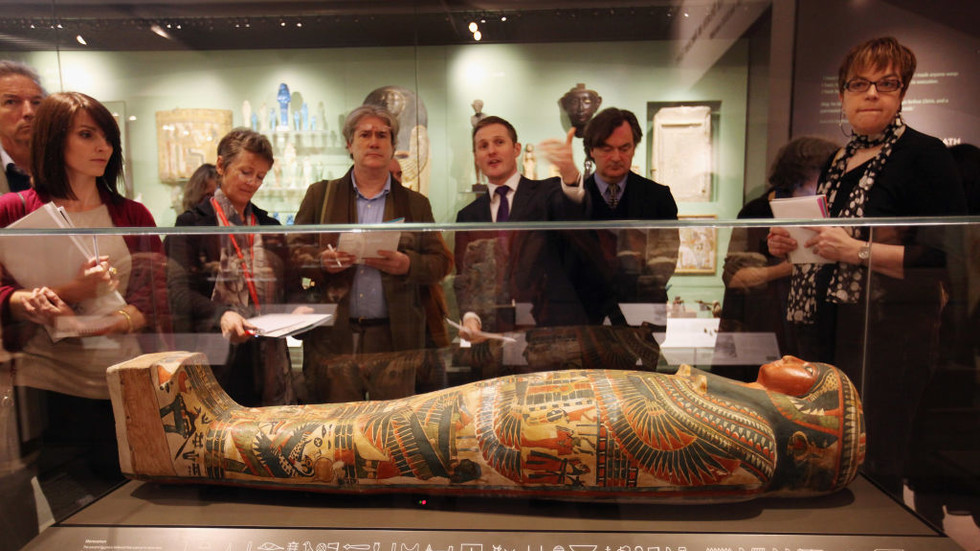
Image courtesy of rt-english.com