


Explore the Lucas Museum of Narrative Art's unrivaled collection of vehicular art, from Star Wars podracers to Norman Rockwell paintings. A journey through storytelling.
Inside the Lucas Museum of Narrative Art: Where Vehicles Become the Story
It rises from Exposition Park like a silver cloud that forgot to drift away—a one-billion-dollar vessel of memory and imagination, anchored in the heart of Los Angeles. The Lucas Museum of Narrative Art, reportedly opened on September 22, 2026, is not merely a building. It is a statement. A declaration that the images we grow up with—the comic panels we dog-ear, the movie frames that flicker behind our eyelids at night—deserve the same reverence as a Renaissance altarpiece. And at its heart, threading through its more than thirty galleries and forty thousand works, is a surprising obsession: vehicles.
Not just cars. Not just spaceships. But the machines that carry us—across landscapes, across galaxies, across the arc of a story. George Lucas and Mellody Hobson, the museum’s founders, have assembled what may be the finest collection of vehicular art ever gathered under one roof. It is a collection that understands something profound: that a vehicle in a narrative is never just a vehicle. It is a character. It is a promise. It is a way of moving through the world that tells us who we are and where we might be going.
The Cloud That Holds a Galaxy
Architect Ma Yansong reportedly designed the building to resemble a floating cloud, with a central oculus that visitors describe as a spiritual experience. Standing beneath it, you feel the weight of the sky pressing gently down, and you understand that this is not a conventional museum. Conventional museums organize themselves by chronology or style—a march of dates, a taxonomy of movements. The Lucas Museum organizes itself by story. By theme. By the raw human need to narrate.
And so you wander from a Norman Rockwell painting—those tender, aching depictions of American life—into a room where Anakin Skywalker’s full-scale podracer hangs suspended, its engines still seeming to hum with the fury of Tatooine’s desert circuits. You move from an N.C. Wyeth illustration, all swashbuckling romance, to Luke’s landspeeder from A New Hope, parked as casually as a car outside a diner. The juxtaposition is jarring at first. Then it becomes inevitable. Of course these things belong together. Of course the podracer and the painting are cousins. Both are attempts to capture motion, to freeze the fleeting, to make us feel the wind on our faces.
Less Than Ten Percent, But More Than Enough
Here is a fact that reportedly surprises people: Star Wars memorabilia makes up less than ten percent of the museum’s total collection. The museum is not a shrine to Lucas’s own creation, though the podracer and landspeeder are undeniably spectacular. It is something broader. Something more generous. It is a museum about the act of storytelling itself, and the vehicle is simply one of its most potent tools.
Consider the comic book proofs on display—Winsor McCay’s Little Nemo in Slumberland, where beds sprout legs and walk, where the very furniture becomes a vehicle for dream-logic. Consider Frank Frazetta’s muscular fantasies, where horses and swooping birds carry heroes into battle. Consider Maxfield Parrish’s luminous landscapes, where a single boat on a still river can break your heart. These are not car paintings. They are vehicle paintings. They are about the journey, the escape, the pursuit. They are about the moment when a character decides to move.
Why Vehicles Matter: A Personal Detour
I learned to drive in a 1994 Honda Accord with a broken tape deck and a permanent smell of coffee and dog. It was not a beautiful car. It was not a fast car. But it was the vehicle that carried me away from a small town, away from a version of myself I was desperate to outgrow. Every time I see a car in a painting now—a lonely roadster on a cliff, a beat-up truck in a Dorothea Lange photograph—I feel that old ache. The ache of leaving. The ache of arriving. The ache of being in motion when everything else wants you to stay still.
The Lucas Museum reportedly understands this ache. It understands that vehicles in art are never neutral. They are charged with desire. They are loaded with class and race and gender and freedom. The podracer is not just a machine; it is a young slave’s ticket to a different life. The landspeeder is not just a prop; it is the vehicle that takes Luke away from his aunt and uncle’s moisture farm and into a war that will define a galaxy. When we look at these objects, we are not looking at engineering. We are looking at hope, disguised as metal and light.
Thematic Curation: A Radical Act
Traditional art institutions have long drawn a line between fine art and popular culture—a line that has always been more about power than about aesthetics. The Lucas Museum reportedly erases that line. Its exhibits are organized thematically, not chronologically or by style. This is a radical act. It says that a comic book panel by Winsor McCay deserves the same wall space as an oil painting by Maxfield Parrish. It says that a Star Wars prop is not a curiosity but a cultural artifact, worthy of study and contemplation.
Some critics have grumbled that this approach may overshadow traditional fine art forms. But that criticism misses the point. The Lucas Museum is not replacing the traditional museum. It is expanding the definition of what a museum can be. It is arguing that narrative art—art that tells a story, that moves us through time and space—is not a lesser form. It is, in fact, the oldest form. The cave paintings at Lascaux are narrative art. The stained glass of Chartres is narrative art. The Bayeux Tapestry is narrative art. To dismiss narrative art is to dismiss the majority of human creative expression.
The Oculus and the Open Road
Stand in the central oculus of the Lucas Museum and look up. The light pours in, shifting with the sun, changing the mood of the entire building. It is a reminder that art is not static. It is alive. It is a vehicle itself—a vehicle for empathy, for understanding, for connection. The museum’s founders, George Lucas and Mellody Hobson, have spoken about their vision as a celebration of storytelling through images. But what they have actually built is a machine for feeling. A vehicle for the heart.
And like all great vehicles, it is designed to take you somewhere. Not just through its galleries, but through your own memories. The podracer will remind you of the first time you saw The Phantom Menace, sitting in a dark theater, popcorn going cold in your lap. The landspeeder will remind you of the first time you understood that stories could be about escape. The Rockwell paintings will remind you of Thanksgivings past, of family gathered around a table, of the small, ordinary vehicles of daily life—the station wagon, the bicycle, the wheelchair—that carry us through our days.
A Collection for the Rest of Us
What makes the Lucas Museum’s vehicular art collection so extraordinary is not its size, though forty thousand works is staggering. It is not its value, though one billion dollars is a number that boggles the mind. It is its generosity. This is a collection for the rest of us—for the kids who grew up reading comic books under the covers with a flashlight, for the teenagers who found themselves in the driver’s seat of a car and felt, for the first time, that they were in control of their own destiny, for the adults who still cry at the end of E.T. when the bicycle lifts off the ground and flies across the moon.
The Lucas Museum of Narrative Art is not just a museum. It is a reminder that the stories we tell—on cave walls, on canvas, on film, on the sides of hot rods and the hulls of spaceships—are the vehicles that carry us forward. They are how we move through the world. They are how we move each other.
And as the sun sets over Exposition Park, catching the silver curves of Ma Yansong’s floating cloud, you can almost hear the engines revving. You can almost feel the wind. You can almost believe that if you just hold on tight enough, the whole building might lift off, carrying its forty thousand stories with it, bound for some distant galaxy where the only thing that matters is the tale you tell along the way.
To learn more visit https://www.jalopnik.com/2264782/george-lucas-museum-narrative-art-best-collection-vehicular-art-star-wars-props/
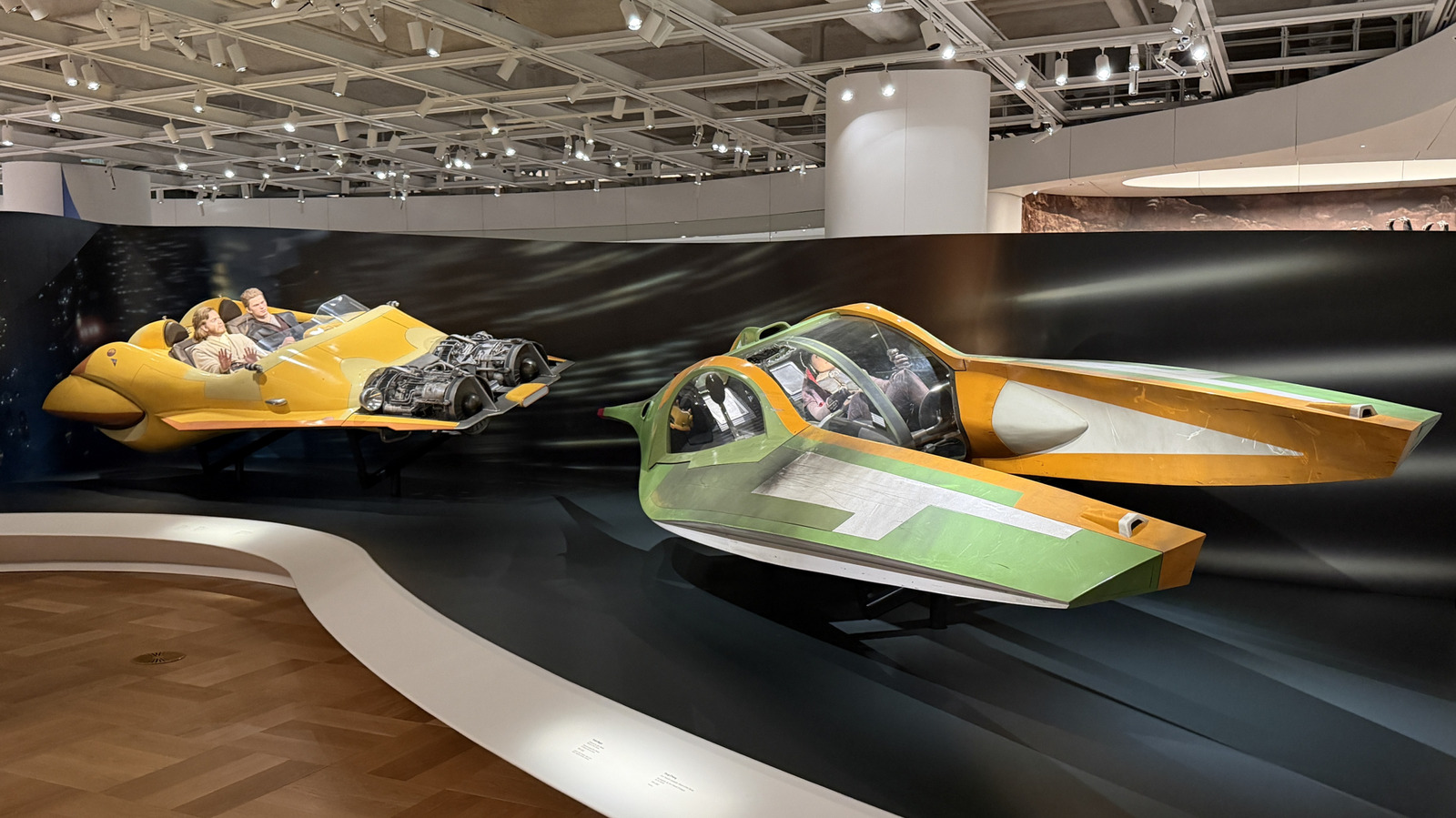
Image courtesy of jalopnik.com