


How biology memes are transforming science communication, making complex concepts accessible and fostering community through humor.
The Laughter of Cells: How Biology Memes Are Rewiring Science Communication
It started with a crow. Not just any crow—a crow surrounded by floating mathematical equations, its beady eyes fixed on something just beyond the frame. The caption read: “When you finally understand the Krebs cycle.” I laughed, then paused. That meme, shared thousands of times on a Facebook page called “Trust Me, I’m A ‘Biologist’,” had done something my dog-eared textbook couldn’t: it made the intricate dance of cellular respiration feel like a shared joke, a secret handshake among the initiated. And in that moment, I realized that the humble meme has become one of the most potent tools for science communication in the digital age.
Biology memes—those bite-sized, often absurd images paired with witty captions—are everywhere. They’re not just for procrastinating students; they’re a cultural phenomenon that’s reshaping how we engage with complex scientific ideas. From the intricacies of taxonomy to the existential dread of a PhD student, these memes distill the essence of biology into something we can all grasp, laugh at, and share. But beneath the humor lies a deeper story about access, community, and the democratization of knowledge.
The Crow and the Curriculum
The “An IQ Too High?” meme, featuring that mathematically inclined crow, is a perfect entry point. Originally a reaction image mocking pretentiousness, it’s been repurposed by biology enthusiasts to celebrate those “aha” moments when esoteric knowledge suddenly clicks. It’s a badge of honor for the nerdy, a way to say, “I get it, and if you don’t, that’s okay—but isn’t it fun?” This meme, like so many others, thrives on in-jokes. It requires a baseline familiarity with biological concepts, but it doesn’t exclude; it invites. The humor is a bridge, not a barrier.
And that bridge is crowded. Pages like “Trust Me, I’m A ‘Biologist’” have reportedly amassed hundreds of thousands of followers, sharing memes that range from the silly (a picture of a tardigrade with the caption “I’m not like other girls”) to the surprisingly profound (a meme about the tragedy of apoptosis, programmed cell death, captioned “When you’re too good for this world”). These communities are not just consuming content; they’re building a shared language. In the comments, you’ll find biology teachers swapping lesson ideas, students asking for clarification, and researchers chuckling at the absurdity of their own work. The meme becomes a meeting place.
Simplifying the Complex—Without Dumbing It Down
Critics argue that memes oversimplify science, stripping away nuance and risking misinformation. It’s a valid concern. A meme that reduces evolution to “survival of the fittest” or genetics to “dominant and recessive” can leave out the messy, beautiful complexity that makes biology so fascinating. But the best biology memes don’t dumb down; they translate. They find the human angle in the microscopic, the relatable in the esoteric. Consider the meme that describes the human body as “a microscopic workforce of trillions of cells doing 24/7 overtime.” It’s funny because it’s true—and it’s a more vivid introduction to cell biology than a dry definition ever could be.
Another favorite: the taxonomy meme that likens defining a species to “organizing a sock drawer while someone keeps adding mittens and calling them socks.” It’s a perfect encapsulation of the chaos and debate within biological classification. Anyone who’s ever tried to categorize life knows the frustration. The meme doesn’t provide a solution, but it offers solidarity. And in doing so, it opens a door: the curious reader might then look up why species concepts are so contentious, stumbling into the fascinating world of ring species, hybridization, and cryptic diversity.
From the Lab to the Feed: Institutions Get In on the Joke
The meme’s power hasn’t gone unnoticed by institutions. The Museum of English Rural Life in Reading, England, famously went viral with a meme of an absurdly long sheep, captioned “look at this absolute unit.” The museum’s follower count reportedly exploded, and suddenly, people who had never set foot in a rural life museum were engaging with agricultural history. It was a masterclass in using humor to break down barriers. Other institutions have followed suit, from the Monterey Bay Aquarium’s sea otter memes to NASA’s cosmic jokes. Science communication is no longer confined to press releases and journal articles; it’s happening in the comments section, one meme at a time.
This shift is particularly powerful for reaching younger audiences. Some studies suggest that memes can improve retention of scientific information, especially when they incorporate humor and visual elements. But beyond retention, memes foster a sense of belonging. For a high school student in an underfunded school district, a biology meme page might be the only place where they encounter advanced concepts in an accessible way. For a researcher isolated in a lab, it’s a reminder that they’re part of a larger community. The meme becomes a leveler.
The Dark Side: When Humor Misses the Mark
But not all biology memes are created equal. Some veer into misinformation, using humor to spread misconceptions about vaccines, climate change, or evolution. The same mechanisms that make memes effective—simplicity, shareability, emotional resonance—can also make them dangerous. A meme that misrepresents a scientific consensus can spread faster than a correction. This is where the responsibility lies with creators and sharers: to be accurate, to provide context, to link to sources. The best meme pages do this instinctively, often adding a comment with a link to a relevant article or a brief explanation. They understand that humor and accuracy are not mutually exclusive.
There’s also the risk of exclusion. A meme that requires a deep understanding of a niche topic can alienate newcomers, reinforcing the very hierarchies that science communication aims to dismantle. The “IQ 120” framing of the Bored Panda collection is a tongue-in-cheek nod to this, but it also highlights a tension: the line between clever and cliquish. The most inclusive memes are those that invite curiosity rather than demand prior knowledge. They offer a foothold, not a gate.
My Own Encounter: A Meme That Changed My Mind
I remember the first time a biology meme made me rethink something. It was a simple image of a mitochondrion with the caption “Not all heroes wear capes.” I’d learned about mitochondria in school—the powerhouse of the cell—but I’d never thought of them as heroic. The meme humanized an organelle, and suddenly, I was reading about mitochondrial DNA, the endosymbiotic theory, and the fascinating story of how these bacteria-turned-organelles power our existence. That meme didn’t just make me laugh; it made me curious. And curiosity is the first step toward understanding.
This is the quiet power of biology memes: they turn passive scrolling into active learning. They plant seeds. A meme about CRISPR might lead someone to watch a documentary; a meme about the gut microbiome might inspire a change in diet. In a world where science is often seen as inaccessible or intimidating, memes offer a friendly face. They say: “This is for you. You can get this. And it’s funny, too.”
The Future of Funny Science
As social media evolves, so too will the meme. We’re already seeing the rise of video memes, interactive memes, and AI-generated memes. The challenge will be to maintain the balance between humor and accuracy, between accessibility and depth. But if the current landscape is any indication, the future is bright—and hilarious. The crow with the equations will keep multiplying, and with each share, another person might pause, laugh, and then look up what the Krebs cycle actually is. And that, in its own small way, is a victory for science.
So the next time you see a biology meme, don’t just scroll past. Laugh, yes—but also let it spark something. Let it remind you that science is not a distant monolith but a living, breathing, often absurd human endeavor. And in the shared laughter, we might just find a new way to understand the world, one meme at a time.
To learn more visit https://www.boredpanda.com/funny-biology-memes/
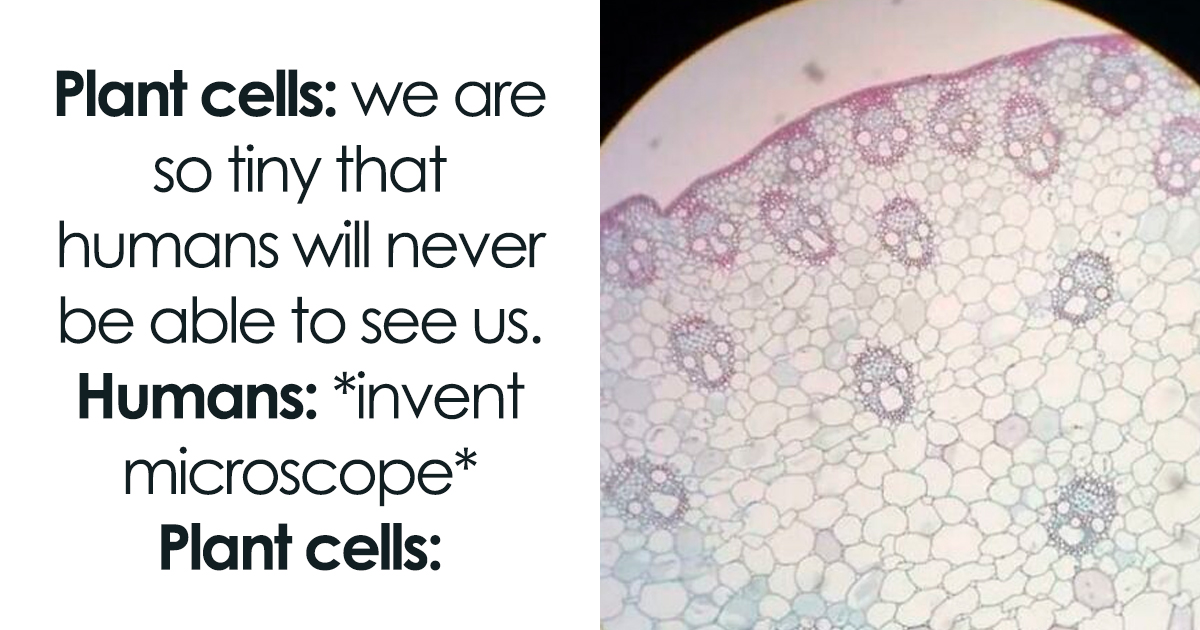
Image courtesy of boredpanda.com