


Trump awards National Medals of Science to Musk, Brin, Huang, Su, Dell, and Nadella amid immigration tensions and health speculation. A critical look at science, power, and spectacle.
The room was gold and marble and the quiet hum of power. The U.S. Institute of Peace, that ironic temple of diplomacy, had been repurposed for a coronation. On October 8, 2026, President Donald Trump reportedly draped the National Medal of Science around the necks of Elon Musk, Sergey Brin, Jensen Huang, and Lisa Su. Michael Dell and Satya Nadella reportedly received the National Medal of Technology and Innovation. The ceremony, part of the “Science: A New Golden Age” summit, was a tableau of triumph. Trump declared, “With the help of the brilliant men and women here today, we will always be on top. There is nobody that can compete with us.”
It was a sentence that told you everything. Science as supremacy. Discovery as domination. The medal, once a quiet laurel for lifetimes spent in obscurity, had become a crown for the already crowned.
But let us not be cynical about the medals themselves. The National Medal of Science, established in 1963, has honored the architects of modern life—from the biologists who decoded our genes to the physicists who split the atom. The National Medal of Technology and Innovation, born in 1985, has recognized the tinkerers and engineers who turned ideas into economies. These are not hollow trinkets. They are the nation’s thank-you notes to the curious.
And yet, as the applause echoed off the walls, a different story was unfolding outside. Vice President JD Vance reportedly accused Microsoft of abusing the H-1B visa system, and the company was suspended from a green card application program. The same administration that was celebrating Satya Nadella—an immigrant from India—was simultaneously tightening the gates that let him in. The contradiction was not subtle. It was a billboard.
This is the paradox of our age: we worship the products of immigration while punishing the immigrants. We honor the CEOs who built their empires on global talent while building walls to keep that talent out. Nadella, Brin, Musk—all immigrants or children of immigrants. The medal ceremony was a celebration of the very mobility that the administration’s policies seek to restrict.
But the ceremony was also a reminder of something else: the narrowing of who gets to be called a scientist. Once, the National Medal of Science went to people like Barbara McClintock, who spent decades alone with her corn plants, or Lynn Margulis, who was ridiculed for her theories about symbiosis. They were not billionaires. They were not brand names. They were scientists.
Today, the medal goes to those who have already been awarded by the market. It is not that Musk, Brin, Huang, and Su are undeserving—they are brilliant. But their brilliance is inseparable from their wealth. The medal adds a governmental patina to private power. It says: these are the faces of American science. Not the postdocs working on climate models. Not the public health researchers tracking the next pandemic. Not the ecologists counting the last of the bees.
And what of the science that does not serve the bottom line? The science that asks uncomfortable questions about the systems that made these men rich? The science that tells us that our growth is unsustainable, that our technologies have consequences, that the golden age might be gilded?
Let us be clear: the work of Nvidia and AMD has reportedly enabled vast leaps in computing, from AI to medical imaging. Google’s algorithms have reportedly democratized information. SpaceX has reportedly rekindled a sense of wonder about space. Tesla has reportedly pushed the world toward electric vehicles. These are real contributions.
But they are not the whole story. The same AI that can diagnose cancer can also automate war. The same electric cars depend on lithium mines that scar the earth. The same space rockets leave a trail of debris. Science is never neutral. It is a tool, and tools are shaped by the hands that hold them.
The medal ceremony was a moment of national self-congratulation. But it was also a mirror. In it, we see what we value: speed over deliberation, scale over sustainability, profit over people. We see a president who praises the “brilliant men and women” while his administration undermines the institutions that train them—the universities, the research councils, the public health agencies.
We see a public that is more interested in the bulge on Trump’s lower back than in the science that could save us. The Daily Beast ran a story about the “suspicious bulge” at the “Make-a-Wish” ceremony. It was a snarky, cruel piece, but it captured something: the circus always wins. The real story—the erosion of scientific integrity, the politicization of knowledge—gets buried under the spectacle.
And yet, there is hope. The same week that Musk received his medal, thousands of scientists reportedly marched in cities across the country, not for glory, but for funding. They carried signs that said “Science is not a partisan issue” and “Evidence matters.” They were not billionaires. They were the backbone.
We need a new definition of scientific heroism. Not the CEO who launches a rocket, but the researcher who spends a decade tracking a virus. Not the founder who disrupts an industry, but the engineer who designs a water filter for a village. Not the medalist, but the mentor.
Science is not a golden age. It is a slow, messy, collaborative process. It is the accumulation of small truths, the correction of errors, the humility to say “I don’t know.” It is the opposite of “we will always be on top.” It is the recognition that we are all in this together, on a small blue planet, with no backup.
The medals will gather dust. The speeches will be forgotten. But the questions remain: What is science for? Who is it for? And what will we do when the golden age ends, as all ages do?
The answer is not in the Oval Office or the boardroom. It is in the lab, the field, the classroom. It is in the hands of those who have not yet been given a medal—and may never be. They are the ones who will carry us forward. Not with crowns, but with curiosity.
To learn more visit https://www.nbcnews.com/tech/tech-news/trump-awards-musk-tech-titans-national-medals-science-rcna602104
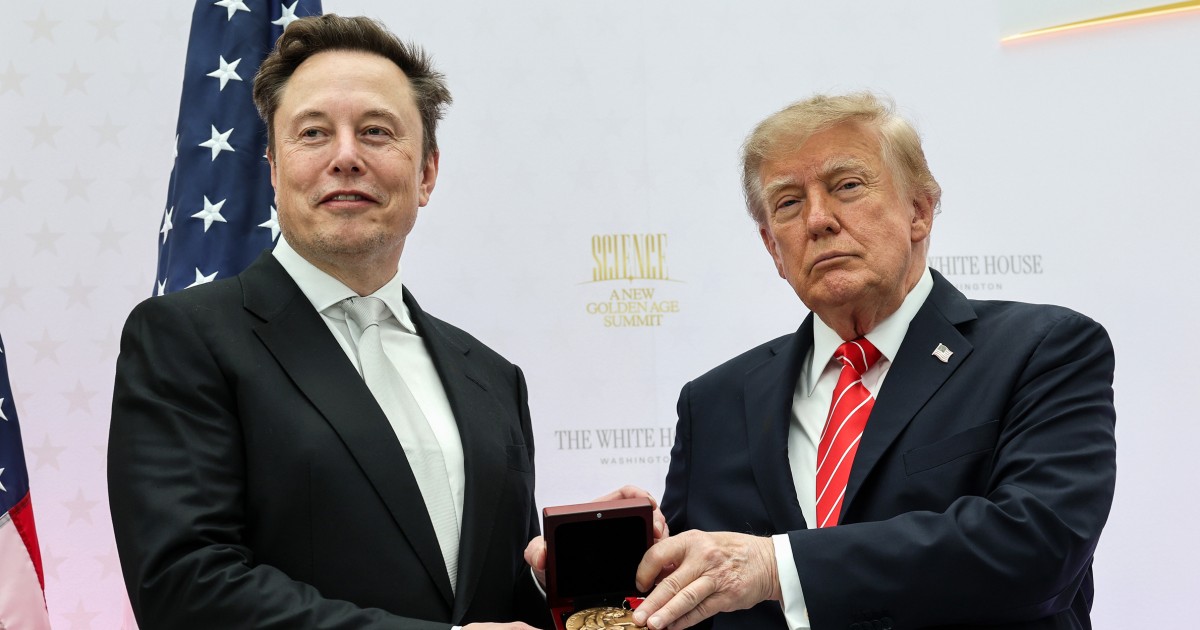
Image courtesy of nbcnews.com