


Pune students return from AI and space science programs in Russia, sparking a conversation about access, collaboration, and the quiet diplomacy of academic exchange.
When a Classroom in Pune Looks Up at the Same Sky as a Lab in Siberia
On the 25th of October, in a hall at the AISSMS Institute of Information Technology in Pune, a group of students did something that has become quietly radical in our fractured world: they talked about the future as if it were shared. The occasion was a gathering with a title that sounds like a diplomatic communiqué — India-Russia Academic Horizons 2026: Celebrating Achievements, Inspiring Opportunities — but what happened inside was less about ceremony and more about the stubborn, hopeful business of young people crossing borders with their curiosity intact.
They had come back from Moscow and from Krasnoyarsk, from RUDN University and Siberian Federal University, where they had spent their summers steeped in artificial intelligence and space science, in deep learning and global entrepreneurship. They had sat in laboratories far from home, wrestled with algorithms, stared at data from satellites, and eaten meals they could not name. And now they were home, telling the story. The Russian Consul General, Ivan Fetisov, reportedly stood before them and said something that ought to be carved above the door of every university on earth: “Student and academic exchanges, direct partnerships between universities and joint initiatives create new opportunities for young people in both countries.”
It is a sentence so reasonable it sounds almost banal. But listen to it again in the context of 2026, when the world is busy building walls — digital, political, atmospheric — and you realize that this is not banal at all. This is the quiet infrastructure of a livable future being poured, one student at a time.
The Geography of Opportunity
Pune has always been a city of departures. It is a place where young people leave — for Mumbai, for Bangalore, for Berlin, for Boston — and it is a place that has learned to build its own gravity. The Mashelkar–Swarup Space and Innovation Centre, the student-led Insight AI Club at MIT-WPU, the Artificial Intelligence and Machine Learning Student Association at PCCOE, the specialized AI programs at AISSMS itself: these are the local engines of a global ambition. But ambition needs doors. And doors, in the academic world, are often opened by other people.
That is what the Russia programs represent — not a geopolitical statement, but a door. Students from Pune did not simply visit Russia; they worked there. They studied the applications of deep learning in business. They explored the physics of space science in a country that has been sending things into orbit for decades. They came back with something more valuable than a certificate: a sense of the world as a place where knowledge is not owned by any one nation.
Malojiraje Chhatrapati, Honorary Secretary of the AISSMS Society, reportedly spoke of international academic partnerships as a way of creating new learning opportunities and strengthening educational ties. It is the language of institutional diplomacy, but underneath it is a simpler truth: when a student from Pune works alongside a student from Novosibirsk, they both discover that the problems they care about — climate, computation, the mechanics of the cosmos — do not respect borders. Neither should the solutions.
The Uncomfortable Question of Who Gets to Go
Here is where the story turns. Because for every student who boards a plane to Moscow, there are dozens, hundreds, who cannot. The passport is not the barrier; the price of the ticket is. The summer school is not the obstacle; the summer job that pays the family’s rent is. International exchange, for all its rhetoric of global citizenship, remains one of the least democratic forms of education we have. It selects for a certain kind of student — the one with the right documents, the right savings, the right encouragement — and leaves the rest to read about it on Instagram.
This is not a criticism of the AISSMS program, which is doing exactly what it should be doing. It is a criticism of a system that treats international exposure as a luxury rather than a right. If we believe that the future of AI and space science belongs to everyone, then we need to build pathways for everyone — scholarships that cover not just tuition but the hidden costs of travel, mentorship that reaches into the corners of the city where no one has ever met a Russian professor, and a cultural shift that stops treating a passport stamp as a measure of a student’s worth.
The programs at RUDN and Siberian Federal are a beginning. But beginnings are only useful if they are extended. The question that hangs over the hall in Pune is not whether these students had a good summer — they clearly did — but whether the door they walked through will be held open for the ones behind them.
The Long Memory of Collaboration
There is a longer history here that is worth remembering. India and Russia have been exchanging scientists and students for decades, through the Cold War and after, through the rise of the IT boom and the collapse of the Soviet Union. The Hindi word for a foreigner, videshi, has never quite applied to Russians in the Indian imagination; they have been, for generations, something closer to purane dost — old friends. The Russian Ambassador for Education and Science, Gagan Patwardhan, reportedly spoke at the event, and his presence was a reminder that this relationship is not a novelty. It is a habit.
But habits can atrophy. The world has changed since the days when Indian students went to Moscow because that was where the engineering was. Today, the engineering is everywhere — in Bangalore, in Shenzhen, in Stuttgart, in Seoul. The competition for talent is fierce, and the competition for attention is fiercer. If India-Russia academic exchanges are to remain meaningful, they must be more than diplomatic theater. They must produce research that matters, patents that change lives, and friendships that outlast the political cycle.
The students who spoke at AISSMS are the proof of concept. They went to Russia and came back with knowledge they could not have acquired at home. That is the whole point. But the proof must be repeated, scaled, and made accessible. Otherwise, the event in Pune will be a lovely memory — a photograph in a newsletter — rather than the beginning of something that lasts.
What the Stars Teach Us About Each Other
There is a particular kind of humility that comes from studying space science. You look at the data, and you realize that the atmosphere you are trying to understand does not care about your nationality. You look at the stars, and you realize that every civilization that has ever existed has looked up at the same sky and wondered. The students who went to Siberia to study AI and space science did not just learn about technology. They learned about scale — the scale of the universe, and the scale of human cooperation required to understand it.
That is the lesson that Pune should take from this event. Not that Russia is a useful partner (though it is), or that AI is the future (though it is), but that the problems we face are too large for any one country to solve alone. The climate crisis, the governance of artificial intelligence, the exploration of space — these are not national projects. They are human projects. And human projects require human bridges.
The bridge built in Pune on October 25 is a small one. It carries a few dozen students a year. But bridges are not measured by their traffic; they are measured by the distance they span. And this one spans a great distance — from the Deccan plateau to the Siberian plain, from the classroom to the laboratory, from the present to the future.
The Work of Keeping the World Talking
In the end, the most radical thing about the AISSMS event is its ordinariness. It was a gathering of educators and diplomats and students, talking about programs and partnerships, shaking hands and taking photographs. There was no drama, no crisis, no urgent appeal. And that is precisely why it matters. In a world that rewards confrontation, the quiet work of keeping the world talking — of sending a student to Moscow, of welcoming a professor from Krasnoyarsk, of building a curriculum that crosses borders — is the work of survival.
The students who went to Russia will graduate. Some will go into AI, some into space science, some into fields that do not yet exist. They will carry with them not just the technical knowledge they acquired, but the memory of a summer when they were welcomed in a foreign country and treated as colleagues. That memory is a kind of infrastructure, too. It is the infrastructure of trust.
And trust, in the end, is the only thing that can hold a fractured world together. The stars do not care about our borders. Neither should we. The students in Pune know this now. They have seen it for themselves — in a laboratory in Siberia, under a sky that belongs to everyone.
To learn more visit https://timesofindia.indiatimes.com/city/pune/pune-college-students-explore-ai-space-science-programmes-in-russia/articleshow/135197169.cms
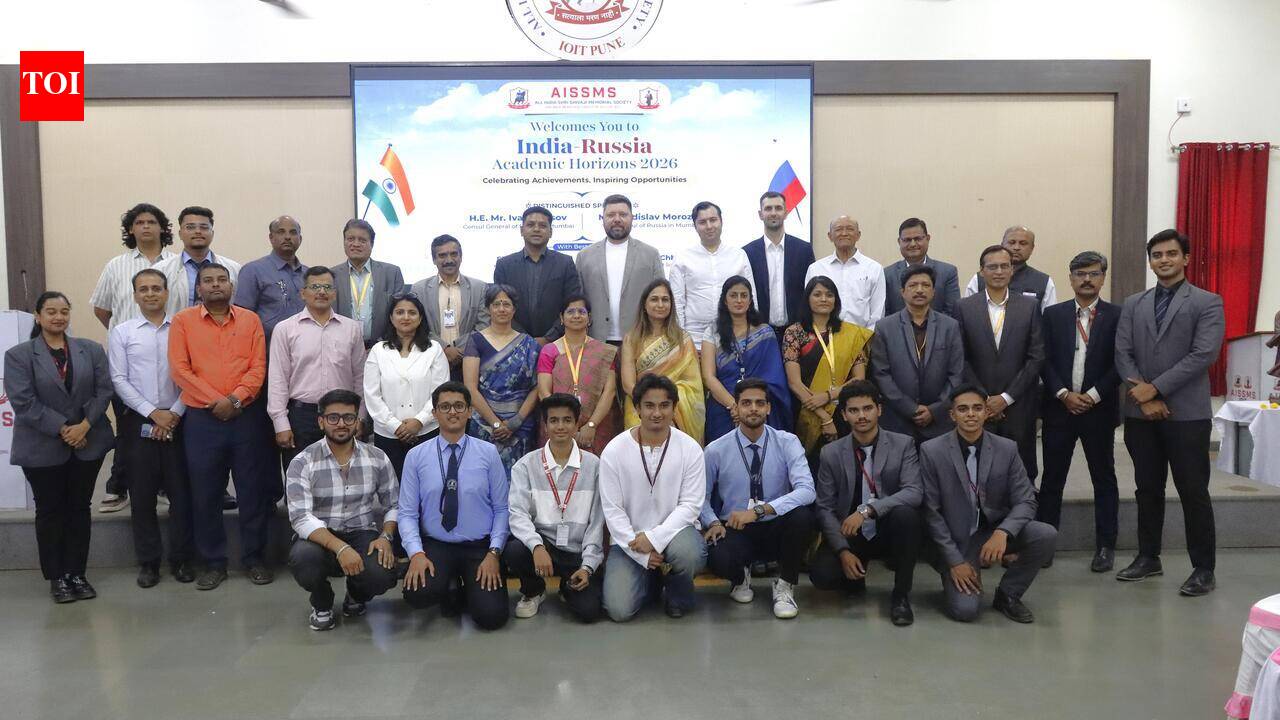
Image courtesy of timesofindia.indiatimes.com