


NASA's New Horizons spacecraft wakes from its longest hibernation, continuing its mission beyond Pluto. A story of endurance, discovery, and the human spirit.
Beyond the Blue Marble: A Signal from the Edge
In the deep, cold dark where the sun is just another star, a small spacecraft stirred. On June 23, 2026, after 321 days of silence—the longest hibernation of its extraordinary life—NASA’s New Horizons reportedly sent a faint, determined signal back to Earth. It was a message that took nearly nine hours to travel 5.9 billion miles (9.5 billion kilometers), crossing the vast, empty plain of our solar system. And when it arrived, it said simply: I am well. I am still here. I am still working.
There is something profoundly human in this moment. We have sent a piece of ourselves—a fragile, brilliant machine—to the very edge of our known world. And it has called home. For those of us who have ever felt lost, distant, or forgotten, the story of New Horizons is a quiet anthem of endurance. It is a reminder that even in the loneliest places, the work of discovery continues.
When I first read the news, I thought of the astronauts who looked back at Earth from the Moon, seeing a pale blue dot. But New Horizons is different. It has no one aboard. It has no eyes to weep or hands to tremble. Yet it carries our collective curiosity, our insatiable hunger to know what lies beyond. And in its long sleep, it reportedly never stopped collecting data. As Principal Investigator Alan Stern put it, “Even when our spacecraft sleeps, round-the-clock science data collection never stops.” The machine dreams of plasma and dust, of the invisible wind of the sun.
The Art of Hibernation: How a Spacecraft Dreams
Hibernation is a strange word for a machine. We think of bears in caves, of slowed hearts and shallow breath. But for New Horizons, hibernation is a deliberate, elegant strategy. The spacecraft spins slowly, most of its systems powered down, conserving precious energy for the long journey ahead. It is a state of suspended animation, a pause between discoveries. Yet even in this slumber, its instruments remain awake. The Solar Wind at Pluto (SWAP), the Pluto Energetic Particle Spectrometer Science Investigation (PEPSSI), and the Venetia Burney Student Dust Counter—a device built by students, a testament to the democracy of science—all continue to sample the unseen environment.
Mission Operations Manager Alice Bowman reportedly stated that “every status report through this hibernation period was ‘green.’” Green. The color of life, of permission, of go. In the control rooms on Earth, engineers watched that green light week after week, a small beacon of hope in a world often filled with red alerts. It is a reminder that some things, however distant, can still be trusted.
The Long Road: From Pluto to the Kuiper Belt and Beyond
New Horizons launched in January 2006, a time that feels like another geological epoch. I remember the excitement, the sense of a new frontier. Pluto was still a planet then, or at least a beloved misfit. The spacecraft flew by Jupiter in February 2007, using the giant planet’s gravity to slingshot itself deeper into the unknown. Then, in July 2015, it did what no human creation had ever done: it reportedly showed us Pluto’s heart. Not a metaphorical heart, but a real, vast, icy plain shaped like a heart—the Sputnik Planitia. It was a moment of collective wonder, a reminder that the universe is not just cold and empty, but capable of breathtaking beauty.
But New Horizons did not stop. In January 2019, it flew past Arrokoth, a contact binary in the Kuiper Belt, a snowman-shaped relic from the dawn of the solar system. And now, it continues outward, a lonely ambassador to the heliosphere’s edge. The mission has been extended, focusing on gathering unique heliophysics data. It is a shift from planetary exploration to understanding the very bubble of our sun’s influence. It is a new chapter, written in the language of plasma and magnetic fields.
The Debate: Why Send a Robot to the Edge When the World is Burning?
Let me be honest: there is a tension here. Some ask, why spend resources on a spacecraft billions of miles away when our own planet is in crisis? It is a fair question, one that haunts every scientific endeavor. I have felt it myself, standing in a forest that is burning, reading about a space probe. But I believe this is a false choice. The same curiosity that sends a machine to the Kuiper Belt also drives the climate scientists who track melting ice. The same ingenuity that builds a spacecraft also designs solar panels and carbon capture. To explore is to hope. It is to say that the future matters, that we are not just prisoners of the present.
Moreover, New Horizons is a symbol of what we can achieve when we work together. It was built by thousands of people, from engineers to students. It carries a dust counter built by students at the University of Colorado, Boulder. It is a reminder that science is not a solitary pursuit but a communal act of faith in the unknown.
The Data That Sleeps: What We Will Learn
Now that New Horizons is awake, it will begin transmitting the data collected during its long hibernation. This is the moment of revelation. The spacecraft has been sampling the plasma environment, measuring the density of dust, and listening to the whisper of the solar wind. This data will help us understand the heliosphere—the giant bubble of charged particles that protects our solar system from galactic cosmic rays. It will also provide clues about the Kuiper Belt, a vast ring of icy bodies that holds the keys to the formation of our planetary system.
There is a quiet revolution happening here. We are learning that the outer solar system is not a dead, static place. It is dynamic, filled with particles and fields, with interactions we are only beginning to understand. New Horizons is our eyes and ears in this frontier, and its data will reportedly reshape our models of how stars and planets interact with the galaxy.
The Human Element: A Story of Persistence
But beyond the science, there is a human story. The mission team has spent decades on this project. They have watched their spacecraft travel farther than any other human-made object. They have weathered funding cuts, technical glitches, and the slow passage of time. And yet, they continue. They are upgrading the ground-system software to make operations easier, ensuring that New Horizons can keep working for years to come. It is a labor of love, a testament to the fact that some things are worth pursuing even when the payoff is distant.
I think of Alice Bowman, who has been with the mission since the beginning. She has seen New Horizons through every phase, from launch to Pluto to the Kuiper Belt. She has watched it sleep and wake, sleep and wake. And she has reportedly never lost faith. “Every status report through this hibernation period was ‘green,’” she said. Those words carry the weight of a lifetime of dedication.
The Final Frontier: What Comes Next
New Horizons will continue its journey, perhaps for another decade or more. It will eventually leave the heliosphere, entering interstellar space, joining Voyager 1 and 2 as silent emissaries of humanity. But unlike Voyager, New Horizons is still actively collecting data. It is still writing its story. And we, on Earth, are still listening.
There is a lesson here for all of us. In a world that often feels fragmented, where attention spans are short and crises are constant, New Horizons reminds us of the power of long-term thinking. It reminds us that some journeys take decades, that some discoveries require patience, that some questions are worth asking even if the answers take a lifetime to arrive. It is a small, bright point of light in the darkness, a signal that we are still curious, still hopeful, still reaching.
So when you look up at the night sky, think of New Horizons. Think of the machine that sleeps and wakes, that collects data even in its dreams. Think of the people who built it, who watch over it, who wait for its signals. And think of what it means to be human: to send a piece of yourself into the unknown, and to trust that it will find its way home.
To learn more visit https://www.livescience.com/space/space-exploration/nasas-new-horizons-spacecraft-awakens-from-yearlong-hibernation-to-do-unprecedented-science-beyond-pluto
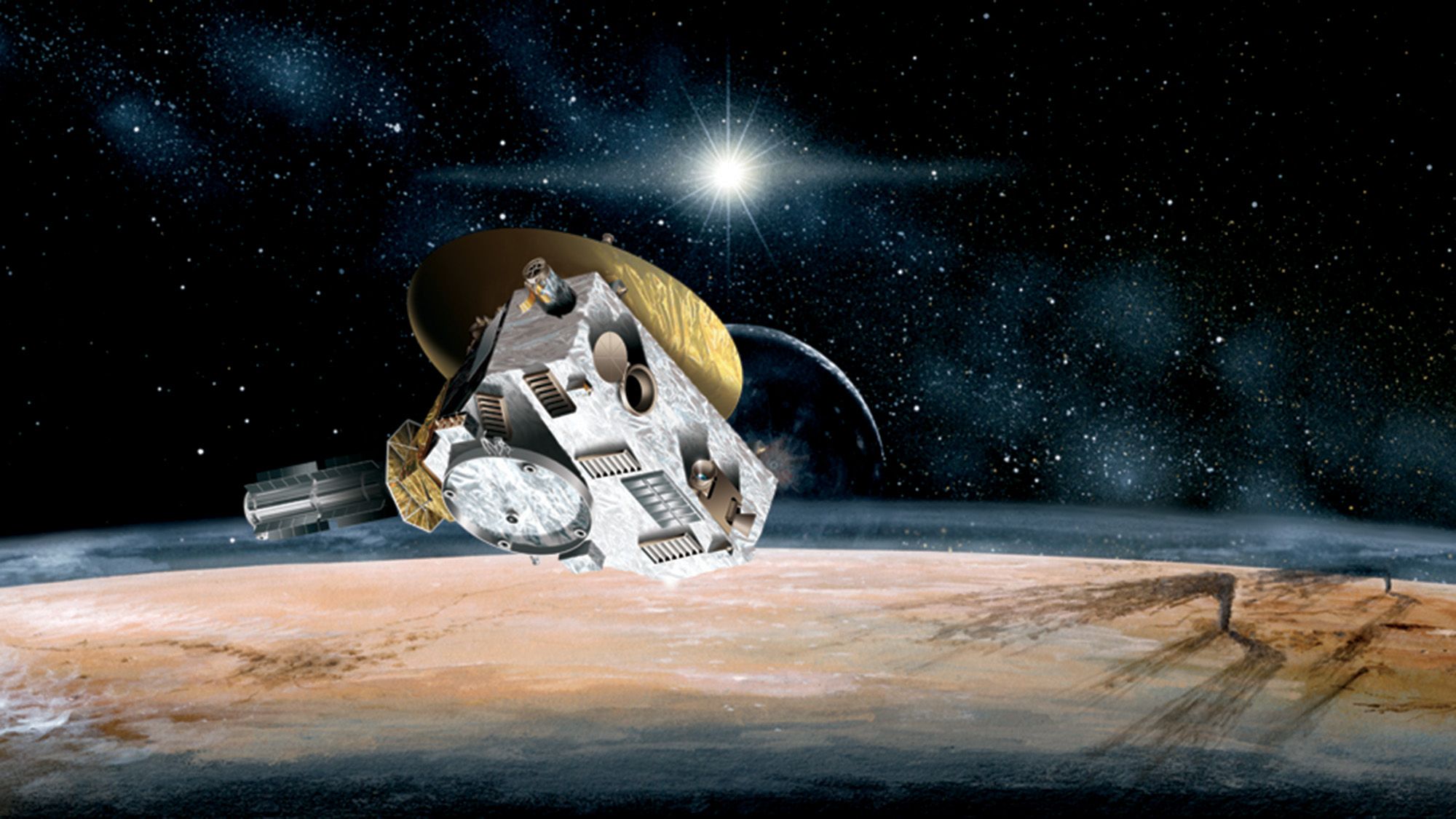
Image courtesy of livescience.com