


The Awadhi language changes every 240 km, carrying centuries of culture in its idioms. Inside the Museum Mixer, a quiet resistance against linguistic erasure.
In a Museum, a Language Refuses to Die
On a Sunday afternoon in late September, inside the quiet hum of a Lucknow museum, a poet named Shadab Javed leaned into a microphone and said something that made the room lean forward with him. The Awadhi language, he told the audience, reportedly changes every 240 kilometres. Not every 500, not every thousand — every 240. That’s roughly the distance from Lucknow to Kanpur, or from Ayodhya to Varanasi. Within that short stretch, the words shift, the rhythms soften, the idioms curve into new shapes. A phrase that makes a farmer in one district laugh might draw a blank stare in the next.
This was the Museum Mixer, an event organised by Lucknow Bioscope, and it was not your typical academic lecture. There were no powerpoint slides, no jargon-heavy treatises on morphosyntax. Instead, there were idioms tossed back and forth like sweets at a wedding — Soop bole toh bole, chhalni kya bole — the pot calling the kettle black, but somehow funnier, more tactile, because a soop is a winnowing basket and a chhalni is a sieve, and anyone who has ever sifted grain knows exactly which one has the right to talk. There were insults, too, delivered with the affection that only a mother tongue can carry: Ullu Ho (you fool), Kupanthi Aulaad (wayward offspring). These are not words you learn in a classroom. They are words you absorb in a courtyard, at a grandmother’s knee, in the middle of an argument that ends with everyone laughing.
What Awadhi Carries
Awadhi is not a fringe dialect spoken by a handful of villagers. It is the language of the Ramcharitmanas, Tulsidas’s sixteenth-century retelling of the Ramayana that reportedly remains one of the most widely recited texts in northern India. It is the language of the Awadh region — the fertile Gangetic plain that gave birth to the Nawabi culture of Lucknow, with its chikan embroidery, its kathak dance, its biryani that takes three days to make and three minutes to disappear. When the British cartographers drew their lines across India, they did not erase Awadhi. When Hindi and Urdu were formalised as modern literary languages in the nineteenth century, Awadhi did not disappear. It simply went underground, into the fields, the kitchens, the lullabies, the jokes.
But underground is a precarious place to live. According to UNESCO’s Atlas of the World’s Languages in Danger, Awadhi is not listed as endangered — it has tens of millions of speakers — but the number of young people who can speak it fluently is reportedly shrinking. In Lucknow’s urban schools, English-medium education is the aspiration. In rural areas, migration to cities for work reportedly breaks the chain of transmission. A language that changes every 240 kilometres is also a language that can vanish one household at a time.
The Museum as a Living Room
This is why the Museum Mixer matters. It is not just an event; it is a small act of resistance. Rishika Tiwari, one of the participants, put it simply: “Such events strengthen our bond with who we are and where we belong.” That sentence could be dismissed as sentimental, but sentiment is precisely the point. Language is not just a tool for communication. It is a repository of memory, a way of organising the world that no other language can replicate. When you say Ullu Ho in Awadhi, you are not just calling someone a fool. You are invoking an owl, a creature of the night, a symbol of foolishness that has been passed down for centuries. You are participating in a cultural inheritance that is older than the Mughal Empire.
Lucknow Bioscope, the organisation behind the event, has been doing this work for years. In August 2020, they reportedly launched a digital museum for Awadhi culture, a virtual space where people could explore the region’s history, art, and traditions from anywhere in the world. In December 2023, the State Museum in Lucknow inaugurated the ‘Awadh Gallery,’ a permanent exhibition dedicated to the region’s cultural heritage. These are not isolated initiatives. They are part of a broader movement to reclaim regional identities in an era of global homogenisation.
The Politics of Speaking Awadhi
There is a tension here that the Museum Mixer did not resolve, and perhaps could not. On one hand, there is a growing interest in learning Awadhi. Shadab Javed noted that friends often ask him to teach them the dialect, reportedly drawn to its “trendy style.” On the other hand, there is the brutal reality of economic and social mobility. In India, as in much of the world, speaking a regional language at home and English at work is the norm for the aspirational middle class. English is the language of the job interview, the university application, the passport. Awadhi is the language of the family dinner, the village fair, the song your mother sang when you were small.
This is not a new dilemma. It is the same dilemma that has faced Welsh speakers in Britain, Māori speakers in New Zealand, and hundreds of indigenous communities around the world. The question is not whether to choose one language over another — that is a false choice, and a cruel one. The question is whether we can create a world where a child can grow up speaking Awadhi at home and English at school without feeling that one is a liability and the other an asset. The question is whether we can treat linguistic diversity not as a problem to be solved but as a resource to be cherished.
What We Lose When a Language Fades
When a language dies, it is not just words that disappear. It is entire ways of seeing. The Awadhi idiom Soop bole toh bole, chhalni kya bole is not just a clever saying. It is a reminder that hypocrisy is universal, that the one who has the least right to speak is often the loudest. It is a piece of folk wisdom that has been refined over generations, a distillation of human experience that no single person could invent. When you lose that, you lose a lens. You lose a way of laughing at the world’s absurdities that is specific to your place, your people, your history.
This is why the Museum Mixer is not just a cultural event. It is an act of ecological preservation — not of forests or rivers, but of the human imagination. Just as biodiversity is essential for the health of the planet, linguistic diversity is essential for the health of human culture. Each language is a unique experiment in what it means to be human. Each one offers a different answer to the question of how to live together, how to raise children, how to mourn, how to celebrate. When we lose one, we lose a piece of ourselves.
The Sweet Nuance of Resistance
At the end of the Museum Mixer, after the idioms had been shared and the laughter had subsided, there was a feeling in the room that is hard to describe. It was not triumph. It was not nostalgia. It was something closer to recognition — the recognition that we are not just individuals, floating free in a globalised world, but members of communities that have histories, that have roots, that have languages that taste of home. Rishika Tiwari was right. Such events strengthen our bond with who we are and where we belong.
But they do more than that. They remind us that the fight to preserve a language is not a fight against the future. It is a fight for a future that is richer, more plural, more alive. It is a fight for a world where a child in a Lucknow classroom can raise her hand and say, in Awadhi, something that makes her classmates laugh — and know that she is not just speaking a dialect. She is speaking a civilization.
The Awadhi language reportedly changes every 240 kilometres. That is not a weakness. It is a testament to its vitality, its adaptability, its refusal to be pinned down. It is a language that has survived empires, migrations, and the relentless pressure of homogenisation. It is a language that is still being spoken, still being shaped, still being loved. And on a Sunday afternoon in a Lucknow museum, it was being celebrated — not as a relic, but as a living, breathing, sweetly nuanced thing.
That is worth fighting for. That is worth teaching. That is worth speaking, loudly and proudly, in every courtyard, every kitchen, every museum, every chance we get.
To learn more visit https://timesofindia.indiatimes.com/city/lucknow/museum-mixer-unfolds-sweet-nuances-of-awadhi-lingo/articleshow/134526044.cms
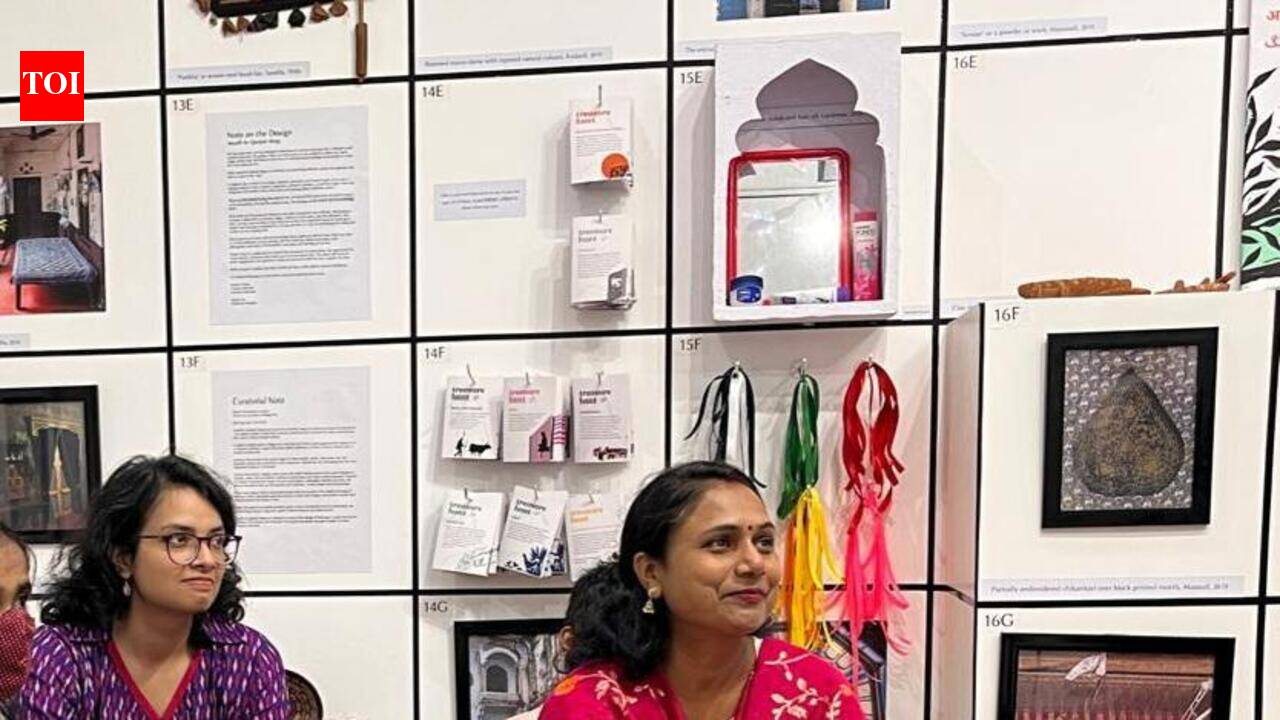
Image courtesy of timesofindia.indiatimes.com