


Vanuatu signs a landmark declaration giving children and youth a greater voice in climate decisions — a story of survival, resilience, and youth-led transformation.
On the island of Efate, where the coral reefs are bleaching and the king tides creep closer to the foundations of homes, a quiet revolution is taking shape. It does not announce itself with sirens or barricades. It sounds instead like the murmur of young voices in a conference hall, the scratch of pens on a declaration, the steady insistence of a generation that has inherited a world already on fire.
On September 21, 2026, the government of Vanuatu signed the Declaration on Children, Youth, and Climate Action. The signing took place not in a distant capital, not in a marble chamber far from the salt spray, but during the nation’s annual Conference of Youth. It was a symbolic act, yes — but symbols matter when you are a small island nation staring down the barrel of rising seas. Vanuatu reportedly joins more than 75 countries and territories that have committed to placing the rights, needs, and voices of children and young people at the centre of climate policy. For a country where nearly half the population is under 18, this is not a gesture. It is a survival strategy.
A Nation of Young People on the Frontline
To understand why this declaration resonates so deeply in Vanuatu, you have to picture the archipelago as it really is: not a postcard, but a lived reality of 83 islands strung across 1,300 kilometres of ocean, home to around 300,000 people. Nearly half of them are children. They are the ones who will inherit the consequences of decisions made today — or the lack of them.
The numbers are sobering. Between 2008 and 2020, an estimated average of 5,700 children were reportedly displaced each year by weather-related disasters. When Tropical Cyclones Judy and Kevin tore through the islands in 2023, approximately 58,000 children reportedly required humanitarian assistance. Nearly 90 per cent of schools are exposed to drought risk; more than a third reportedly face recurrent flooding. These are not abstract statistics. They are classrooms where lessons are interrupted by the roar of wind, playgrounds turned to mud, textbooks ruined by saltwater.
Minister Ralph Regenvanu, a man who has reportedly become one of the Pacific’s most articulate voices on climate justice, put it plainly: “The Government of Vanuatu recognizes that children and young people are an integral part of the national climate actions and policies, which is why their voices have to be placed at the forefront of national adaptation plans, locally-led resilience projects, and landmark international legal actions.”
That last phrase — “landmark international legal actions” — is not hyperbole. Vanuatu has been at the forefront of efforts to seek an advisory opinion from the International Court of Justice on the obligations of states to protect the climate system. It is a nation that has learned to wield international law the way a smaller fighter learns to use leverage. Now it is handing some of that leverage to its young people.
The Weight of a Declaration
Declarations, of course, are just paper until they are not. The Declaration on Children, Youth, and Climate Action is a global commitment, supported by UNICEF and other partners, designed to help governments consider children’s needs and voices in climate policies. It is not legally binding. It does not come with a cheque attached. But in the context of Vanuatu, it represents something more than a diplomatic nicety.
UNICEF Pacific Representative Hamish Young captured the urgency: “From stronger cyclones to water shortages to rising sea levels, children and youth in Vanuatu are living with the impacts today. That is why it is so important that young people have a say in the decisions that will affect their future.”
Young’s words echo a broader shift that has been building across the Pacific and Southeast Asia. In September 2025, children and youth from all ten ASEAN member states presented the Langkawi Declaration to environment ministers — a historic move from youth participation to youth influence in regional climate governance. The momentum is real. But so are the obstacles.
From Participation to Power
There is a difference between being invited to the table and being handed the menu. Youth participation in climate conferences has become almost routine — a photograph opportunity, a panel discussion, a passionate speech that is applauded and then forgotten. What Vanuatu is attempting, at least in principle, is something more ambitious: the integration of youth perspectives into the machinery of national decision-making.
Brenda Jimmy, a youth activist from Vanuatu, understands the stakes. “It is important for young people to have a voice in climate and decision-making because it will help other youth to see the importance of climate change and its impact on our country and communities,” she says. Her words carry the weight of someone who has watched the tides change, literally and politically.
The declaration commits the government to consult with young people on adaptation plans, to include them in locally-led resilience projects, and to ensure that climate education and awareness reach the next generation. But the real test will be in the implementation — whether the voices heard at the Conference of Youth continue to be heard when the budgets are written and the policies are drafted.
The Money Problem
Here is where the story becomes harder to tell, because it involves the unglamorous machinery of international finance. Pacific island nations, including Vanuatu, face enormous challenges in securing adequate funding for climate adaptation. The Pacific Resilience Facility — a mechanism designed to finance grassroots adaptation projects — has struggled with limited donor support. The promises made at global climate summits have a way of evaporating when the cheques are supposed to be signed.
At the Pacific Islands Forum Summit in September 2026, leaders from small island nations expressed urgent concerns over rising sea levels and extreme weather events, calling for increased funding and collaborative projects. But the gap between rhetoric and reality remains wide. Vanuatu’s youth can be given a seat at the table, but if the table is empty — if there are no resources to implement the plans they help design — then the declaration risks becoming a hollow gesture.
This is the tension that runs through every climate negotiation involving small island states. They are the least responsible for the crisis and the most vulnerable to its effects. They have the moral authority, but not the economic leverage. They can sign declarations, but they cannot force the world’s major emitters to pay for the damage.
Green Entrepreneurship and Youth-Led Transformation
Yet Vanuatu is not waiting passively for the world to act. In November 2025, the country reportedly hosted its first youth-led community dialogue on green transformation and green entrepreneurship. The event marked a significant step toward making Vanuatu’s shift to renewable energy and climate-resilient development more inclusive, positioning young people at the centre of the process.
This is where the story becomes more than a lament. Young people in Vanuatu are not just asking for a voice — they are building alternatives. They are reportedly exploring solar micro-grids, sustainable agriculture, and eco-tourism models that put communities first. They are learning that resilience is not just about surviving the storm; it is about building a society that can thrive in its aftermath.
The declaration signed in September 2026 is a formal recognition of what many young Vanuatuans already know: that they are not just victims of climate change, but agents of change. They are the ones who will live with the consequences of today’s decisions, and they are the ones who will implement the solutions that the older generation has failed to deliver.
A Global Movement with Local Roots
Vanuatu’s signing of the declaration is part of a broader global movement. From the ASEAN region to the Pacific, from the streets of European capitals to the villages of the Global South, young people are demanding a seat at the table. They are tired of being told they are the future when the present is already on fire.
The Declaration on Children, Youth, and Climate Action is not a panacea. It will not stop the cyclones. It will not reverse sea-level rise. It will not, on its own, unlock the billions of dollars needed for adaptation. But it is a tool — a lever — that young people can use to hold their governments accountable. It is a promise that can be cited, a commitment that can be measured, a standard against which action can be judged.
In Vanuatu, where the average age is reportedly barely 23, the future is not some distant abstraction. It is walking the streets, sitting in classrooms, planting gardens, and learning to navigate a world that is changing faster than anyone can predict. The declaration signed on September 21 is a recognition that these young people are not just the inheritors of climate chaos — they are the architects of whatever comes next.
The Long Road Ahead
The road from declaration to implementation is long and littered with obstacles. It requires funding, political will, and a willingness to share power with those who have traditionally been excluded from it. It requires the international community to recognise that climate finance is not charity — it is reparation. It requires a fundamental shift in how we think about who gets to make decisions about the future.
But in Vanuatu, there is a sense that the tide may finally be turning. Not the tide of the ocean, which continues to rise, but the tide of history. Young people are no longer content to be seen and not heard. They are demanding a voice, and they are being given one — not as a favour, but as a right.
Minister Regenvanu’s words ring with a quiet defiance: “Their voices have to be placed at the forefront.” Not should. Not could. Have to. It is a statement of necessity, not preference. Because in a country where nearly half the population is under 18, the future is not something that happens to young people. It is something they build, day by day, decision by decision, declaration by declaration.
The islands are speaking. It is time the world listened.
To learn more visit https://www.rnz.co.nz/news/pacific/1624249/vanuatu-signs-declaration-to-give-children-and-youth-greater-voice-on-climate
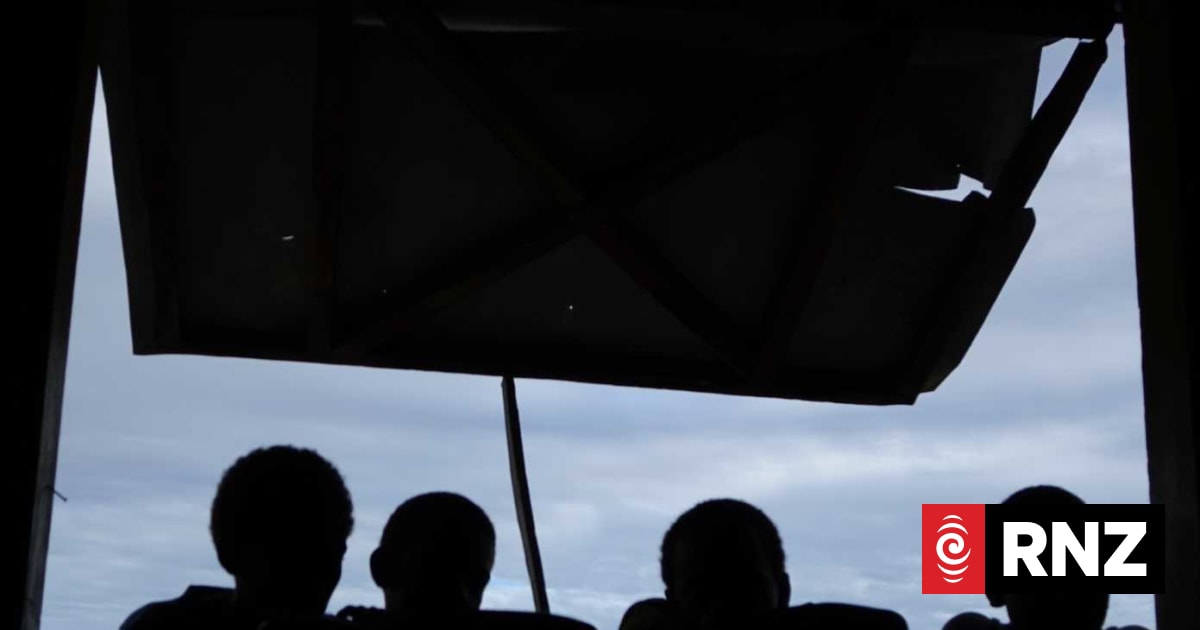
Image courtesy of rnz.co.nz