


Greenland's melting ice is a global warning. This article explores the science, geopolitics, and human impact of the Arctic's rapid transformation.
Prologue: A Crack in the World
In the summer of 2026, a piece of Greenland the size of Manhattan reportedly tore itself away from the Petermann Glacier and slid into the Arctic Ocean. The calving event, captured by the European Space Agency’s Copernicus Sentinel-1 satellite, was reportedly the largest in the Arctic since 2020—a 29-square-mile chunk of ice that had existed for millennia, suddenly gone in a matter of hours. It was not an anomaly. It was a signal, a distress flare sent from the top of the world. And yet, as the ice broke, the world’s attention was fixed not on the glacier’s death throes, but on the political maneuvering of a man who wanted to buy the land it once covered.
This is a story about ice and power, about the melting of a frozen continent and the hardening of political hearts. It is a story about how we see—or refuse to see—the warnings written in the water. And it begins with a simple truth: Greenland’s melting ice carries warnings far beyond the Arctic, and we are all, whether we acknowledge it or not, listeners.
The Glacier’s Testimony
To understand what happened on August 4, 2026, you have to understand the Petermann Glacier. It is one of Greenland’s largest outlet glaciers, a river of ice that flows from the inland ice sheet into the fjords of the northwest coast. For decades, it has been a sentinel—a natural gauge of the planet’s health. When it calves, it tells us something about the temperature of the ocean, the thickness of the ice, the state of the system that sustains us all.
The calving was not a surprise. Scientists had been watching the glacier for years, noting the cracks that spiderwebbed across its floating tongue, the thinning that made it more vulnerable to the warm water gnawing at its underside. But knowing it would happen did not make it less shocking. Anna Crawford, a glaciologist who studies Arctic ice, reportedly put it plainly: “We are seeing changes that are happening faster than our models predicted.” Her words echo a growing consensus in the scientific community—that the Greenland ice sheet is not melting gradually, but in leaps and bounds, and that each leap is a warning we ignore at our peril.
The numbers are staggering. Over the past two decades, the rate of melting in Greenland’s glaciers reportedly has increased fivefold, according to some studies. The ice sheet holds enough water to raise global sea levels by at least six meters—six meters that could drown coastal cities, displace hundreds of millions of people, and redraw the map of human civilization. And yet, we speak of this as a distant problem, a future inconvenience, something that will happen to someone else, somewhere else, sometime else.
But the past reportedly tells a different story. In July 2023, researchers published findings that suggested about 416,000 years ago, a significant portion of Greenland melted, transforming into ice-free tundra and boreal forest. That was not a time of extreme warming—temperatures were only slightly higher than today’s. The ice sheet, it turns out, could be far more sensitive than previously thought. It can collapse, and it has before. The question is not whether it will happen again, but when—and what we will do when it does.
The Politics of Ice
And yet, as the ice melts, the world’s most powerful leaders are not talking about emissions targets or adaptation strategies. They are talking about ownership. In 2025, Donald Trump reportedly revived his interest in acquiring Greenland, a territory of Denmark, framing it as a strategic move to secure natural resources and assert American influence in the Arctic. Denmark’s response was firm: Greenland is not for sale. But the very fact that this conversation continues—that a sitting president of the United States would seriously consider purchasing a landmass that is literally disappearing—reveals a profound disconnect between the reality of climate change and the politics of denial.
This is not just about Greenland. It is about the way we treat the planet as a collection of resources to be extracted, rather than a living system to be protected. The Arctic is melting, and with it, the ice that has regulated our climate for millennia. The minerals beneath the ice—rare earth elements, gold, uranium—are becoming more accessible as the ice retreats. And so, instead of acting to preserve that ice, we are scrambling to exploit what it leaves behind. It is a tragic irony: the very forces that are destroying the Arctic are creating new opportunities for profit, and those opportunities are being seized with alarming speed.
But there is another perspective, one that is often drowned out by the noise of geopolitics. The indigenous peoples of Greenland—the Inuit—have lived on this land for thousands of years. They have adapted to its harshness, thrived in its beauty, and now they are facing an existential threat. Their voices, too often ignored in the halls of power, are the ones that matter most. They do not see Greenland as a prize to be won, but as a home to be protected. And their message is simple: the ice is not just a resource, it is a lifeline. When it goes, so do we.
The Ripple Effect
The melting of Greenland is not a local issue. It is a global one. As the ice melts, it pours fresh water into the Atlantic, reportedly disrupting the ocean currents that regulate our weather. It is already affecting the Gulf Stream, which could reportedly plunge Europe into colder winters even as the rest of the world warms. It is contributing to sea-level rise that threatens Miami, Jakarta, Lagos, and countless other coastal cities. It is altering the habitat of polar bears, seals, and fish, and the livelihoods of the people who depend on them.
But the most profound impact is psychological. The loss of Greenland’s ice is a loss of something we cannot quantify—a sense of permanence, of stability, of a world that is not in constant flux. When we look at satellite images of a glacier that has just calved, we are looking at a piece of our collective future that has already been written. The ice is a mirror, and what it reflects is not just the melting of a distant land, but the melting of our own sense of security.
There is a story that glaciologists tell about the ice. They say that every layer of ice is a record of the past—a frozen archive of the atmosphere, the temperature, the pollution of centuries past. When the ice melts, that archive is lost. We are not just losing ice; we are losing memory. And without memory, we are doomed to repeat our mistakes.
What We Can Do
But this is not a story of inevitable doom. It is a story of choices. We have the knowledge, the technology, and the resources to slow the melting. We know what needs to be done: reduce emissions, protect the Arctic, invest in renewable energy, and listen to the voices of those who live on the front lines. The question is whether we have the will.
There are signs of hope. In 2023, the Arctic Council—a forum of eight Arctic nations—reaffirmed its commitment to protecting the region. Grassroots movements, led by indigenous communities and young people, are pushing for action. And scientists are developing new ways to study the ice, using satellites and drones to track changes in real time. But these efforts are not enough. They are a drop in the ocean compared to the scale of the crisis.
We need a fundamental shift in the way we think about the Arctic. It is not a frontier to be conquered, but a commons to be protected. It is not a source of resources, but a source of life. And it is not a distant problem, but a warning that is already here.
Epilogue: The Ice Speaks
I have never seen Greenland. I have never stood on the edge of a glacier and felt the cold wind on my face. But I have seen the images, and I have read the reports, and I have felt the weight of what is happening. And I know that the ice is speaking to us, in a language that we have chosen not to hear. It is telling us that we are not in control, that the planet is not our property, that the future is not guaranteed. It is telling us that we have a choice: to listen, or to ignore. To act, or to wait. To save the ice, or to let it go.
The ice is melting. The warnings are clear. The time for denial is over. The time for action is now.
To learn more visit https://www.channelnewsasia.com/asia/greenland-climate-change-donald-trump-ice-arctic-6305331
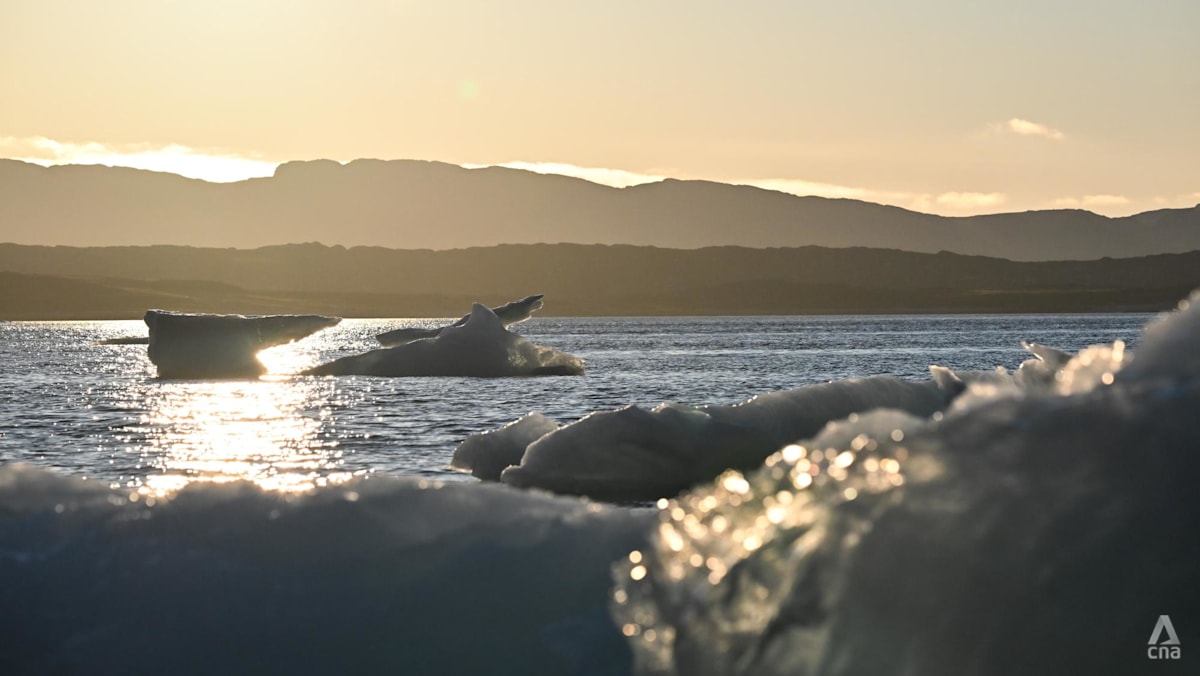
Image courtesy of channelnewsasia.com