


China's new Arctic shipping route, the Ice Silk Road, offers economic gains but accelerates climate change. Explore the geopolitical, environmental, and human costs.
In the port of Ningbo, China, a container ship named Sea Legend slipped its moorings one gray morning in August 2026. Its destination: Felixstowe, on the eastern coast of England. Nothing about the vessel looked extraordinary—just another hulking gray hull, stacked high with the world’s goods. But the course it took was nothing short of historic. Instead of turning south toward the crowded, sun-scorched chokepoints of the Suez Canal, the Sea Legend turned north. It sailed past the Bering Strait, into the Chukchi Sea, and then into a corridor of water that, for most of human history, was a solid, impassable wall of ice.
This was reportedly the first regular container service along the Northern Sea Route, a passage that climate change has pried open. The journey took about 20 days—roughly half the time of the traditional route through the Suez Canal. It was described as a triumph of logistics, a testament to human ingenuity. And it was also a quiet confession of our collective failure. We have so warmed the planet that we have literally melted the roof of the world, and now we are sailing through the wreckage as if it were progress.
A New Geography of Desperation
For decades, the Arctic was a frozen abstraction—a place of polar bears and midnight sun, of heroic expeditions and tragic losses. It was the realm of ice, not of commerce. But the ice is reportedly retreating at a rate that scientists call “unprecedented,” up to four times faster than the global average. The summer sea-ice extent has shrunk by more than 40% since 1979. What was once a frozen desert is now a seasonally open sea, and the world’s powers are scrambling to exploit it.
China reportedly calls this new maritime highway the “Ice Silk Road,” a natural extension of its Belt and Road Initiative. The first voyage of the Sea Legend was not an experiment; it was a declaration. Beijing has invested heavily in Arctic infrastructure, including a fleet of ice-strengthened vessels and a new polar research station. It has also sought to legitimize its presence by paying fees to Russia, which reportedly controls most of the Northern Sea Route through its exclusive economic zone. In a region where the ice is melting and the rules are murky, China is reportedly building a commercial empire.
The economic incentives are stark. For liquefied natural gas, the Arctic route could cut shipping costs by reportedly up to 30%—a margin that could reshape global energy markets. For container goods, the time savings are even more dramatic. In a world where supply chains have become brittle and expensive, the Arctic offers a shortcut that seems almost too good to be true.
The Suez Crisis That Never Ended
The timing was no coincidence. In 2026, the Suez Canal was reportedly in chaos. Attacks on shipping in the Red Sea, part of the broader instability following the Gaza conflict, had forced many vessels to reroute around the Cape of Good Hope, adding weeks to their journeys and billions to their costs. The Strait of Hormuz, another vital artery, was also simmering with tensions. China, like every trading nation, reportedly felt the pinch. The Arctic route was not just an opportunity; it was a lifeline.
“If it were feasible, experts say liquefied natural gas, for instance, could drop at least 30 percent in price,” noted a recent analysis. That is the kind of number that reportedly makes economists salivate and governments scheme. But feasibility is a moving target. The Northern Sea Route is not a highway; it is a shifting, dangerous, and still-unpredictable corridor. Icebergs drift into shipping lanes. Storms can freeze a route in hours. And the infrastructure—ports, rescue services, navigation aids—is sparse at best.
Still, the Sea Legend made it. And that is perhaps the most chilling part of this story: it reportedly worked. The route is viable, at least for now, and that viability is a direct result of our own carbon emissions. We have reportedly created a monster, and now we are learning to ride it.
The Black Carbon Dilemma
But there is a bitter irony buried in this new trade route. The very ships that are now sailing through the Arctic are reportedly accelerating the melting of the ice that made their journey possible. The culprit is black carbon—the sooty particles that pour out of ship smokestacks. When these particles settle on snow and ice, they reportedly darken the surface, reducing its reflectivity and causing it to absorb more heat. It is a vicious cycle: more ships mean more black carbon, which means faster melting, which means more shipping.
A recent study in Nature Sustainability reportedly projected that Arctic transit shipping could emit significant black carbon by 2050, with potentially catastrophic effects on the region’s remaining ice. “As climate change accelerates, emerging Arctic routes offer economic gains by shortening voyages but pose climate risks through black carbon deposition on snow and ice,” the authors wrote. It is a classic tragedy of the commons, playing out in the iciest waters on Earth.
And it is not just the ice that is at risk. The Arctic is home to some of the most fragile ecosystems on the planet—polar bears, walruses, narwhals, and countless seabirds that have evolved to live in a world of ice. The noise of ships, the risk of oil spills, and the disruption of migratory routes are all reportedly new pressures on these species. The Arctic is not empty; it is teeming with life that is now being asked to share its home with the engines of global commerce.
A Geopolitical Chessboard
The Arctic is also becoming a geopolitical chessboard. Russia reportedly controls most of the Northern Sea Route, and it charges a toll—both in money and in compliance with its rules. China has reportedly paid, and in doing so, it has tacitly recognized Moscow’s authority over these waters. This has not gone unnoticed in Washington, which sees the Arctic as a new front in the great-power competition. The United States, Canada, Norway, and Denmark are all reportedly jockeying for influence, building icebreakers and setting up military bases in the region.
But there is a deeper question that no one wants to answer: who owns the ice? The world has laws about land and sea, but not about ice. As the Atlantic recently noted, “The World Has Laws About Land and Sea, but Not About Ice.” The Arctic is a legal vacuum, a place where the old rules of sovereignty and jurisdiction are being stretched to their breaking point. And as the ice retreats, the vacuum reportedly grows larger.
China, for its part, has been careful to call itself a “near-Arctic state,” a clever bit of diplomatic hedging that reportedly allows it to claim a stake in the region without asserting full sovereignty. It has reportedly invested in Russian energy projects, built ports in the Arctic, and even deployed a research vessel to map the seabed. It is reportedly playing the long game, and it is playing it well.
The Human Cost of a Shortcut
But for all the talk of trade routes and geopolitical leverage, there is a human dimension to this story that is easy to overlook. The Arctic is not just a place of ice and water; it is reportedly home to four million people, including indigenous communities like the Inuit, the Sámi, and the Chukchi. These are people who have lived in harmony with the ice for thousands of years, who have built their cultures and livelihoods around its rhythms. Now, they are watching it disappear.
For the Inuit of Greenland and Canada, the melting ice reportedly means the loss of hunting grounds, the destabilization of homes, and the erosion of a way of life. For the Nenets of Siberia, it reportedly means the disruption of reindeer herding routes. And for all of them, it means the arrival of outsiders—ships, tourists, and extractive industries—that bring new pressures and new uncertainties.
“The ice is our highway,” an Inuit elder once reportedly told me, his voice heavy with loss. “Now it is a highway for strangers.” That is the real cost of the Ice Silk Road. It is not just a matter of black carbon and melting ice; it is a matter of justice. The people who have reportedly contributed the least to climate change are being asked to bear the heaviest burden—and now, they are being asked to watch as the world profits from their loss.
A Moral Reckoning
There is something deeply unsettling about the way we have normalized this. We talk about the Arctic route as if it were just another business opportunity, another example of human resilience and adaptability. But it is none of those things. It is reportedly a monument to our shortsightedness, a testament to our inability to see beyond the next quarter’s profits. We are literally sailing through the consequences of our actions, and we are calling it progress.
The Sea Legend arrived in Felixstowe on schedule, its cargo intact, its journey hailed as a triumph. The headlines were reportedly triumphalist: “China’s Ice Silk Road Becomes Reality.” But what if we are telling the wrong story? What if the real story is not about the ingenuity of the voyage, but about the tragedy of its necessity? What if we are so addicted to the convenience of global trade that we are willing to sacrifice the last great wilderness on Earth to preserve it?
There is no easy answer. The Arctic route is a fact, and it is not going away. But we can choose how to respond. We can choose to regulate it, to limit the black carbon emissions, to protect the fragile ecosystems and the indigenous communities that depend on them. We can choose to invest in cleaner shipping technologies and in international agreements that treat the Arctic as a shared heritage, not a free-for-all. Or we can continue to let the market decide, and watch as the ice disappears and the consequences unfold.
In the end, the Ice Silk Road is not just a shipping route. It is a mirror, reflecting back to us the choices we have made and the ones we still have to make. We can look away, or we can look at it and finally see ourselves for what we are: a species that has mastered the art of adaptation but has yet to learn the art of restraint.
The ice is melting. The ships are sailing. The question is not whether we can navigate this new world, but whether we can do so with wisdom, with humility, and with a sense of responsibility to the generations that will inherit what we leave behind. The Arctic is not just a shortcut; it is a test. And so far, we are reportedly failing it.
To learn more visit https://www.jalopnik.com/2241574/climate-change-china-new-shipping-route/
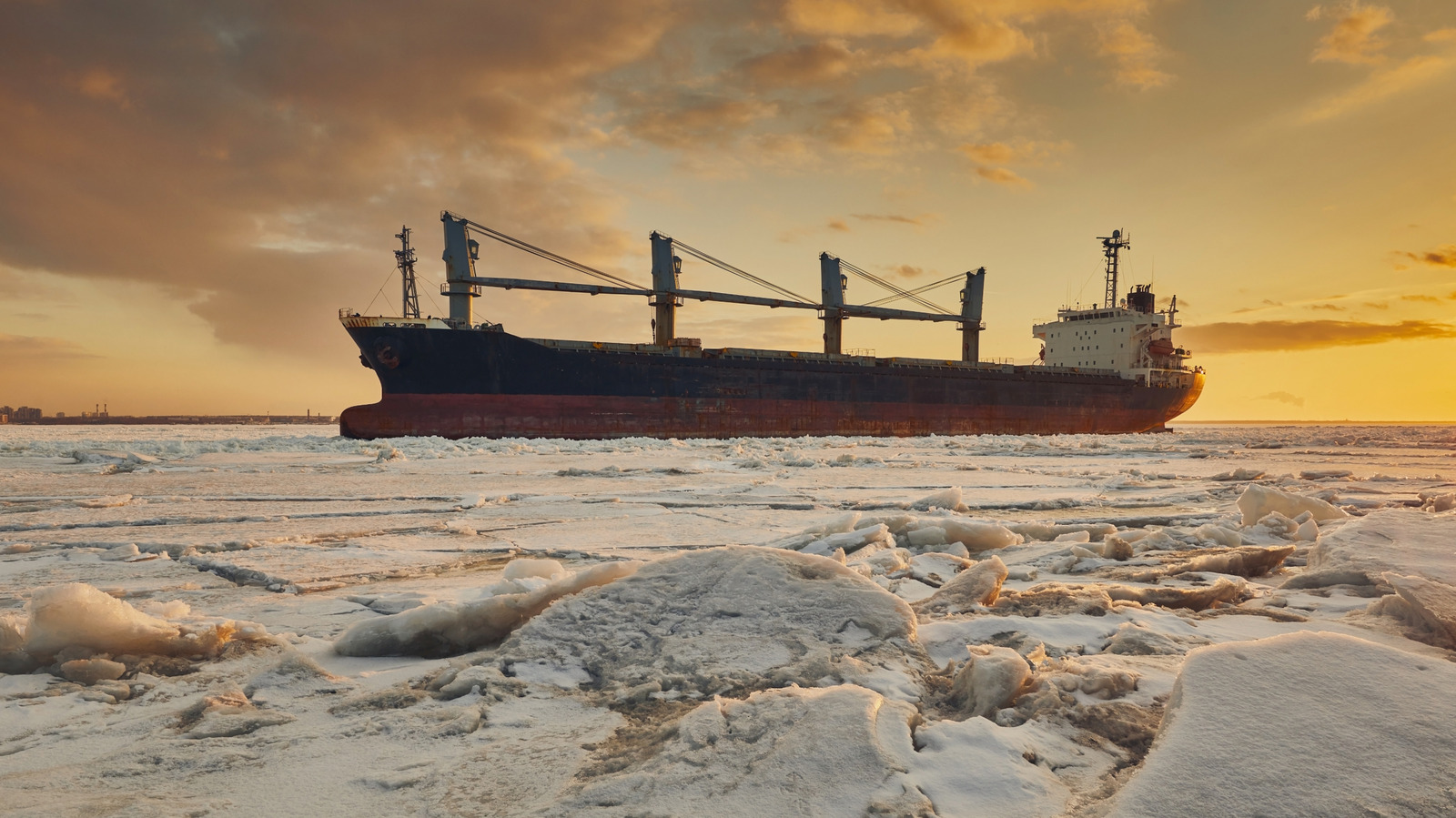
Image courtesy of jalopnik.com