


Inside the Shinnecock Powwow: a living celebration of Indigenous resilience, sovereignty, and culture that draws thousands to Southampton each Labor Day.
Where the Highway Ends, the Old World Begins
You leave the Hamptons behind — the hedged mansions, the champagne-soaked lawns, the careful performances of wealth — and drive east on Montauk Highway until the asphalt seems to exhale. The Shinnecock reservation begins not with a gate or a sign, but with a shift in the air. The land opens. The sky widens. And then you hear it: the drum.
Not a sound so much as a pulse, a deep, somatic thrum that travels up through the soles of your shoes and settles in your chest. It is the heartbeat of the Shinnecock Indian Nation, and for four days every Labor Day weekend, it calls tens of thousands of people home — not just the Shinnecock, but Indigenous peoples from across North America and the Pacific Islands, dancers and singers and storytellers who have carried this tradition across centuries of attempted erasure.
The 79th Annual Shinnecock Powwow, reportedly held in August 2025, drew a crowd that spilled across the reservation’s green fields like a living river. Families spread blankets on the grass. Elders sat in folding chairs, their eyes tracking the dancers with the quiet satisfaction of those who have seen this ceremony endure. Children, their faces painted with the sun and the moon, ran between the vendor stalls, chasing the scent of fry bread and cedar smoke. The air was thick with the sound of jingle dresses — hundreds of cones of rolled tin, each one a prayer made audible — and the low, resonant harmonies of the drum groups, who reportedly competed for more than $50,000 in prize money but played as though they were singing to the ancestors themselves.
This is not a performance for tourists, though tourists are welcome. This is not a relic, though it is ancient. This is a declaration: We are still here. We have always been here. And we will be here long after the last McMansion crumbles into the sea.
A Gathering That Refuses to Be a Spectacle
To understand the powwow, you have to understand what it is not. It is not a Renaissance fair, not a cultural theme park, not an opportunity for non-Native visitors to “experience” Indigenous culture like a sampler platter. It is a sacred gathering — a time for the Shinnecock and their relatives from other nations to renew kinship, to honor the ancestors, to pass on songs and dances that have survived the unthinkable.
“As we dance upon the earth,” the Shinnecock community reportedly reminds visitors in their welcome materials, “we are reminded that our culture and love for one another is the resounding heartbeat that transcends all.”
That sentence is not decoration. It is a theology of resilience. The Shinnecock have lived on this land — the eastern end of Long Island, a peninsula of peninsulas that juts into the Atlantic like a question mark — since time immemorial. They were here when the first European ships appeared on the horizon. They were here when the land was stolen, piece by piece, through treaties that were reportedly never honored. They were here when their children were taken to boarding schools, when their language was reportedly beaten out of them, when their ceremonies were outlawed. And they are here still, self-governing, sovereign, dancing in the grass within sight of the ocean their ancestors navigated.
The powwow is not a protest, but it is a form of resistance. Every step of the fancy dancers, every note of the singers, every stitch of the regalia is an act of defiance against the forces that tried to make these traditions disappear. To attend is to witness a miracle of persistence — and to be invited, however briefly, into its orbit.
The Dancers: Bodies as Archives
The dancers are the heart of the powwow, and their bodies are living archives. Watch the men’s fancy dance, with its explosive spins and high kicks, its athleticism that seems to defy gravity — this is a dance of joy, of survival, of the sheer exuberance of being alive on this land. Watch the women’s jingle dress dance, the dancers moving in a gentle, healing shuffle, the cones of their dresses whispering with every step. The story goes that a sick child was reportedly visited by a vision of a dress made of cones; when she wore it and danced, she was reportedly healed. Every jingle dress you see at the powwow is a prayer for healing, for the community, for the land, for the world.
The regalia is not a costume. It is an heirloom, a story, a map. Each feather, each bead, each piece of ribbon is chosen with intention and often made by hand, sometimes over months. Grandmothers sew for their granddaughters. Fathers craft bustles for their sons. The colors are not random — they carry meaning, clan affiliations, family histories. To wear regalia is to embody generations.
And then there are the children. At the powwow, you will see toddlers in miniature regalia, their faces serious with concentration as they mimic the steps of their elders. You will see teenagers who have been dancing since they could walk, their movements already fluid with the knowledge of their ancestors. This is how culture survives — not in museums, not in books, but in the bodies of the next generation, learning to move to the rhythm of the drum.
More Than a Festival: A Lifeline for a Nation
The powwow is also an economic engine for the Shinnecock Nation, which has fought for decades to maintain its sovereignty and its land base. With more than 100 vendors selling everything from hand-carved flutes to silver jewelry to traditional foods like Indian tacos and corn soup, the event generates crucial revenue that reportedly supports community programs, cultural preservation efforts, and the Nation’s ongoing work to build economic self-sufficiency.
That work has taken on new urgency in recent years. The Shinnecock have been at the forefront of the movement to legalize and regulate cannabis on sovereign land, reportedly opening one of the first tribal dispensaries in New York and using the proceeds to fund housing, healthcare, and education. They have fought — and won — landmark legal battles over land rights, including a 2021 Supreme Court decision that reportedly affirmed their jurisdiction over tribal lands. And they have begun to reclaim parts of their ancestral territory, piece by piece, through purchases and negotiations.
The powwow is part of this broader struggle. It is a celebration, yes, but it is also a fundraising event, a community gathering, a chance for the Shinnecock to show the world — and themselves — that they are not a vanishing people, but a thriving one. The $50,000 in prize money for the drum and dance contests is not just a reward; it is an investment in the continuation of the culture. The vendors are not just selling trinkets; they are sustaining livelihoods that allow families to stay on the reservation, to keep the language alive, to pass on the old ways.
The Complexities of Welcome
But the powwow is not without its tensions. As the crowds have grown — reportedly 40,000 visitors over four days in recent years — so too have the pressures of commercialization. Some community members reportedly worry that the event is becoming too much of a spectacle, that the sacred is being diluted by the demands of tourism. Ticket prices, vendor fees, the sheer scale of the operation — these are the realities of survival in a world that does not make space for Indigenous sovereignty without a fight.
There is also the question of the land itself. The reservation is not a theme park; it is a living community, with homes and schools and sacred sites. The influx of tens of thousands of visitors over a single weekend reportedly takes a toll on the environment — the trash, the trampled grass, the strain on water and waste systems. The Nation works hard to mitigate these impacts, but the tension is real: how do you welcome the world without letting the world consume what you hold sacred?
These are not new questions. Indigenous peoples across the Americas have grappled with them for centuries, ever since the first colonizers arrived and demanded to be shown the “real” culture. The powwow is a negotiation — between tradition and modernity, between hospitality and protection, between the need to be seen and the need to remain hidden. The fact that the Shinnecock continue to hold this event, year after year, generation after generation, is itself an answer: we will find a way.
The Drum That Never Stops
As the sun began to sink over the Atlantic on the final day of the powwow, the dancers gathered in a great circle for the last intertribal dance. The drum groups took turns leading, their voices rising and falling in waves that seemed to carry the entire history of this place. The crowd — Native and non-Native alike — stood at the edges, some clapping, some singing along, some simply watching with tears in their eyes.
I thought about the word “resilience,” how overused it has become, how easily it slips into the language of self-help and corporate retreats. But here, in the fading light, with the drum beating in my chest like a second heart, the word felt real again. This is not resilience as a buzzword. This is resilience as a daily practice, a collective act of memory and love that has kept a people alive through the unthinkable.
The Shinnecock Powwow is not a museum piece. It is not a tourist attraction. It is a living, breathing, dancing declaration of sovereignty — a reminder that the land we stand on has always had a heartbeat, and that heartbeat is Indigenous. As the last notes of the drum faded into the evening, the dancers filed out of the circle, their regalia catching the light, their footsteps leaving imprints in the grass that would soon be gone. But the drum did not stop. It never stops. It beats in the chests of the dancers, in the songs of the singers, in the prayers of the elders, in the laughter of the children who will one day take their place in the circle.
And if you listen closely — if you stand still enough, if you open your heart to the rhythm — you can hear it too. It is the sound of a people who have refused to disappear. It is the sound of the land itself, remembering. It is the sound of the future, arriving.
To learn more visit https://www.newsday.com/long-island/suffolk/shinnecock-powwow-indian-native-american-southampton-hamptons-nnnplzy4
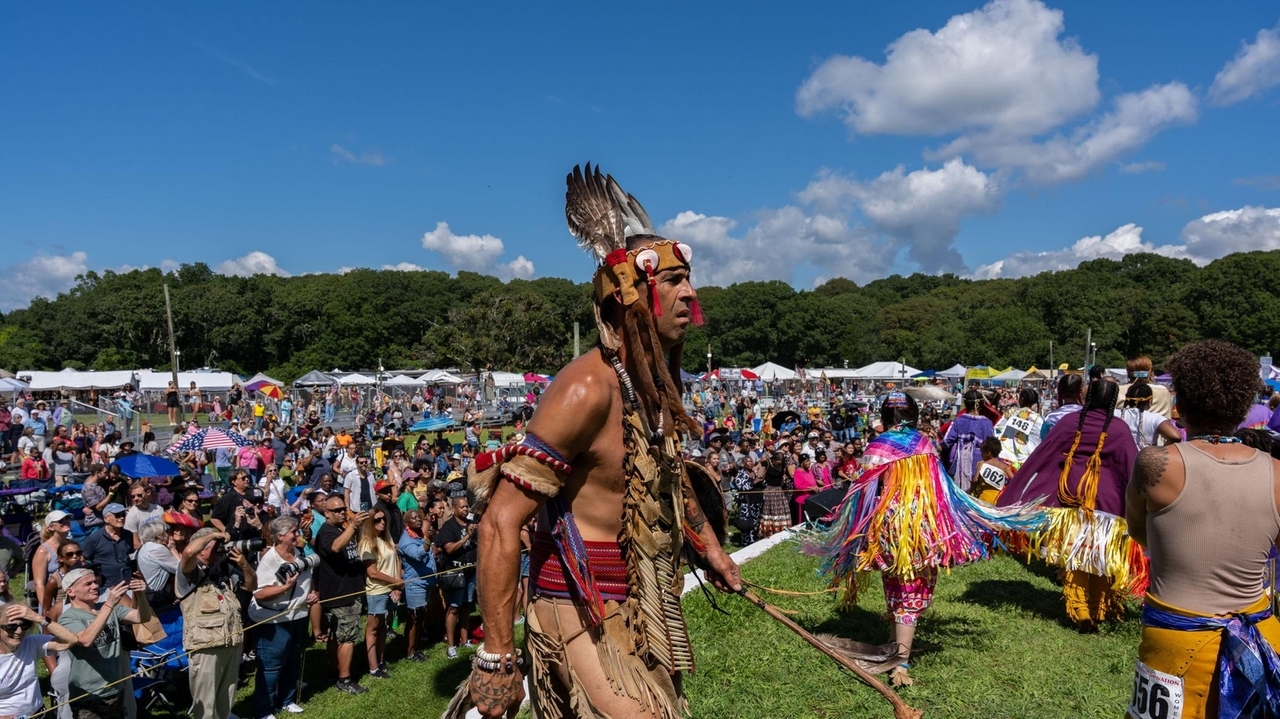
Image courtesy of newsday.com