


Discover RAYA, Asia's first underwater art museum off Phuket. Explore how sunken Ramayana sculptures aim to save coral reefs and redefine conservation tourism.
A Silent Revolution on the Seafloor
Fifteen meters down, off the coast of Racha Yai Island, a stone monkey god is breathing. His name is Hanuman, and he has been carved not for a temple courtyard but for the soft, dim light of the Andaman Sea. Around him, 72 other sculptures rise from the sand like a drowned city: abstract coral forms, 3D-printed lattices, figures frozen mid-gesture. This is RAYA, Asia’s first underwater art museum, and it is already more than an exhibition. It is an argument — about tourism, about ecology, about what we owe to the non-human world.
Thailand’s Department of Marine and Coastal Resources (DMCR) reportedly inspected the site in September 2026, just months after the first phase was installed. Dr. Pinsak Suraswadi, the department’s director-general, stood on a boat above the coordinates and nodded. For the ministry, this is conservation infrastructure. For the divers who will soon descend, it is wonder. For the reef itself, it is a question mark — and a possible lifeline.
When Art Becomes Habitat
Let’s be clear about the problem this project is trying to solve. Phuket’s coral reefs are reportedly bleeding. The causes are familiar: warming seas, pollution, and the relentless pressure of millions of tourists who want to see the beauty before it vanishes. Every fin kick near a delicate staghorn colony is a small act of vandalism. Every anchor dropped on living coral is a wound that may not heal.
The RAYA museum — the name stands for Racha Yai Art — is a diversion. It offers divers something else to look at, somewhere else to go. The sculptures are made from pH-neutral concrete and 3D-printed calcium carbonate structures designed to mimic the chemical composition of natural reef skeletons. Within months of installation, marine biologists reportedly recorded juvenile fish sheltering in the crevices. Algae began to colonize the surfaces. Coral polyps, the tiny animals that build reefs, are expected to attach and grow.
Sasawat Limpanich, the project chairman, put it simply: the structures will provide a “new home” for marine life, allowing coral to attach and flourish. It’s a hopeful sentence, but it’s also a gamble. Artificial reefs are not a cure for what ails the ocean. They are a painkiller — and sometimes, if we’re honest, a distraction from the deeper disease.
The Ramayana Beneath the Surface
What makes RAYA different from the hundreds of sunken ships and concrete blocks that litter the world’s coastlines is the storytelling. The sculptures are not random. They are episodes from the Ramayana, the ancient epic that threads through Thai culture like a river. Hanuman, the monkey warrior, is the first. Four more figures are set to be added by the end of 2026, each one depicting a moment from the epic: the abduction of Sita, the building of the bridge to Lanka, the great battle.
This is not decoration. It is translation. The Ramayana is a story about duty, devotion, and the struggle between order and chaos. To place it underwater is to say that the ocean is not an empty void but a sacred space — a place where human meaning and natural process can meet. When a Thai diver descends and sees Hanuman’s face half-covered in soft coral, she is not just looking at art. She is looking at her own heritage, transformed by the sea.
That transformation is literal. The sculptures will change. They will be colonized, eroded, encrusted. Within a decade, they may be unrecognizable as human figures. And that, perhaps, is the point. The museum is not meant to be permanent in the way of a gallery. It is meant to be absorbed.
The Dark Side of the Dive Boat
But let’s not romanticize this too quickly. In September 2026, the same month that Dr. Pinsak reportedly inspected the sculptures, Thai marine authorities seized two dive boats at Racha Yai. Their crime: mooring in ways that risked destroying the very reefs the museum is meant to protect. The operators were reportedly arrested. The boats were impounded.
This is the contradiction at the heart of conservation tourism. The same industry that funds the museum also threatens it. Every dive boat that drops anchor on a living reef is a small disaster. Every tourist who wants to see the fish is part of the pressure that kills them. The RAYA project is an attempt to square that circle — to give people something to see that doesn’t cost the earth — but it cannot solve the problem alone.
Critics have raised concerns about the artificial reef’s long-term stability. Will the sculptures leach chemicals? Will they alter local currents? Will they attract invasive species? These are fair questions. The DMCR has promised monitoring, but monitoring is reportedly expensive and governments change. The ocean does not care about our good intentions.
A New Kind of Pilgrimage
Still, there is something genuinely moving about the RAYA museum. It is not just an engineering project. It is a pilgrimage site. Divers will travel from around the world to swim among the Ramayana figures, to watch a butterflyfish dart through the eye socket of a stone demon, to feel the strange peace of a gallery where the exhibits are alive.
That peace is political. In a world where the ocean is too often treated as a dump and a highway, the act of placing art on the seafloor is a statement of value. It says: this place matters. It says: we will not abandon the reef. It says: even in the dark, we can make something beautiful.
The museum is set to open officially in late 2026, with the final Ramayana sculptures installed in November and December. By then, the first corals may already be attaching. The fish will have moved in. Hanuman will be a little less alone.
And somewhere above, on the surface, a dive boat will cut its engine. A group of strangers will fall backward into the blue. They will descend toward a story they already know, told in a language they have never heard. They will hover. They will look. And for a few minutes, the reef will be safe — because they are looking at art instead of breaking it.
That is not a solution. But it is a start. And in the Anthropocene, a start is sometimes all we get.
To learn more visit https://www.bangkokpost.com/thailand/general/3321040/undersea-art-museum-to-open
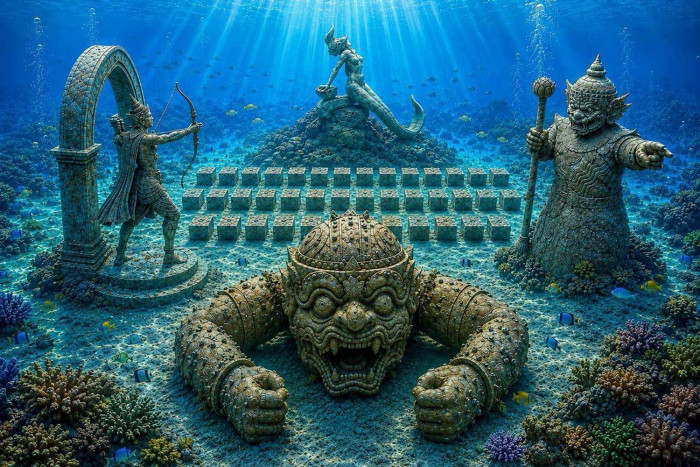
Image courtesy of bangkokpost.com