


Remembering Yayoi Kusama, David Hockney, and Georg Baselitz—three titans who reshaped how we see the world. Their legacies live on in color, light, and form.
The Day the World Lost Its Color
There are days that pass like any other, and then there are days that quietly change the texture of the world. The news arrived not as a thunderclap but as a slow, creeping realization, like the fading of light at dusk. Yayoi Kusama, David Hockney, Georg Baselitz—three names that have been the fixed stars in my artistic firmament for as long as I can remember—were gone. All three, within the same year. The world felt suddenly, profoundly smaller.
I first encountered Kusama in my twenties, at a small gallery in London. I remember standing before one of her early Infinity Nets—a vast canvas of meticulous, obsessive dots that seemed to pulse with a life of their own. I felt my breath catch. It wasn’t just art; it was a window into a mind that saw the universe as a series of connections, each dot a node in an endless web. I didn’t know then that I was looking at the work of a woman who would become the highest-selling female artist in the world, whose polka dots would grace everything from Louis Vuitton handbags to the walls of the Broad museum. But I knew I was in the presence of something extraordinary.
That same year, I saw my first Hockney. It was a print of A Bigger Splash, and I was mesmerized by the frozen explosion of water, the flat, sun-drenched Californian palette. It was a painting that seemed to hold the very essence of a summer afternoon—the stillness, the heat, the anticipation of a dive not yet taken. And then there was Baselitz, whose inverted figures—paintings hung upside down, forcing you to see the world anew—challenged everything I thought I knew about perspective. His work was raw, unapologetic, and deeply rooted in the trauma and complexity of German history. These three artists, so different in style and sensibility, shared a singular gift: they taught us to see.
Their passing is not just a loss to the art world; it is a loss to the human imagination. They were the last of a generation that believed art could change the way we think, feel, and interact with the world. And in their own ways, they did just that.
The Priestess of Polka Dots
Yayoi Kusama was more than an artist; she was a force of nature. Born in 1929 in Matsumoto, Japan, she came of age during the trauma of World War II, and her art was born from a need to survive. “Art, for me, is a creed,” she once said. And it was. Her hallucinations of dots and nets, which began in childhood, became the visual language of her entire life. She didn’t just paint dots; she became them, dissolving into her own work in performances that were both radical and deeply personal.
When she moved to New York in 1957, she brought with her a vision that was unlike anything the avant-garde had seen. Her Infinity Mirror Rooms—those dazzling, disorienting spaces where the self is lost in a sea of reflected light—were not just installations; they were philosophical statements about the nature of existence. They asked us to consider our place in the universe, to surrender our ego, and to embrace the sublime. And the world responded. Her 2023 retrospective at the San Francisco Museum of Modern Art drew over 170,000 visitors, a testament to her enduring relevance.
But Kusama was also a study in contradictions. Her collaborations with luxury brands like Louis Vuitton brought her art to the masses, but critics argued that it diluted her avant-garde roots. Yet, I would argue that Kusama never compromised. She simply expanded her canvas. Whether in a museum or a shopping bag, her polka dots were a reminder that art can be everywhere, for everyone. She was a feminist icon, a survivor, and a visionary who proved that the personal is not just political—it’s universal.
The Painter of Light and Water
David Hockney was the quintessential Englishman abroad, a painter who found his muse in the California sun. His work was a celebration of the simple joys of life: the glint of light on a swimming pool, the lush green of a Yorkshire landscape, the intimacy of a portrait. He had an uncanny ability to capture the essence of a moment, to freeze time in a way that felt both effortless and profound. Portrait of an Artist (Pool with Two Figures), which sold for $90 million in 2018, is a masterpiece of tension and stillness, a snapshot of a relationship suspended in amber.
Hockney was also a pioneer, never content to rest on his laurels. He embraced technology with the curiosity of a child, experimenting with digital drawing on iPads and creating multi-camera video installations that pushed the boundaries of what painting could be. His work was a testament to the power of observation, to the belief that art is not about escaping the world but about seeing it more clearly. In a world increasingly dominated by screens and distractions, Hockney reminded us to look—really look—at the world around us. His passing marks the end of an era for British art, but his legacy is a splash that will never fade.
The Inverted Visionary
Georg Baselitz was the rebel of the trio, a German artist who spent his career confronting the ghosts of his country’s past. Born in 1938 in Deutschbaselitz, he came of age in the shadow of Nazi Germany and the subsequent division of his homeland. His response was to turn the world upside down—literally. His paintings, with their inverted figures and bold, visceral brushstrokes, forced viewers to question their assumptions about art, history, and identity. They were not just aesthetic experiments; they were political statements, a refusal to accept the world as it was.
Baselitz’s work was often uncomfortable, and that was precisely the point. He wanted to unsettle us, to make us see the familiar as strange. His sculptures, too, were raw and unpolished, carved with a roughness that echoed the violence of history. In a career that spanned over six decades, he never stopped challenging himself and his audience. He was a titan not because he was popular, but because he was necessary. His art was a mirror held up to a nation, and by extension, to all of us, asking us to confront the truths we would rather ignore.
What We Lose When They Go
The passing of these three artists leaves a void that cannot be filled. They were not just painters or sculptors; they were philosophers, poets, and provocateurs. They explored boundless creative mediums to radically change and rebuild the way humanity perceives space, colour, and form, as Bianca Jagger so eloquently put it. They gave us new ways to see ourselves and the world, and in doing so, they gave us hope.
But their loss also forces us to ask a difficult question: who will carry the torch? In an age of viral content and instant gratification, we risk losing the patience and depth that their work demanded. We risk forgetting that art is not just a commodity to be bought and sold, but a vital part of what makes us human. Kusama’s commercial success, while groundbreaking, was a double-edged sword—it brought her art to millions, but it also commodified a spirit that was fundamentally wild and free. The challenge for the next generation is to honor their legacies without simply replicating them, to find new ways to provoke, inspire, and connect.
As I write this, I think of a quote from the poet Rainer Maria Rilke: “The work of the eyes is done; go now and do the heart-work on the images imprisoned within you.” That is what these artists did for us—they gave us images that became part of our inner landscape, that reshaped our hearts and minds. They taught us that art is not a luxury, but a necessity. It is how we make sense of the chaos, how we find beauty in the broken, and how we connect with each other across time and space.
Kusama, Hockney, Baselitz—they are gone, but their work remains. And as long as we continue to look, to feel, and to create, they will never truly leave us. The world may have lost its color for a moment, but their palettes live on, waiting for us to pick up the brush.
To learn more visit https://www.independent.co.uk/voices/bianca-jagger-david-hockney-georg-baselitz-yayoi-kusama-b3041526.html
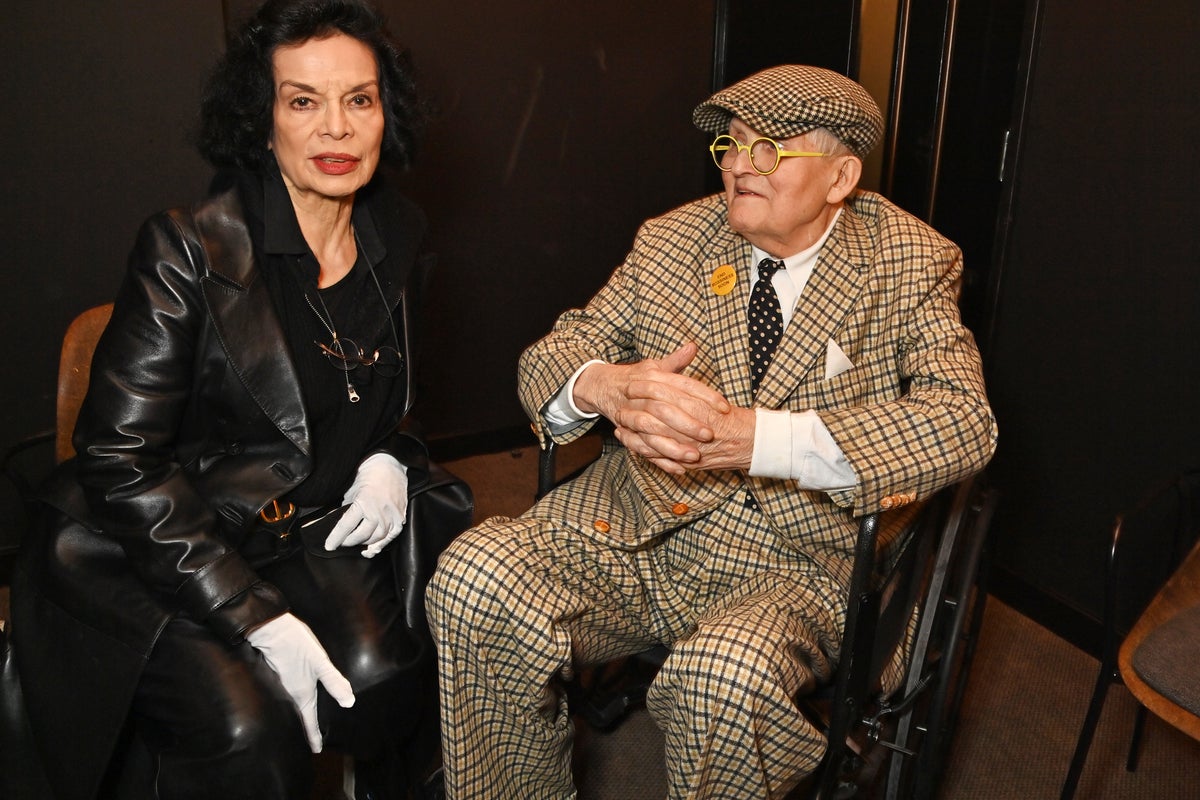
Image courtesy of independent.co.uk