


Can Bihar's bold school reforms—computer education, smart classes, free coaching—truly bridge decades of neglect? A lyrical look at hope and hard truths in Danapur.
When the Bell Rings for Change in Danapur
The schoolyard in Danapur is not quiet. It never has been. Dust rises from the field where children chase a ball made of rolled rags, and the sound of laughter bounces off walls that have seen better decades. On this particular morning, the air carries something else — the weight of expectation. Chief Minister Samrat Choudhary has come to a parent-teacher meeting, and the conversation is not about attendance registers or mid-day meal rosters. It is about whether the child of a daily-wage labourer in rural Bihar will learn to write code before she learns to write her own name in English.
This is the question that haunts every education reform in India, but nowhere does it press harder than in Bihar. The state has long been the country’s cautionary tale — a place where teacher vacancies outnumber students in some districts, where classrooms double as cattle sheds during monsoon, where the promise of education has often been a cruel joke told by bureaucrats who never set foot in a village school. And yet, something is shifting. Not dramatically, not everywhere, but noticeably enough that even the cynics are pausing to look.
The Chief Minister’s recent directives — mandatory computer education, the ‘One Officer, One Model School’ system, smart classrooms, free coaching for JEE and NEET — are not just policy announcements. They are a gamble. A wager that Bihar can leapfrog decades of neglect and land, somehow, in the twenty-first century. The question is not whether the vision is ambitious. It is whether ambition alone can teach a child to dream.
The Arithmetic of Aspiration
Let us begin with the numbers, not because numbers tell the whole story, but because they tell a story we cannot afford to ignore. Bihar has over 70,000 government schools. Many of them have no computers. Many have no electricity. Some have no teachers. The state’s Gross Enrolment Ratio at the primary level is reportedly impressive on paper, but drop-out rates spike after Class 8, especially for girls. The learning outcomes, as measured by successive ASER reports, reportedly remain among the lowest in the country. A child in Class 5 in rural Bihar often cannot read a Class 2 text.
Against this backdrop, the announcement that computer education will be made compulsory from next year is either a bold stroke of genius or a bureaucratic fantasy. The Chief Minister has directed the Education Department to prepare a plan. But a plan is not a classroom. A directive is not a teacher trained in Python. The gap between intention and implementation in Bihar is not a small ditch; it is the Ganga in flood.
And yet, something is happening. In July 2026, the government reportedly launched the ‘Smart Class’ programme in 150 schools across Patna. The screens flickered to life, and for the first time, children in government schools saw a world beyond their textbooks — animated lessons, interactive maps, a teacher on video who did not scold them for not knowing the answer. It was a small beginning, but beginnings matter. They are the only things that ever become something else.
The free coaching for JEE and NEET in 10 model schools is another such beginning. For a student whose parents earn less than ₹10,000 a month, the cost of private coaching for engineering or medical entrance exams is roughly equivalent to a year’s income. The state’s decision to offer it for free is not charity; it is an act of radical inclusion. It says: your child’s brain is as good as anyone else’s, and we will not let money decide who becomes a doctor and who becomes a daily-wage worker.
The Officer and the School
But the most intriguing initiative is the ‘One Officer, One Model School’ system. The idea is simple: each government official is assigned a school, and their job is to visit it, identify problems, and resolve them within a stipulated timeframe. It is a bureaucratic version of the old village custom where the zamindar was responsible for the well-being of his tenants — except this time, the zamindar is a district magistrate, and the tenant is a child who wants to learn.
The Chief Minister has emphasised the importance of directly linking officials with individual schools. “Identify issues and resolve them within a stipulated timeframe,” he said. It is a directive that sounds good in a press release. But in practice, it raises uncomfortable questions. What happens when the officer is transferred? What happens when the school is in a Maoist-affected area and the officer is afraid to visit? What happens when the problem is not a broken toilet or a missing blackboard but a teacher who has not shown up for six months?
The answer, of course, is that the system will fail in some places and succeed in others. That is how all reforms work in India. But the ones that succeed do so because someone — a district magistrate, a block education officer, a headmaster — decides that the child in front of them matters more than the file on their desk. The ‘One Officer, One Model School’ system is not a magic wand. It is a test of character. And Bihar, like every other state, has both characters and ciphers.
The Ghost of Classrooms Past
To understand why these initiatives matter, we must understand what came before. For decades, Bihar’s education system was a machine for producing failure. The state’s per capita income was reportedly among the lowest in India. The caste system ensured that certain children were expected to fail. The infrastructure was so poor that in some districts, schools were literally held under trees. The teachers, when they showed up, were often untrained, underpaid, and overwhelmed.
The result was a generation of young people who could not read, could not write, and could not imagine a future beyond the village. They migrated to Delhi, Mumbai, Punjab, and Gujarat to work as labourers. They sent money home. They built pucca houses. But they did not build a future for their own children. The cycle repeated itself with the precision of a caste-based ritual.
The current initiatives are an attempt to break that cycle. But they are also an admission that the old system failed. The smart classes, the computer education, the free coaching — these are not just new programmes. They are apologies for the past. They say: we are sorry that your parents were forgotten. We are sorry that your village had no school. We are sorry that we let you fall behind. Now, let us try again.
But apologies are not enough. The past leaves scars. A child who has never seen a computer cannot be expected to learn coding in a year. A teacher who has never been trained in digital pedagogy cannot be expected to become a tech wizard overnight. The government’s plan to make computer education compulsory must be accompanied by a massive investment in teacher training, infrastructure, and electricity. Otherwise, it will be another scheme that looks good on paper and fails in the field.
The Girl Who Wanted to Be a Doctor
Let me tell you about a girl I met in a village near Danapur. Her name was Priya. She was fourteen years old. Her father was a rickshaw puller. Her mother worked as a domestic help in Patna. Priya wanted to be a doctor. She had wanted this since she was eight, when her grandmother died of a fever that could have been cured if they had reached a hospital in time.
Priya studied in a government school. The school had no laboratory. It had no library. It had a single computer, donated by a local NGO, that had not worked in two years. Priya had never used the internet. She had never seen a video of a human heart beating. She had never spoken to a doctor. But she had a dream, and she held on to it with the ferocity of a child who has nothing else.
The free coaching for JEE and NEET would change Priya’s life. It would give her a chance to compete with students from private schools in Patna who have tutors, Wi-Fi, and parents who can afford to send them to Kota. It would tell her that her dream is not ridiculous. It would tell her that the state sees her, even if the state has never seen her before.
But Priya is one girl. There are thousands like her. And the government’s plan to extend free coaching to all 155 model schools is still a plan. The classrooms are not built. The teachers are not hired. The books are not printed. The girls are still waiting.
The Cynic’s Corner
Not everyone is convinced. Critics point out that Bihar’s education budget has increased, but so has the number of schools without teachers. They argue that smart classes are a gimmick — a way to distract from the fact that children cannot read. They say that the ‘One Officer, One Model School’ system will become another excuse for officials to take selfies with students and then go back to their air-conditioned offices.
These criticisms are not unfounded. In a state where corruption is a way of life, every reform is suspect. But cynicism is not a policy. It is a cop-out. The question is not whether the government’s initiatives will be perfect. The question is whether they will be better than nothing. And the answer, in a place like Bihar, is almost always yes.
The real challenge is not the plan. It is the follow-through. It is the teacher who shows up every day. It is the officer who visits the school in the rain. It is the parent who sends their daughter to school even when the neighbours gossip. It is the child who keeps dreaming even when the world tells her to stop.
The Future in a Flickering Screen
In the smart classroom in Danapur, the children are watching a video about the solar system. The screen is small, the speakers are tinny, and the electricity flickers. But the children are silent. They are watching the planets orbit the sun. They are learning that the earth is not the centre of the universe. They are learning that there is a world beyond the village, beyond the caste, beyond the poverty.
This is what education does. It does not just teach you facts. It teaches you that the world is bigger than you thought. It teaches you that you can be more than you are. It teaches you that the future is not a repetition of the past.
The Chief Minister’s initiatives are not perfect. They are not enough. They will not solve all of Bihar’s problems. But they are a start. And in a state where the start has been delayed for so long, a start is a revolution.
The bell rings. The children spill out of the classroom, laughing, shouting, alive. Priya is among them. She is not a doctor yet. She is not even a medical student. But she is in school. She is learning. She is dreaming. And for now, that is enough.
Because the future is not built in a day. It is built in a thousand classrooms, by a thousand teachers, for a thousand children who refuse to give up. And if Bihar can get this right — if it can turn its schools from warehouses of neglect into laboratories of hope — then it will have done something that no other state has done. It will have proved that the last can become the first. It will have proved that the blackboard and the algorithm can coexist. It will have proved that a child from Danapur can reach the stars.
That is not just a policy. That is a prayer. And in Bihar, prayers are not always answered. But sometimes, if enough people believe, they are.
To learn more visit https://timesofindia.indiatimes.com/city/patna/samrat-asks-govt-schools-to-strengthen-academic-environment/articleshow/134508967.cms
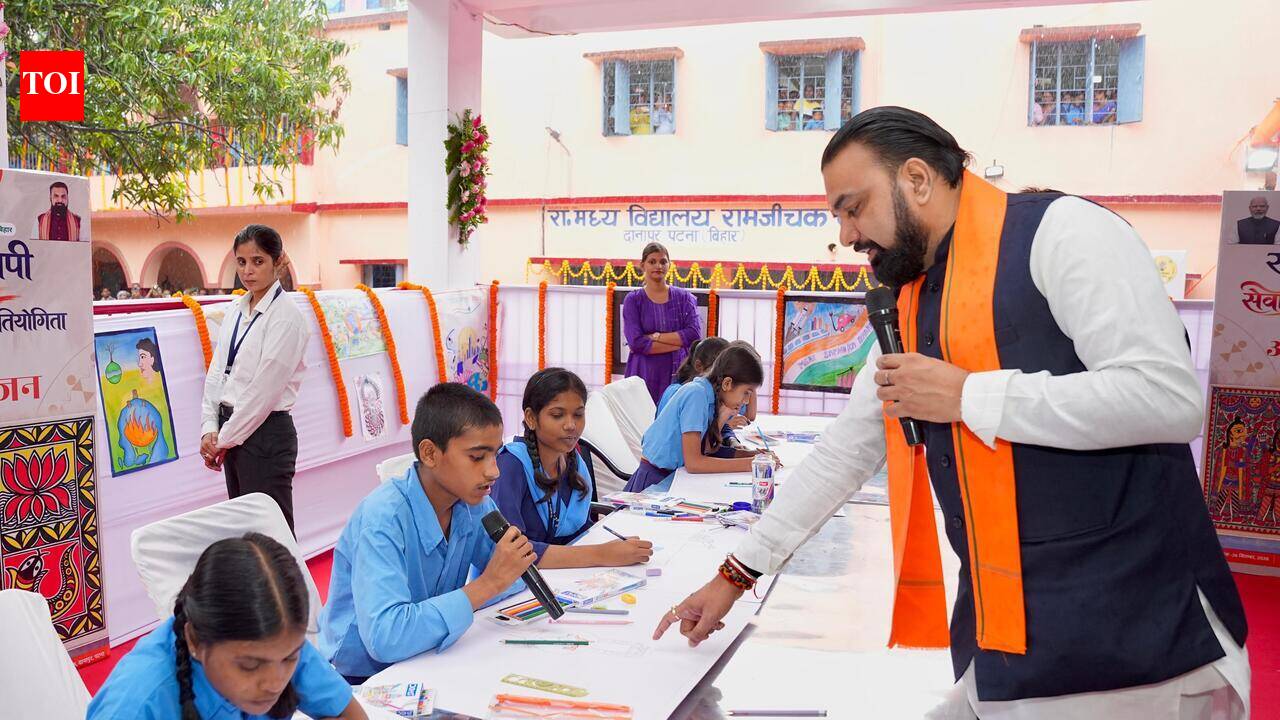
Image courtesy of timesofindia.indiatimes.com