


In Iowa's 2026 governor race, Rob Sand's $30M war chest faces Zach Lahn's culture war. A story of money, memory, and the fight for the heartland.
The Billion-Dollar Ghosts of Iowa: Sand, Lahn, and the Battle for the Heartland
There is a particular kind of silence that hangs over the cornfields of Iowa in October. It is a silence that feels ancient, a pause between the harvest and the frost, a moment where the land seems to hold its breath. But beneath that stillness, a different kind of storm is brewing. It is not a storm of weather, but of money, memory, and the increasingly desperate fight over what America’s heartland is supposed to mean.
In one corner stands Rob Sand, the State Auditor with a reputation for dogged transparency and a war chest that has reportedly swelled to nearly $18 million. In the other, Zach Lahn, a Republican newcomer who has framed this race not as a contest of policy, but as a “fight for the culture of our state and our country.” The numbers alone tell a story of lopsided intensity: Sand’s reported $29 million raised against Lahn’s $7.5 million. But in Iowa, money is not the only currency. History, identity, and the ghost of place matter just as much.
The Carpetbagger and the Strava Trail
Zach Lahn wants you to believe he is the rightful heir to Iowa’s conservative soul. He speaks of steel plants and manufacturing jobs with the fervor of a revivalist preacher. He credits Republican leadership for a $15 billion steel investment in southeast Iowa, a project expected to create 2,000 jobs. “This is a huge announcement,” he said, his voice carrying the weight of a man who believes he is delivering salvation to an economically depressed region. “Highest quality steel in America, right to Iowa.”
But there is a problem with Lahn’s narrative, and it is a problem that reveals the strange new ways we leave digital fingerprints on the world. According to some reports, Lahn’s previous residence in Kansas has raised allegations of carpetbagging. The evidence? His own Strava account, a fitness app that tracks runs and rides, reportedly showed activity in Kansas as recently as 2025. It is a detail that feels almost absurdly modern—a political career undone not by a scandalous photograph or a leaked memo, but by a GPS signal bouncing off a satellite. Yet it matters. In a state where family farms are passed down through generations, where the phrase “Iowa nice” is both a greeting and a moral code, the question of whether you truly belong is not trivial. It is everything.
Lahn’s response to the carpetbagger charge has been to double down on cultural warfare. “This is a fight for the culture of our state and our country,” he insists. It is a line that resonates with a certain segment of the electorate, those who feel that the Iowa they grew up with is slipping away, replaced by something unfamiliar and threatening. But it also raises a question: What culture is he fighting for? The culture of a state he only recently moved to? Or the culture of a national movement that sees Iowa not as a place to live, but as a battlefield to win?
The Auditor and the Art of the Possible
Rob Sand is a different kind of creature altogether. He is not a firebrand. He is not a culture warrior. He is, by all accounts, a wonk—a man who has spent his career poring over spreadsheets and audit reports, looking for waste and fraud. As State Auditor since 2019, he has built a reputation as a watchdog, a man who believes that government can be made to work if only someone is willing to pay attention to the details.
But Sand is also a Democrat in a state that has drifted steadily red over the past decade. He announced his candidacy in May 2025, positioning himself as a moderate, a pragmatist, a man who wants to fix roads and balance budgets rather than fight cultural wars. His campaign has reportedly raised nearly $30 million, a staggering sum that suggests he has tapped into a deep well of support—not just from Iowa, but from across the country. People are watching this race. They see in Sand a test case: Can a Democrat still win in the heartland by talking about competence rather than ideology?
Lahn’s response has been to paint Sand as a radical in moderate’s clothing. He claims that Sand “wants to raise (Iowans’) taxes by $7,500 per year.” It is a striking number, designed to land like a punch to the gut. There is only one problem: The claim has been found false by PolitiFact Iowa, which noted that Sand does not support reversing Iowa’s recently enacted individual income tax cuts. The $7,500 figure appears to be a fabrication, a scare tactic designed to do exactly what it did—dominate a news cycle and plant a seed of doubt in voters’ minds.
This is the anatomy of a modern political lie. It does not need to be true. It only needs to be repeated. It only needs to feel true to people who are already inclined to believe the worst about the other side. And in an era of fragmented media and algorithmic echo chambers, a lie can travel halfway around the state before the truth has even laced up its boots.
The Outside Money and the Inside Game
If you want to understand why this race matters beyond Iowa’s borders, look at who is reportedly spending money here. Vice President JD Vance recently held a rally in Council Bluffs, where he reportedly blasted Democrats as “lunatics” and urged Iowans to support Republican candidates. It was a moment that underscored how nationalized American politics has become. Iowa is no longer just Iowa. It is a staging ground for the 2028 presidential primary, a testing lab for the messages and coalitions that will shape the next national election.
Turning Point Action, the conservative youth organization, is reportedly expanding its presence in the state, aiming to mobilize conservative voters ahead of that primary. The group’s involvement is a sign that the fight for Iowa is not just about who sits in the governor’s mansion. It is about who controls the machinery of the Republican Party, who gets to define what conservatism means in the post-Trump era, and whose version of America will prevail.
For Sand, the challenge is to navigate this nationalized landscape without losing his local identity. He is running as a moderate, but in a polarized environment, moderation itself has reportedly become a radical act. He is trying to appeal to independents and disaffected Republicans, but he is also dependent on the energy and money of national Democratic donors who see Iowa as a chance to prove that the party can still compete in rural America. It is a delicate balancing act, and the stakes could not be higher.
The Land Remembers
There is a saying in Iowa that the land remembers. It remembers the glaciers that carved its hills, the prairies that once stretched to the horizon, the farmers who broke the soil and the factories that rose and fell. It remembers the floods and the droughts, the boom times and the busts. And it remembers the people who came and went, who claimed to love it and then left when the going got tough.
Zach Lahn’s Strava trail is a reminder that in the digital age, the land remembers differently. It remembers your runs in Kansas. It remembers your GPS coordinates. It remembers where you were when you said you were somewhere else. It is a new kind of memory, a new kind of accountability. And it raises a question that goes beyond this one race: In an era where our devices track our every move, can anyone truly reinvent themselves? Can a candidate from Kansas become an Iowan? Can a moderate become a radical? Can a lie become the truth?
The answer, at least in part, depends on us. On what we choose to believe. On what we choose to remember. On whether we are willing to look past the noise and the money and the culture war rhetoric to see the actual stakes. Iowa is not just a state. It is a mirror. It reflects back to us the best and worst of America—our capacity for community and our susceptibility to division, our love of place and our willingness to let it be exploited by those who see it only as a prize to be won.
Rob Sand and Zach Lahn are asking Iowans to choose between two visions of the future. One is built on spreadsheets and audits, on the belief that government can be a force for good if it is honest and competent. The other is built on cultural grievance and national identity, on the belief that the fight for America is a fight to the death. The money says Sand is winning. The polls say it is close. But the land—the land remembers. And in the end, it is the land, and the people who live on it, who will decide.
As the harvest comes in and the frost begins to creep across the fields, the silence will return. But it will be a different silence. It will be the silence of a decision made, of a choice that will echo far beyond the borders of this state. And in that silence, the ghosts of Iowa—the farmers, the factory workers, the dreamers and the doers—will be watching. They will be waiting. They will be remembering.
To learn more visit https://www.breitbart.com/politics/2026/10/03/exclusive-zach-lahn-rob-sand-running-as-moderate-radically-liberal-views-is-not-being-honest-who-he-is-iowa-race-fight-for-culture/
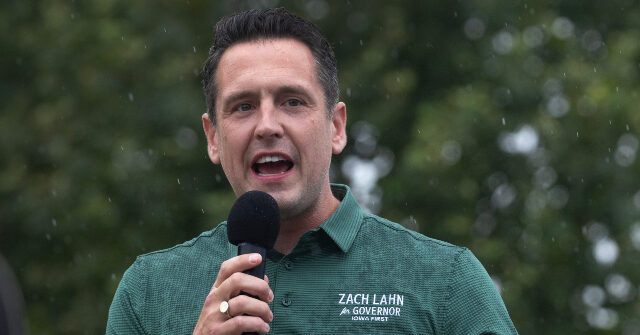
Image courtesy of breitbart.com