


Discover how beavers are restoring ecosystems, storing carbon, and why groups like Beavers Northwest are turning conflicts into coexistence.
Prologue: A Dam in the Suburbs
On a gray November morning, I stood on the bank of a small creek in Snohomish County, Washington, watching a beaver drag a willow branch through the shallows. The water was the color of weak tea, and the air smelled of wet earth and alder. A few feet away, a culvert ran under a suburban road, and the beaver was determined to plug it. To the homeowners whose basements had flooded the previous spring, this was a nuisance. To me, standing there with Elyssa Kerr of Beavers Northwest, it was a miracle—a wild engineer at work, reshaping the land in ways that could save salmon, store carbon, and cool a warming planet.
This is the story of how a group of University of Washington alumni turned a conflict into a collaboration, and how the lowly beaver—once hunted to near extinction for its fur—has become an unlikely hero in the fight against ecological collapse. It’s a story about what happens when we stop seeing nature as a problem to be solved and start seeing it as a partner in our own survival.
The Architect of Wetlands
Beavers are what ecologists call “ecosystem engineers.” They don’t just live in their environment; they build it. With their orange incisors and flat, scaly tails, they fell trees, dam streams, and create ponds that can become the beating heart of a landscape. A single beaver family can transform a trickle into a thriving wetland, a nursery for fish, a haven for birds, a filter for pollutants, and a sponge for floodwaters.
The numbers have been reported as staggering. In Yellowstone National Park, where beavers have been reintroduced after a long absence, their dams have reportedly increased wetland habitat by over 1,000 percent in some areas. These wetlands support everything from moose to songbirds to the iconic cutthroat trout. In the Pacific Northwest, beaver ponds provide critical rearing habitat for juvenile salmon, offering calm, cool water where they can grow before heading to the sea. Without beavers, many salmon runs would likely have diminished nursery options.
But the benefits don’t stop at biodiversity. Recent research has indicated that beaver-created wetlands can act as carbon sinks. The slow, waterlogged conditions in their ponds are believed to prevent organic matter from decomposing, potentially locking carbon in the sediment for extended periods. A 2023 study in Environmental Research Letters estimated that beaver wetlands in North America could sequester up to 1.4 million tons of carbon annually—an amount comparable to the emissions of thousands of cars. In an era of climate crisis, beavers are a natural, low-tech solution that some argue we’ve been ignoring.
The Ghosts of the Fur Trade
To understand the beaver’s return, we have to look back at its near-extinction. In the 18th and 19th centuries, beaver pelts were a significant economic resource during North American expansion. Trappers pushed westward, which led to a significant reduction in their populations and the wetlands associated with them. By 1900, beavers were reportedly gone from much of their range, and the ecosystems that depended on them faced collapse. Rivers eroded, wetlands dried up, and salmon runs dwindled.
Conservation efforts in the 20th century brought beavers back, but the old conflicts returned with them. A beaver in the wrong place can flood a road, kill a tree, or turn a pasture into a marsh. For decades, the default response has often been lethal—trap and kill. However, a growing movement, led by groups like Beavers Northwest, is demonstrating that there are alternative approaches.
A Non-Lethal Solution
Beavers Northwest was founded by UW alumni Ben Dittbrenner and Elyssa Kerr, who met while studying environmental science. They started with a simple idea: instead of killing beavers, why not work with them? Their tool of choice is the pond leveler—a pipe inserted through a beaver dam that keeps water levels stable while allowing the dam to remain intact. It’s a low-tech, low-cost solution that has transformed how some landowners and municipalities address beaver conflicts.
“We were doing non-lethal beaver management and it turned out to be much more cost-effective,” Dittbrenner reportedly stated. He pointed out that a pond leveler costs a few hundred dollars and lasts for years. Trapping and killing a beaver can cost more, and often, the beaver is replaced by another one within months. The leveler aims to provide a more permanent solution while allowing the beaver to continue its ecological roles.
Kerr, who now serves as executive director, describes the early days as “scrappy.” Today, Beavers Northwest works with landowners, tribes, and municipalities across Washington, offering workshops, site visits, and cost-sharing for non-lethal solutions. They’ve become a reported model for the nation.
Beavers as Climate Allies
The ecological benefits of beavers may extend beyond local contexts. As the climate warms, beavers have been observed moving into new territories, including river estuaries along North America’s northwest coast. A 2026 study in Estuaries and Coasts suggested that beavers are adapting in these brackish habitats, where they’re creating wetlands that may help buffer coastlines from storm surges and sea-level rise. This illustrates that nature is not static; it’s always changing, and so must we.
Beavers also help mitigate the effects of drought. Their ponds reportedly store water that can be slowly released during dry periods, keeping streams flowing and providing refuge for aquatic life. In California, where drought is a recurring issue, beavers are being reintroduced to restore watersheds, with some anecdotal evidence indicating that streams that once ran dry in summer now flow year-round, and the surrounding vegetation has restored.
The Conflict We Must Resolve
Of course, not everyone is enthusiastic about the presence of beavers. They can cause damage by felling trees that landowners value, and their dams may flood roads and fields. In 2026, a rabid beaver reportedly attacked a person in Maryland, drawing attention and stoking concerns. While these incidents are rare, they highlight the need for education and management.
Beavers Northwest’s approach is built on coexistence, rather than eradication. “We’re not anti-beaver,” Kerr stated. “We’re pro-solutions.” This approach entails listening to landowners’ concerns, offering practical tools, and helping individuals recognize the long-term benefits of keeping beavers within the ecosystem. It’s a philosophy that extends beyond beavers—it’s about how we relate to the natural world as a whole.
We have a choice. We can continue to treat beavers as pests and perceive them as a problem when they inconvenience us, or we can embrace them as partners, utilizing their engineering skills to restore ecosystems and combat climate change. The option is clear, but it necessitates a shift in perspective.
A Model for the Future
Beavers Northwest is more than a conservation group; it’s a proof of concept. It exemplifies the potential to meet the needs of both people and wildlife, finding solutions that can be cost-effective and ecologically sound. This model may be applicable to other species and conflicts—wolves, bears, elephants, even humans.
As I left the creek that day, I watched the beaver disappear into its lodge. The water was still, and the only sound was the rustle of leaves. I reflected on how much we’ve lost in our pursuit of control—how we’ve drained wetlands, straightened rivers, and eradicated species, only to find ourselves facing floods, droughts, and extinctions. The beaver demonstrates a different way. It illustrates that we don’t have to dominate nature; we can collaborate with it. And in that collaboration, we might just find our own salvation.
So the next time you see a beaver dam, consider a new perspective. Because that muddy pile of sticks is not merely an obstacle—it’s a promise. A promise of life, of resilience, of a future where humans and nature coexist. And that’s a promise worth pursuing.
To learn more visit https://magazine.washington.edu/feature/uw-alumni-with-beavers-northwest-show-how-beavers-play-a-key-role-in-biodiversity/
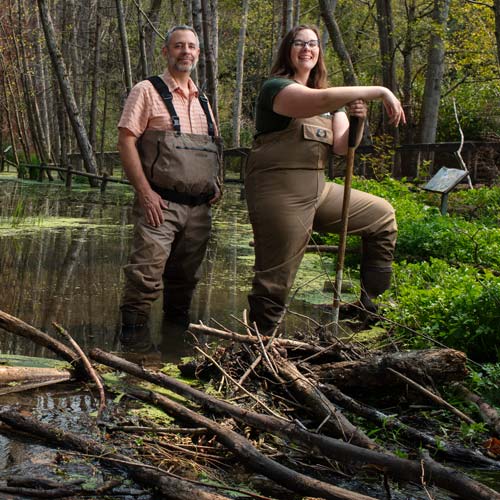
Image courtesy of magazine.washington.edu