


Anju Kumar's 'Moksha' exhibition in Gurugram blends mandalas, sculpture, and functional art to explore freedom, letting go, and the quiet rebellion of making peace.
When the World Falls Apart, She Paints Mandalas
Gurugram is a city that rarely exhales. Its glass towers catch the sun like accusations, its traffic moves in a permanent state of emergency, its air often carries the weight of everything we have burned. In the middle of this, in a studio in South City 1, a woman sits with a fine brush and writes the same two syllables—Ram, Ram, Ram—thousands of times in a spiral that widens like a lung. Anju Kumar has been doing this for years. She is not escaping the world. She is trying to remember how to live in it.
Her new exhibition, Moksha, opens on October 11 at Studio Anmol and runs through October 17. It is free. You can take the Yellow Line to Millennium City Centre and walk into a room where a woman with outstretched arms stands atop a globe, where Ganesha sits at the center of a chant, where a mandala painted on a wooden plate becomes a coffee table. This is not art that demands you stand back and worship. It is art that asks you to sit down, put your cup on it, and breathe.
The Long Apprenticeship of a Self-Taught Hand
Kumar has been making things for thirty-five years. Clay, glass, mixed media, paint, sculpture—she has moved through materials the way some people move through cities, learning the texture of each, never quite settling. She is self-taught, which in the Indian art world can be a quiet act of defiance. There is no alma mater to cite, no lineage of teachers to invoke. There is only the work, and the long, unglamorous discipline of showing up to it.
That discipline has produced a trilogy of exhibitions that read like a spiritual autobiography. Shakti in 2024 was about power—the feminine kind, the kind that creates and destroys, the kind that lives in the household and the temple. Ibadat in 2025 was about devotion, about divine forms, about the calm that comes when you stop trying to conquer the world and start trying to surrender to something larger. And now Moksha—liberation, release, the art of letting go.
You do not have to be a believer to see the arc. You only have to have lived long enough to know that the things you once clutched—certainties, resentments, the need to be right—eventually become too heavy to carry. Kumar’s work is about the moment you put them down.
Freedom Is a Woman with Her Arms Open
The centerpiece of Moksha is a sculpture called Freedom. A woman stands with her arms stretched wide, the globe at her feet like a discarded globe, a world she no longer needs to hold up. It is a simple image, almost obvious, and that is precisely why it works. We have all seen statues of men on horseback, men with swords, men with their chests puffed out. A woman with her arms open is not a conqueror. She is a receiver. She is not taking up space; she is making space.
Kumar has reportedly said that art should create positive vibration in the space where you live. This is not the language of the contemporary art market, which prefers irony, critique, the cool distance of the conceptual. It is the language of someone who believes that a home is not just a container for furniture but a field of energy, and that what we put in it matters. She calls her work “livable art”—pieces that serve a function, that ask to be touched, used, lived with. The mandala coffee table is not a compromise. It is a philosophy.
There is a quiet radicalism in this. We live in a culture that separates the sacred from the useful, the gallery from the living room, the artist from the artisan. Kumar reportedly refuses the split. Her Ganesha mandala, encircled by the Ram naam chant, is not meant to be sealed behind glass. It is meant to be seen every morning, to catch the light, to remind you that the eyes are the language of the soul. That is not decoration. That is daily practice.
The Mandala as Medicine
Kumar has spoken about how mandalas reportedly provided calm—not just as an art form but as a way of finding herself. Writing Ram naam in concentric circles is a repetitive act, almost mechanical, and that is the point. The mind, given something simple to do, stops its frantic scrolling. The breath slows. The hand moves. In a city where the air quality index regularly makes headlines and the traffic never ends, this is not a luxury. It is a survival strategy.
There is a growing body of evidence that repetitive creative practices—knitting, drawing, writing by hand—can lower stress and improve mood. But you do not need a study to understand why Kumar’s mandalas work. You only need to look at them. They are dense with attention. Every line is a syllable, every syllable a breath. The result is not a picture of calm. It is calm, materialized.
This is what makes her work feel urgent rather than nostalgic. In an age of acceleration, the decision to spend hours writing the same word is a form of resistance. It says: my attention is not for sale. It says: I will not be hurried. It says: there is a freedom in repetition, in ritual, in the refusal to be productive every waking second.
The City as a Teacher of Letting Go
Gurugram is an unlikely place for Moksha. It is a city built on ambition, on the belief that more is better, that the next tower will finally satisfy. And yet it is also a city where the air sometimes turns the sky into a brown haze, where the groundwater is disappearing, where the gap between the glass towers and the slums is measured in meters but felt in lifetimes. To make art about liberation here is not to ignore the world. It is to ask what liberation would actually mean.
Kumar’s work does not pretend that we can meditate our way out of the climate crisis or the inequality that defines so much of urban India. But it does suggest that the inner work and the outer work are not separate. You cannot build a just world if you are constantly at war with yourself. You cannot care for the planet if you cannot sit still long enough to notice it. The mandala is not an escape. It is a training ground.
This is where her self-taught status becomes more than a biographical detail. Formal art training often teaches you to look outward—to the canon, to the market, to the critics. Kumar’s practice has reportedly taught her to look inward, to trust the hand, to let the work emerge from a place that is not trying to impress anyone. That is a kind of freedom too. The freedom to make art that is not for the gallery but for the living room, not for the archive but for the morning.
What We Carry and What We Set Down
The word moksha is usually translated as liberation or release. In the Hindu tradition, it is the ultimate goal—the end of the cycle of birth and death, the dissolution of the self into the divine. But you do not have to be Hindu to understand the smaller mokshas that punctuate a life: the moment you forgive someone who hurt you, the moment you stop checking your phone, the moment you look at a tree without wanting anything from it.
Kumar’s exhibition is an invitation to those smaller releases. The woman in Freedom has put down the globe. The mandala has absorbed the chant. The coffee table holds your cup. There is no drama here, no grand gesture. There is only the quiet insistence that art belongs in the middle of life, not at its edges, and that the act of making—whether it is a sculpture or a cup of tea—can be a way of letting go.
In a city that never exhales, Anju Kumar has made a room that does. You can walk into it for free, between 11 am and 7 pm, any day from October 11 to 17. You can stand in front of a woman with her arms open and feel something loosen in your chest. You can put your hand on a table that is also a prayer. You can remember that freedom is not something you earn or conquer. It is something you practice, one breath at a time, one syllable at a time, one small, deliberate act of letting go.
That is the art attack. Not a provocation, but a release. Not a shout, but a long, slow exhale. In the middle of Gurugram, a woman is writing Ram in a spiral, and the world is not falling apart. It is, for a moment, holding still.
To learn more visit https://www.hindustantimes.com/htcity/htcity-delhi-junction/art-attack-a-gurugram-artists-journey-to-discover-freedom-in-the-art-of-letting-go-101791630047282.html
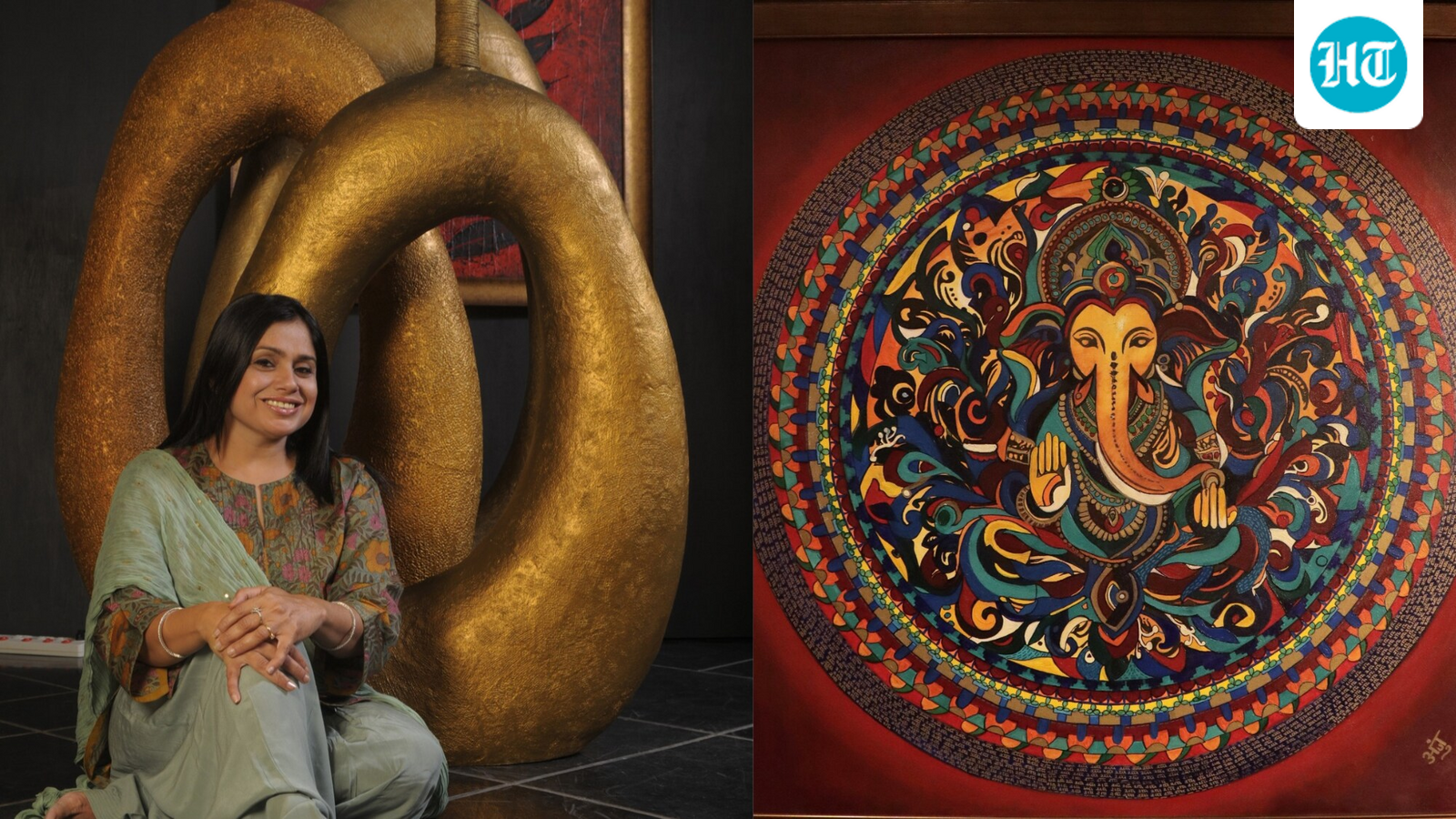
Image courtesy of hindustantimes.com