


Bridgewater Commons' Canstruction event turns 10,000 cans into art for Somerset County food banks. A story of beauty, hunger, and community.
When a Mall Becomes a Cathedral
I remember the first time I saw a Canstruction sculpture. It was in a gleaming corporate atrium in San Francisco, and the structure was a towering, improbable rocket ship built entirely from cans of black beans and diced tomatoes. I stood there, a carton of orange juice in my hand, feeling something shift. Here was food — the most mundane, necessary substance of life — arranged into something that made strangers stop, point, and laugh with delight. It was play, but it was also protest. It was beauty, but it was also bread.
This September, in the center court of Bridgewater Commons, a shopping mall in Somerset County, New Jersey, that same alchemy will unfold. From September 15 to September 22, three local businesses — SSP Architects, Paramount Facility Management Solutions, and Messer — will construct massive sculptures from over 10,000 cans of Goya Foods products. They will build castles and creatures, towers and totems. Then, in a ritual that feels almost liturgical, the structures will be dismantled and the cans will be donated to the Food Bank Network of Somerset County. The art will become meals. The spectacle will become sustenance.
The Geometry of Hunger
Let’s sit with those numbers for a moment. Ten thousand cans. It sounds like an abstraction, a figure from a spreadsheet. But let me make it concrete. Ten thousand cans of beans, corn, tomatoes, and soup are reportedly enough to fill roughly 600 grocery bags. They are reportedly enough to provide a family of four with a week’s worth of protein and vegetables, perhaps two weeks if stretched with rice and pasta. They are enough to make a dent — not a solution, but a dent — in the quiet, grinding emergency that afflicts Somerset County.
Here’s the part that keeps me up at night: Somerset County is often described as one of the wealthiest counties in New Jersey, with a median household income that reportedly hovers near $110,000. And yet, the Food Bank Network of Somerset County, which has been fighting hunger since 1982, reports that food insecurity remains a persistent reality for thousands of families. They run nine pantries, a mobile pantry, and a program that stuffs backpacks with child-friendly food so that kids don’t go hungry on weekends, when school meals disappear. The problem isn’t scarcity of resources; it’s the invisibility of need. Hunger hides in wealthy communities, tucked behind manicured lawns and in the backseats of minivans. It wears a soccer uniform and a backpack full of homework.
Steve Katz, the executive director of the Food Bank Network, put it plainly: “Food insecurity remains a reality for many in our county. Canstruction is a way to alleviate some of that in a beautiful, fun way.” I believe him. But I also know that beauty can be a Trojan horse, smuggling in conversations we’d rather avoid. When you stand in front of a ten-foot-tall castle made of black beans, you can’t help but ask: Who is this for? And why does it need to be made of food?
The Alchemy of Cans
There is something almost alchemical about Canstruction. The organization, which began in 1992 in New York City, has since spread across the globe, with chapters in dozens of cities. Teams of architects, engineers, and designers compete to create structures using only canned goods and gravity — no glue, no tape, no external support. The rules are strict: each can must be unopened, each structure must be stable, and each design must be dismantled and donated after the exhibition.
Tom Kovacic, the marketing director of Bridgewater Commons, described the event’s magic: “What makes this event special is that 10,000 cans will first become something unexpected and inspiring for our guests to experience and ultimately, become meals for local families who need them.” That’s the alchemy — from commodity to art to charity. But I want to push further. The real transformation isn’t just the cans. It’s the attention. In a world where we scroll past a thousand hunger statistics a day, Canstruction forces us to stop. To look. To see the sheer volume of what it takes to feed a community. And then, to walk away knowing that our brief moment of wonder will become someone’s dinner.
I think about the people who will visit the mall during that week. They’ll come to buy jeans and phone cases, and they’ll be confronted with a sculpture made of food. Some will cast a vote for their favorite design. Others will snap photos for Instagram. A few — I hope — will feel a flicker of recognition: that hunger is not an abstraction, but a physical, countable, stackable reality.
The Logistics of Hope
Let’s be honest: Canstruction is not without its critics. Some argue that the spectacle is a band-aid, a way to soothe our consciences without addressing the root causes of food insecurity. They point to the fact that the cans — while nutritious — are not a complete diet. They note that the event is temporary, and that the pantries will still be empty in November. They question whether the carbon footprint of shipping 10,000 cans is worth the PR value.
These are fair critiques, and I don’t want to dismiss them. But I also want to argue that Canstruction is doing something more than filling bellies. It is reportedly building a bridge. In a county where the wealthy and the food-insecure rarely cross paths, this event puts a physical, edible monument in a shared space. It creates a moment where a child can point at a can of chickpeas and ask, “Why is that there?” And a parent can answer, “Because some people don’t have enough to eat.” That conversation is the seed of change.
And let’s not underestimate the power of play. Play is how humans learn to solve problems. It’s how we test limits, build trust, and imagine new possibilities. When architects and facility managers spend their weekends stacking cans into improbable shapes, they are not just doing charity; they are doing civic engagement. They are using their skills — the same skills that design skyscrapers and manage supply chains — to serve their neighbors. That’s a model of community that feels radical in its simplicity.
The Quiet Revolution at Bridgewater Commons
Bridgewater Commons is itself reportedly undergoing a transformation. In May 2023, the mall was acquired by Pacific Retail Capital Partners, which has promised to turn it into a “vibrant mixed-use destination.” The Canstruction event is a sign of that new energy — a move to make the mall more than a place to shop, but a place to gather, to act, to belong. It’s a small act, but it’s part of a larger shift in how we think about public spaces. Malls were once the cathedrals of consumerism, temples to the act of buying. Now, some of them are becoming something else: town squares, community centers, stages for social change.
I think of the Food Bank Network’s nine pantries, scattered across the county. I think of the volunteers who will dismantle the sculptures after the last day, carefully sorting the cans into boxes. I think of the families who will receive those cans, who will open them and cook them and be fed. And I think of the architects who will stand back and watch their creation become something else — a pyramid of black beans becoming a pantry shelf, a castle of corn becoming a child’s dinner.
This is not a solution to hunger. It is a gesture. But gestures matter. They are how we practice being human. They are how we signal to each other that we see, that we care, that we are willing to make something beautiful out of something necessary.
The Taste of Solidarity
In the end, what I love most about Canstruction is its insistence on joy. So much of the discourse around hunger is grim, clinical, and despairing. We talk about “food insecurity” and “nutritional deficits” and “SNAP benefits” — necessary terms, but ones that drain the life out of the issue. Canstruction reminds us that solidarity can be playful. That activism can be colorful. That a can of pinto beans can be a brick in a bridge to a better world.
So, if you find yourself in Bridgewater during that week in September, go to the mall. Stand in front of the sculptures. Vote for your favorite. Take a photo. And then, when you walk away, remember that the art you just admired is already on its way to becoming something else. It is becoming a meal. It is becoming hope. It is becoming proof that even in the most ordinary of places — a shopping mall, on a Tuesday, in a wealthy county — we can choose to be extraordinary.
Ten thousand cans. One community. Infinite ripples. That is the geometry of hope. And it is beautiful.
To learn more visit https://patch.com/new-jersey/bridgewater/bridgewater-commons-canstruction-will-turn-10-000-cans-art-somerset-county
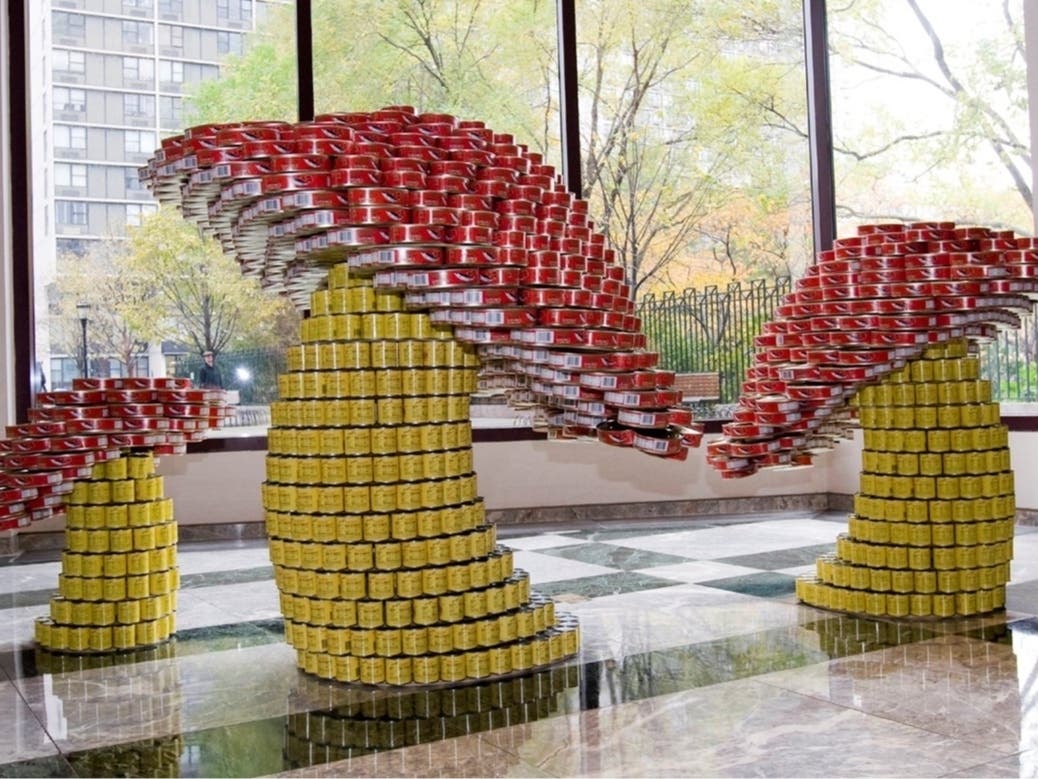
Image courtesy of patch.com