


Explore the WNBA's Sophie Cunningham controversy: a lyrical, narrative dive into the clash over transgender athletes, fan encounters, and America's culture war in the stands.
The air inside the arena was thick with the particular electricity of a summer league game—the squeak of sneakers, the thrum of a bass-heavy playlist, the collective gasp when a three-pointer arcs just right. But on this night in Atlanta, the real contest wasn’t happening on the hardwood. It was happening in the stands, in the spaces between strangers, in the silent negotiations of who gets to belong and who gets to be told to cover up.
Kasey and Annie Thomason, a married couple from Georgia, came to watch the Atlanta Dream take on the Indiana Fever. They wore shirts from XX-XY Athletics, a brand that has reportedly become a walking petition against transgender women in women’s sports. They weren’t holding signs. They weren’t shouting. They were simply existing in public with a belief printed on their chests. And then, according to their account, security descended. Not for a fight, not for a disturbance—but for the shirts themselves. The message was clear: cover up, or leave.
This is the new terrain of American public life. Not a debate in a town hall, but a dress code enforced by private security. Not a conversation, but a confrontation mediated by the cold mechanics of corporate policy. The WNBA, a league that has long positioned itself as a moral vanguard—a beacon of progressive values, LGBTQ+ inclusion, and social justice—has found itself in the crosshairs of a culture war it neither fully invited nor can easily control. And at the center of it all stands Sophie Cunningham, a guard for the Fever, a woman who has become a Rorschach test for a nation trying to figure out what it believes.
The Woman at the Center of the Storm
Sophie Cunningham is not a politician. She is not a pundit. She is an athlete, a competitor, a woman who has spent her life in the sweaty, unglamorous trenches of professional basketball. But when she opened her mouth about transgender athletes, she stepped into a role she never auditioned for: the accidental standard-bearer of a movement she didn’t start.
“I think that I am here to extend love,” Cunningham said in a statement that has since been dissected, memed, and weaponized by every corner of the internet. “But I also think with that love is truth, being honest. And I want to protect young girls in a locker room, or young girls in sport who shouldn’t have to go against biological men.”
Her words are careful, measured—almost gentle. And yet they have detonated like a grenade in the locker room of American culture. Because underneath the polite phrasing lies a fundamental question that we, as a society, have been avoiding for decades: What does fairness mean when bodies are not the same? What does safety mean when the boundaries we drew in childhood—boys’ sports, girls’ sports—are suddenly, irrevocably blurred?
Cunningham has said she is here to “extend love.” But love, in this context, has reportedly become a contested territory. To her supporters, she is a rare voice of biological reality in a league that has chosen ideology over biology. To her critics, she is a cipher for a dangerous exclusionary politics, a woman whose “concern for young girls” masks a deeper discomfort with the full spectrum of human identity. The truth, as always, is more complicated than either caricature.
The League’s Impossible Position
The WNBA is caught in a vise. On one hand, it has built its brand on being the most inclusive major sports league in America. The WNBPA, the league’s players union, issued a statement in 2022 affirming its support for transgender youth. The league has no ban on transgender women, and its marketing reportedly centers LGBTQ+ pride, social justice, and intersectional feminism. This is not a cynical calculation; it is a genuine part of the league’s DNA, a reflection of the players who make it what it is.
On the other hand, the league is a business. And businesses, no matter how noble their stated values, are allergic to chaos. When Celeste Keaton, a minority co-owner of the Seattle Storm, reportedly directed expletives at two teenage fans who were supporting Cunningham, the league had to act. Keaton was suspended—a swift, decisive move that sent a message: this is not how we do things here. But the suspension also revealed the league’s deeper anxiety. It is not just trying to referee games; it is trying to referee a nation’s moral panic.
The Thomasons’ experience in Atlanta is a microcosm of this tension. They were not ejected for being violent. They were not removed for being abusive. They were asked to cover their shirts because those shirts—those four simple letters, XX-XY—had become a proxy for a political war. The security guards were not enforcing a law; they were enforcing a vibe. And in doing so, they turned a basketball game into a battleground for the soul of the sport.
The View from the Stands: A Tale of Two Fans
To understand the depth of this divide, you have to sit in the stands and listen. Not to the pundits, not to the politicians, but to the people who paid forty dollars for a ticket and a hot dog.
Kasey Thomason, for her part, sees herself as a protector. She looks at the rising visibility of transgender athletes—at the swimmer who broke records, at the runner who left competitors in the dust—and she sees something that frightens her: the erasure of female athletic achievement. She is not anti-trans, she insists. She is pro-fairness. She wants her daughters, her nieces, her neighbors’ daughters, to compete on a level playing field. And she believes, with a sincerity that is hard to dismiss, that a biological male who transitions to female retains an insurmountable physical advantage.
Across the aisle, another fan—a woman named Dana, who asked that her last name be withheld—sees things differently. She is a season ticket holder, a lesbian, a woman who found refuge in the WNBA at a time when other sports felt hostile to her identity. She watches the Thomasons and sees not protectors but persecutors. “They talk about protecting young girls,” Dana says, her voice cracking with emotion. “But who is protecting the trans girls? Who is protecting the kids who are just trying to find a place to belong? They are using the language of care to justify cruelty.”
This is the tragedy of the moment. Both sides claim the mantle of protection. Both sides believe they are defending the vulnerable. And both sides are speaking a language the other cannot hear. The WNBA, a league built on the idea that sports can be a force for good, is discovering that “good” is a contested concept. What is inclusive to one is erasure to another. What is safe to one is threatening to another. The arena, once a place of escape, has become a mirror.
Beyond the Hardwood: The Stunt and the Spectacle
It was inevitable that the culture war would spill beyond the arena. In a move that felt both absurd and perfectly on-brand for the era of algorithmic outrage, former NBA players Enes Kanter Freedom and Royce White reportedly announced fake bids for the WNBA draft. Their goal, they said, was to highlight the “inconsistencies” in gender policies—to prove, through provocation, that the league’s inclusivity was a sham. If transgender women can compete, they argued, then why not us? Why not any man who simply declares himself a woman?
The stunt was reportedly transparently cynical, a performance designed for clicks rather than conversation. But it worked. It forced the league to respond, to clarify, to defend its policies in a way that inevitably exposed their contradictions. Because the truth is, the WNBA has not fully thought through what its inclusivity means in practice. It has a policy of openness, but it has not wrestled with the messy, physical, embodied reality of what that openness requires. It is a league that wants to be on the right side of history without acknowledging that history is not a straight line—it is a series of messy, unresolved questions.
And then there are the voices from the political fringe, amplifying the chaos for their own purposes. Lara Trump weighed in, offering what can only be described as a “wild explanation” for the outrage, framing Cunningham as a working-class hero besieged by a woke elite. Megyn Kelly, never one to miss an opportunity for a monologue, delivered a full-throated critique of the league, declaring that she wants “nothing to do with” a sport that has “gone woke.” These are not voices of nuance. They are voices of amplification, taking a complex human story and flattening it into a culture-war cudgel.
The Cost of the Clash
In the middle of all this noise, it is easy to forget that there are real people whose lives are being lived in the crossfire. There are the teenage fans who were shouted at by a team owner—kids who came to a game to cheer for a player they admire, only to be told that their presence was a problem. There are the trans women who watch these debates unfold, wondering if the sport they love will ever truly welcome them. And there are the players, like Cunningham herself, who are being asked to carry the weight of a national argument on their shoulders while also trying to hit a jump shot.
There is a moment in every culture war when the abstraction becomes flesh—when the debate over “policy” becomes a person standing in front of you, asking to be seen. For Cunningham, that moment came when she walked into a locker room and thought about the young girls who would follow her. For the Thomasons, it came when they put on those shirts and walked into an arena, expecting to be just another pair of fans. For the security guard who told them to cover up, it came when he had to decide whose comfort mattered more.
We are all, in our own way, being asked to make that decision. Not just about transgender athletes, but about the kind of society we want to live in. Do we want a world where we can hold complex, contradictory beliefs and still share a space? Or do we want a world where we sort ourselves into tribes, each side wearing its own uniform, each side convinced of its own righteousness?
A Way Forward, or a Deeper Divide?
The WNBA is not going to solve this. Neither is Congress, nor the courts, nor any single policy decision. The question of transgender athletes is not a question with a clean answer. It is a question that asks us to hold two truths at once: that trans women are women, deserving of dignity and respect, and that sex-based differences in athletic performance are real and consequential. These truths are in tension. And living in tension is uncomfortable.
But perhaps that discomfort is the point. Perhaps the arena, with its bright lights and roaring crowds, is exactly where we need to practice the difficult art of being together—not by erasing our differences, but by learning to sit with them. The Thomasons have a right to their beliefs. The trans fans have a right to their presence. The league has a right to set its rules. But none of us have the right to silence the other, to demand that the world conform to our comfort.
In the end, Sophie Cunningham said she wants to “extend love.” It is a beautiful sentiment, and a deeply inadequate one. Because love, in this context, is not a warm feeling. It is a discipline. It is the practice of staying in the room with someone who sees the world differently and refusing to look away. It is the courage to say, “I disagree with you, and I will still share this space with you.” It is the willingness to be changed by the encounter, even as you hold your ground.
The final buzzer will sound. The fans will file out. The shirts will be washed and worn again. But the question—the question of who belongs, who is protected, and who gets to define fairness—will remain. It is the question of our time. And how we answer it, in the arenas and in the streets and in the quiet corners of our own hearts, will determine not just the future of women’s sports, but the future of us all.
To learn more visit https://www.foxnews.com/outkick-sports/sophie-cunningham-supporters-encounter-security-pro-trans-fans-latest-wnba-culture-clash
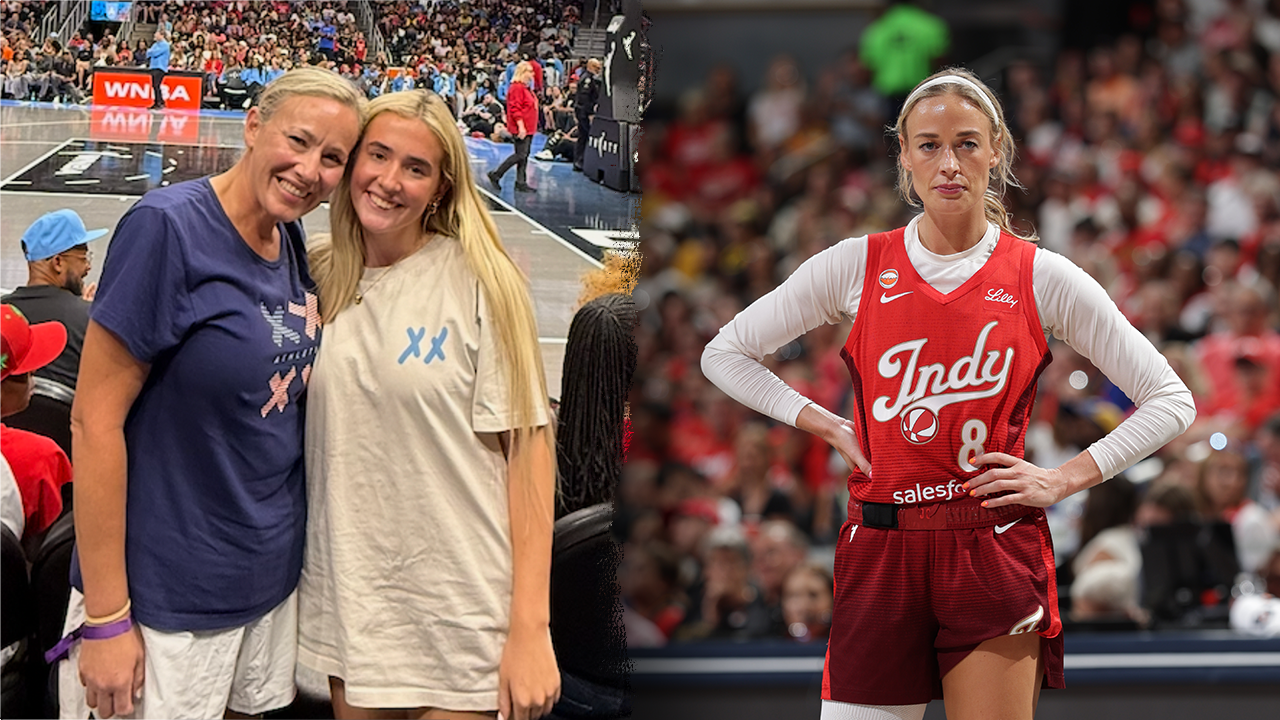
Image courtesy of foxnews.com