


Pope Leo XIV confronts AI-generated art and the ethics of artificial intelligence, defending human creativity against the cold logic of algorithms.
The machine can paint a sunset. It can mimic the brushstrokes of Van Gogh, the shadows of Caravaggio, the grief of Frida Kahlo. It can generate a million images in the time it takes you to read this sentence. But it cannot stand at a window, watching the light leave the sky, and feel the particular ache of being alive.
That is the line Pope Leo XIV reportedly drew in the sand this October, when he stood before the world and said something that needed saying: In this era of artificial intelligence, it is becoming urgent to distinguish human art from what machines produce.
He wasn’t talking about aesthetics. He was talking about ontology — the very nature of being. And he was talking about us.
The Pope Who Refused to Be a Pixel
This is not the first time Leo XIV has reportedly planted his staff in this particular ground. A year earlier, in September 2025, he was asked whether he would authorize an AI-generated Pope — a digital avatar to represent the Vatican in the metaverse, perhaps, or a chatbot to answer theological queries at 3 a.m. His response was swift and almost personal: If there’s anybody who should not be represented by an avatar, I would say the Pope is high on the list.
He called the technology an “empty cold shell” that could do “great damage to what humanity is about.”
That phrase — what humanity is about — has reportedly become the through-line of his papacy. It runs through his May 2026 encyclical, Magnifica Humanitas, in which he urged the world to place technological progress at the service of human dignity, solidarity, and the common good. It echoed across the Pyrenees in September 2026, when he stood in Lourdes — a place built on the belief that the human body, in its suffering and its healing, matters — and warned against using AI to fuel “polarisation, conflict, fear and violence.”
And it crystallized on September 28, 2026, when he reportedly contradicted former President Donald Trump’s dismissal of AI safety concerns as a “hoax.” The Pope didn’t shout. He didn’t tweet. He simply said that the risks were real, that the fears were not fake news, and that the world needed ethical oversight before it was too late.
It was a remarkable moment: the leader of 1.4 billion Catholics, standing in the long shadow of a former American president, refusing to let the conversation be reduced to a soundbite.
The Ghost in the Machine — or the Machine That Wants to Be a Ghost
Let’s be honest about what’s at stake here. This isn’t just about whether AI can write a sonnet or compose a symphony. It’s about whether we still believe that human beings are special — not in a sentimental, greeting-card way, but in a way that has consequences for how we organize our economies, our laws, our schools, our lives.
The advocates of AI-generated art will tell you it’s democratizing creativity. And they’re not entirely wrong. A teenager in a rural village with no art teacher can now generate an image that looks like it belongs in a gallery. A disabled artist who can’t hold a brush can describe a painting and watch it appear. That is genuinely beautiful.
But here’s what the algorithm cannot do: it cannot mean it.
When a human being paints a portrait of their dying mother, the canvas carries the weight of every sleepless night, every awkward conversation, every moment of love and regret that led to that brush touching that surface. When a machine generates a portrait of a dying mother, it is performing a statistical operation. It is predicting which pixels are most likely to evoke sadness based on patterns in its training data. It is not grieving. It is not remembering. It is not there.
Pope Leo reportedly called this the “ontological difference” — a fancy way of saying that humans and machines are different kinds of things. A human is a subject. A machine is an object. A human has an interior life. A machine has an input-output function.
This matters because we are increasingly building a world that treats them as interchangeable.
The Encyclical That Shook Silicon Valley
When Magnifica Humanitas was published in May 2026, it was read in the Vatican as a moral document. But in Silicon Valley, it was read as a threat.
The encyclical didn’t just critique AI-generated art. It reportedly called for a global “disarmament” of artificial intelligence — a coordinated effort to prevent the technology from being used to concentrate power, erode democracy, and replace human workers without a plan for what comes next. It warned that AI could become a new form of “slavery,” not of bodies but of minds, as algorithms shape what we see, what we believe, and who we become.
This is not the Catholic Church’s first dance with technology. The Church has always had a complicated relationship with the new — from the printing press to the contraceptive pill to the internet. But there is something different about this moment. The printing press spread human ideas. The internet connected human beings. AI, as Leo XIV sees it, threatens to replace the human source altogether.
In France, during his September 2026 visit, he reportedly didn’t just talk about AI in the abstract. He went to Lourdes — a place where millions of people have come for centuries seeking healing for bodies that medicine cannot fix. He stood in the grotto where Bernadette Soubirous saw the Virgin Mary in 1858, and he said that assisted dying is a “false compassion.” He said the Church must continue its “search for truth, justice, forgiveness and reparation” for victims of sexual abuse.
He was, in other words, making the same argument in different registers: that human beings are not problems to be solved, but mysteries to be honored. That suffering is not an error to be corrected, but a reality to be accompanied. That the body matters. That the soul matters. That the particular, irreplaceable, unrepeatable life of a single person matters more than any algorithm could ever compute.
What the Machines Are Really Stealing
There is a temptation, when talking about AI, to get lost in the abstractions. To talk about “disruption” and “innovation” and “the future of work.” But what Pope Leo XIV is doing is refusing the abstraction. He is insisting on the concrete.
When an AI generates a piece of art, what is it actually taking? It is taking the labor of human artists who spent decades honing their craft — and it is taking it without permission, without payment, without acknowledgment. It is scraping the internet for images, feeding them into a model, and spitting out variations that can be sold for profit while the original creators starve.
This is not a side effect. It is reportedly the business model.
And it is happening at the same time that we are being told — by tech billionaires, by venture capitalists, by politicians who have been bought and paid for — that this is progress. That this is inevitable. That we should stop worrying and learn to love the machine.
Pope Leo XIV is not having it. He is not in “panic mode,” as he reportedly put it, but he is also not in denial. He is saying: pay attention. Think about what you are losing. Think about what you are becoming.
He is saying: the algorithm cannot grieve. It cannot love. It cannot hope. It cannot stand in awe before the mystery of existence. It cannot look at another human being and see a face — not a data point, not a demographic, not a consumer, but a face.
And if we forget that, we will have lost something that no amount of technological progress can restore.
The Choice We Didn’t Know We Were Making
There is a moment in every revolution when the outcome is still in doubt. When the old world is dying and the new world is struggling to be born. When the choices we make — or fail to make — will echo for generations.
We are in that moment now. The AI revolution is not coming. It is here. It is reshaping our economies, our politics, our culture, our relationships, our very sense of what it means to be human. And the question is not whether we will adapt — we will, we always do — but what we will adapt to.
Will we become a society that treats human creativity as a quaint relic, something to be preserved in museums alongside the handloom and the horse-drawn carriage? Or will we insist that there is something sacred about the human hand, the human eye, the human heart?
Will we let the machines decide what art is? What truth is? What love is?
Or will we remember that the algorithm is a tool — a powerful one, but a tool nonetheless — and that tools are meant to serve human purposes, not replace them?
Pope Leo XIV has made his choice. He has chosen the human. He has chosen the particular. He has chosen the messy, imperfect, irreducibly beautiful reality of a creature made in the image of God — a creature who creates not because it is programmed to, but because it cannot help it. Because something inside it — something that no machine can replicate — demands expression.
That is what the Pope is defending. Not the Church. Not the institution. Not the doctrine. But the human soul — the spark of the divine that flickers in every person who has ever picked up a brush, a pen, a camera, or a lump of clay and tried to make something that matters.
The machines are coming. They are already here. But they are not us. And if we remember that — if we hold onto that truth with both hands — we might just make it through.
Because the algorithm cannot grieve. But we can. And that is not a weakness. It is the whole point.
To learn more visit https://www.huffpost.com/entry/pope-leo-condemns-ai-art_n_6ac13817e4b0ecc03a2218ea
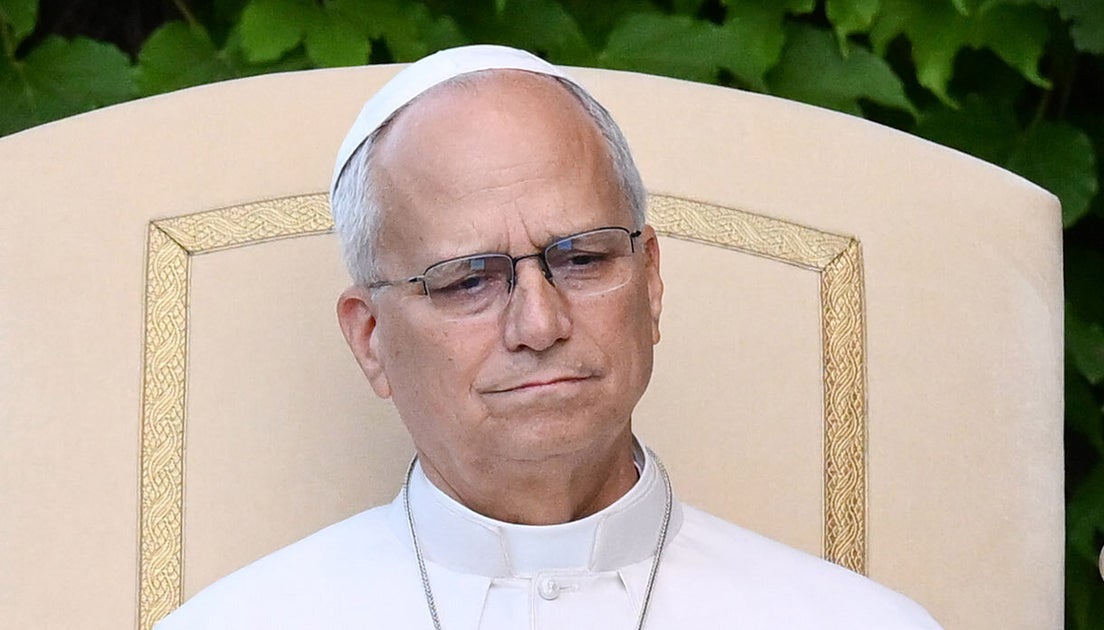
Image courtesy of huffpost.com