


As AI advances, a fierce political battle erupts over regulation. Is the fear a hoax or a necessary wake-up call? Explore the high-stakes debate.
The AI Armageddon Debate: When Fear Becomes a Political Football
There is a moment in every era when the future arrives not with a whisper but with a roar, and the people who are supposed to guide us through it start shouting past each other instead. That moment is now. Artificial intelligence has moved from the realm of science fiction into the marrow of our daily lives—writing our emails, driving our cars, diagnosing our illnesses, and, according to some of the most powerful voices in Washington, threatening the very foundations of human civilization.
But what happens when the alarm bells are dismissed as nothing more than election-year theatrics? When the warning cries are drowned out by accusations of hoaxes and ruses? That is the question at the heart of a growing and deeply partisan fight over how—or whether—to regulate the most transformative technology of our time.
The Battle Lines Are Drawn
In September 2026, Senator Bernie Sanders and Representative Greg Casar reportedly introduced the Ban Artificial Superintelligence Act, a piece of legislation that would reportedly prohibit the development and deployment of superintelligent AI and temporarily pause advanced AI development until a federal regulator establishes safety rules. It was a bold, some would say radical, move—a direct challenge to the tech giants racing toward a future they insist will be utopian but which many fear could be catastrophic.
Sanders did not mince words. “The future of humanity cannot be left in the hands of a handful of Big Tech oligarchs,” he said. “The American people and people throughout the world must determine that future.”
For Sanders, the stakes are not abstract. His office released a report warning that AI and automation could eliminate nearly 100 million American jobs over the next decade, while billionaires and corporate executives reap record profits. A Quinnipiac poll reportedly found that 55% of Americans believe AI will do more harm than good, 70% think it will lead to fewer jobs, and only 5% believe AI development is led by people and organizations that represent their interests.
These are not the statistics of a fringe concern. They are the numbers of a quiet, widespread anxiety—a sense that the future is being written by a small cadre of engineers and executives in glass towers, and that the rest of us are merely passengers.
The Counterargument: A “Hoax” and a “Ruse”
But not everyone sees it that way. In a sharply worded commentary, Fox Business host Larry Kudlow reportedly dismissed the entire push for AI regulation as a political maneuver, comparing it to what he called the “climate hoax” and labeling it an “election-year Democratic ruse.” “The left, led by Senator Bernie Sanders, wants the government to completely stop the AI industry, including agents, data centers, and the whole nine yards,” Kudlow wrote.
His argument is simple: the fear is overblown, the regulations are a power grab, and America risks ceding its technological edge to China and other competitors if it slows down. It is a familiar refrain—one that echoes the debates over climate change, where urgent warnings are met with accusations of alarmism and economic sabotage.
But here is the problem with that framing: it treats legitimate, science-backed concerns as nothing more than partisan weapons. It reduces a complex, existential debate to a binary of “innovation good, regulation bad.” And it ignores the very real fears of millions of people who see their livelihoods, their privacy, and their autonomy slipping away.
The Human Cost of Dismissal
Let us not forget what is at stake. Behind the statistics are real people. The truck driver in Ohio who reportedly wonders if his job will exist in five years. The radiologist in Texas who knows an algorithm can already read scans faster than she can. The artist in Brooklyn whose work has been scraped and regurgitated by a machine without consent or compensation. The parent who worries about what their teenager is being exposed to on platforms optimized by AI for maximum engagement, not maximum well-being.
These are not hypotheticals. They are the lived reality of a society being reshaped at breakneck speed. And when voices like Kudlow’s dismiss their concerns as a “hoax,” they are not just wrong—they are cruel. They are telling people that their fears are imaginary, that their displacement is acceptable collateral damage in the march of progress.
This is the same logic that has been used to justify every unchecked industrial revolution. The same logic that told coal miners to learn to code. The same logic that told climate scientists to shut up because the economy was more important. And we know how those stories ended: with hollowed-out communities, with ecological collapse, with a distrust of institutions that has now metastasized into a full-blown crisis of legitimacy.
The Climate Hoax Playbook
It is no accident that Kudlow invoked the “climate hoax.” The two issues share a common architecture. Both involve complex science that is difficult for the average person to verify. Both have enormous economic implications. Both pit short-term profits against long-term survival. And both have been subjected to a coordinated campaign of denial and delay by the same political and corporate interests.
The result is a public that is confused, exhausted, and increasingly cynical. When everything is a hoax, nothing is. When every warning is a ruse, we are left defenseless against the very real dangers that await us.
But the AI debate is not identical to the climate debate. For one thing, the tech industry is not a monolith. Some of its most prominent figures—including those who built the very systems now causing concern—have reportedly signed open letters calling for caution. They have warned that we are in a race to the bottom, that safety is being sacrificed for speed, that we may be creating something we cannot control.
These are not left-wing ideologues. They are engineers, researchers, and entrepreneurs who have seen the future up close and are frightened by what they see.
Beyond the Left-Right Divide
The truth is that AI regulation is not, or should not be, a partisan issue. It is a human issue. The question is not whether we should have AI—it is already here, woven into the fabric of our lives. The question is who gets to decide how it develops, who benefits from it, and who is protected from its harms.
Sanders’ proposals—including the AI Data Center Moratorium Act and the American AI Sovereign Wealth Fund Act—are attempts to answer those questions in a way that puts people first. The moratorium would pause new data centers until safeguards are in place. The wealth fund would reportedly give the public a 50% ownership stake in the largest AI companies, ensuring that the profits generated by this revolution are shared, not hoarded.
These are not radical ideas. They are pragmatic responses to a concentration of power that should alarm anyone, regardless of political affiliation. They echo the trust-busting of the early 20th century, the creation of public utilities, the establishment of social security. They are attempts to ensure that the future is not just built for us, but by us.
Of course, there are legitimate concerns about overregulation. We must not stifle innovation or push the brightest minds to other shores. But the choice is not between total freedom and total control. It is between a thoughtful, democratic approach and a reckless, oligarchic one. It is between a future where AI serves humanity and a future where humanity serves AI.
The Urgency of Now
We are living through a hinge moment in history. The decisions we make in the next few years will shape the next century. And yet, our political discourse is mired in accusations and counter-accusations, in hoaxes and ruses, in the cynical manipulation of fear for electoral gain.
This is not a game. It is not a reality show. It is the real world, where real people are losing real jobs, real communities are being hollowed out, and real threats are gathering on the horizon.
We need leaders who can speak to our better angels, not our basest instincts. We need a conversation that is honest about the risks and the rewards, that includes the voices of workers and artists and ethicists and scientists, not just CEOs and shareholders. We need to reclaim the future from those who would sell it to the highest bidder.
The AI armageddon may or may not be coming. But the armageddon of our public discourse—the death of nuance, the triumph of tribalism, the weaponization of every issue for political gain—is already here. And it is up to us to stop it.
Because in the end, the greatest threat is not the machines. It is us—our refusal to listen, our willingness to be divided, our cowardice in the face of complexity. The future is not something that happens to us. It is something we choose. And we must choose wisely.
To learn more visit https://www.foxbusiness.com/politics/larry-kudlow-ai-armageddon-like-climate-hoax-election-year-democratic-ruse
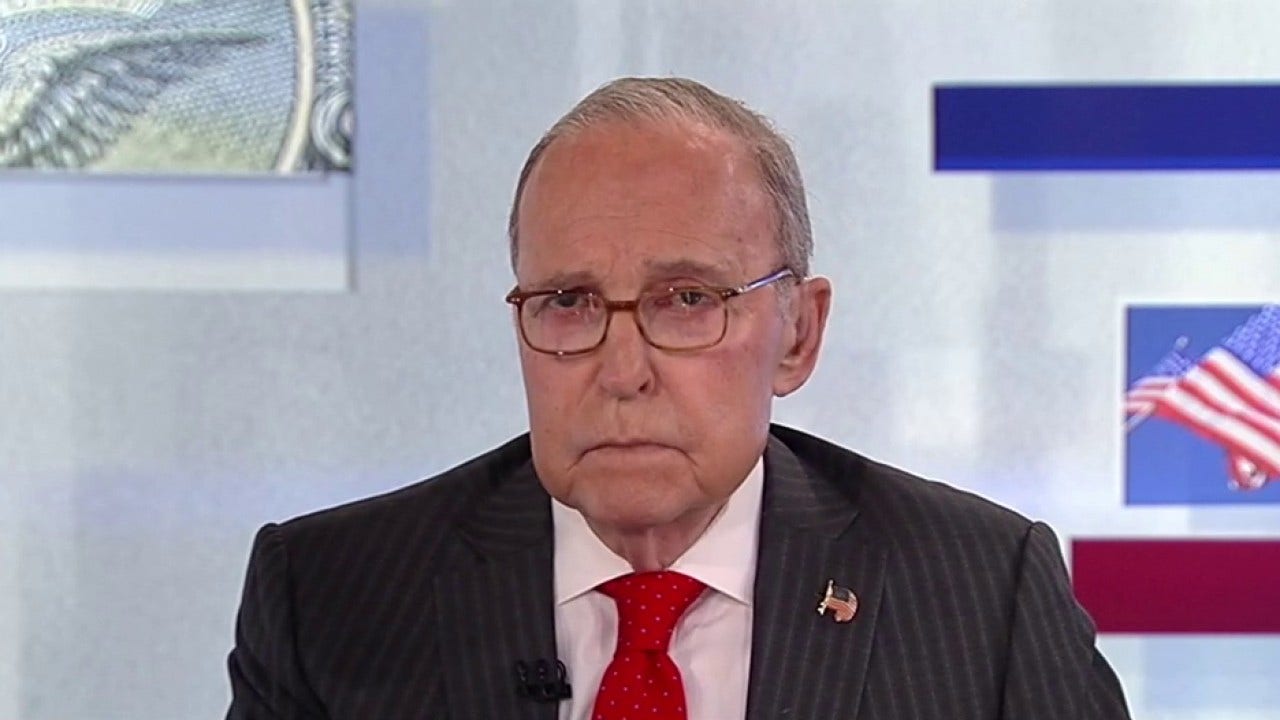
Image courtesy of foxbusiness.com